Tough fishing at a well-known central WA lake 2022/10/27

Starman77

Life of the Party
Forum Supporter
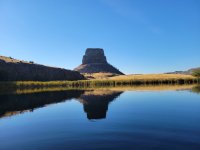
As I drove over the pass on Wed, I was surprised to see the trees all covered with snow, like a Christmas card scene. It must have been slippery earlier, as I saw an 18-wheeler on its side in the ditch. Lately I've been having fun exploring a number of small lakes, but this week I decided to visit an old favorite. This was my 63rd outing to this well-known lake, so you'd think I'd know it like the back of my hand, but it felt like I was having to learn it all over again as it was tough fishing. I fished it on Wed afternoon and Thursday and had the lake to myself most of that time. I was concerned that the sudden cooling might have put the fish off the bite. Even if the fishing is tough there, the scenery is unbeatable, especially on a sunny day:
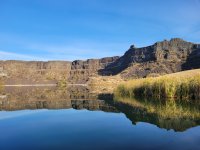
20221027_104956.jpg

20221027_113617.jpg

The water level was quite low and the boat "launch" keeps getting narrower and narrower:
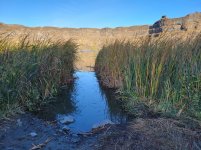
20221026_124704.jpg

The water temperature was in the 55 to 56 degree range, with a slight algae bloom and about 8 feet of visibility.
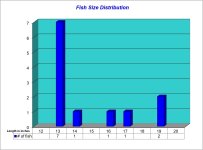
Fish Size Distribution 2022-10-27.jpg

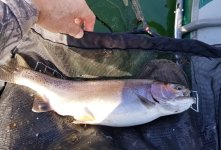
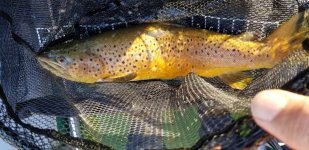
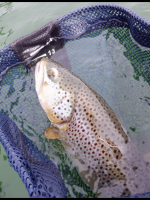
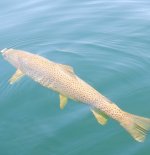
As you can see from the chart above, I mostly caught small 13 inchers, but managed to find a couple of 19 inchers, the best one being this one:
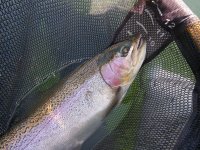
IMGP5799.JPG

Leech patterns and a #14 BH GRHE worked for me (I think the fish took the GRHE for a water boatman, but I only saw one water boatman the entire time).

I even saw a new wildflower at the launch area that I haven't seen before and am not sure what it is:
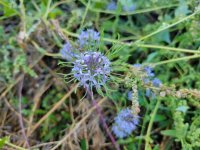
20221026_125457 Whitehead Navarretia.jpg

From PlantNet's suggestions, I'm thinking it is the blue variation on the Whitehead Navarretia, but I'm not sure. Any help?

I kind of think the fish were keyed in on daphnia, but I'm not sure as I don't do any throat sampling and didn't retain any fish. The fish seemed to ignore the light callibaetis hatch that was going on. I'm sure the lake will fish better in the coming weeks as the fish acclimate to the cooler temperatures and the algae gets killed off. The fish ought to be thinking about fattening up for winter. Only a month or so left for this lake before it closes for the winter.

Rex
 
I haven't skuffed off any paint from the bottom of my pram yet this fall..... that launch isn't on anyone from the State Park's radar. Nice trout!
 
You just don't hear about that lake much anymore and when you do - most reports are "slow fishing". Weird compared to what it was say 10+ years ago when crowds and too many folks on the lake was an issue. Looks like WDFW fixed that issue, over the last few years it is being used so much less. I guess that is a good thing :)???? Good quality fish when you catch them - but low numbers. Isn't WDFW making a concerted effort to reduce the amount of fish being stocked there? Are Browns and Tigers still available there or have they discontinued stocking those as well?

Beautiful place to just enjoy the scenery and the newly found solitude when you are getting your ass handed to you, though :).

Peach
 
You just don't hear about that lake much anymore and when you do - most reports are "slow fishing". Weird compared to what it was say 10+ years ago when crowds and too many folks on the lake was an issue. Looks like WDFW fixed that issue, over the last few years it is being used so much less. I guess that is a good thing :)???? Good quality fish when you catch them - but low numbers. Isn't WDFW making a concerted effort to reduce the amount of fish being stocked there? Are Browns and Tigers still available there or have they discontinued stocking those as well?

Beautiful place to just enjoy the scenery and the newly found solitude when you are getting your ass handed to you, though :).

Peach
If “getting my ass handed to me” involves working hard for a dozen fish with the real possibility of catching my biggest of the season…sign me up! And yes on the browns and tigers.
 
I only fished there back when the water level was higher. Spent most of my time working the "fish bowls" down in the shallow end. Some very nice trout!
 
There's either something else besides stocking that explains what's changed there (and in other lakes), or else WDFW's published stocking numbers just don't foot with what actually gets stocked - and are not just off by a little.

It seems universal that for years the reports there contain observations similar to the following:

"What happened to the browns/tigers?"
"The state is methodically trying to manage more for bows and bigger fish by stocking less overall, and less exotics"

But a comparison of the 10 years ending in 2021 versus the prior ten years (ending 2011) seems VERY counter-intuitive to the idea that the stocking strategy is to reduce exotics and stock less fish overall:

1667408091939.png

Yes, they reduced the Browns - but barely. And they reduced the bows by 5x of the reduction in Browns. Tigers up 70%! Total stocking up 42%. In the first ten years, the exotics were 22% of the total stocking, but in the last ten years that grew to 34%. Pretty interesting.

I'm fascinated by both topics so I hope the smart people here chime in on either what other factors besides stocking can explain catch patterns there in recent years - including survival rates for the more piscavorous exotics which you would think should be in the majority now. Also, if anyone has thoughts on if/why the data doesn't seem to be a great way to set expectations about what we might catch in a given lake.
 
@dflett68 this is a topic I can spitball all day. To the best of my knowledge, Stocking density is calculated from surface acres, with different formulas for fingerlings and catchable-sized rainbows. The “exotics” aren’t stocked in waters with connection to the Columbia River and there may be other reasons for excluding them. Tigers are sterile, which may explain why they have been stocked more frequently than browns.

Regional Bios have some latitude to try different stocking plans but everything outside the norm requires more planning, monitoring, and time which is the premium at the end of the day.
 
Last edited:
My experience with browns and tigers is that they are rare in my catch in lakes that also receive lots of rainbows. In the rare places that browns or tigers are the primary species, I tend to catch them at about the rate I would catch other trout.

In our local waters I tend to catch the small-to-medium versions of browns and tigers in the same lakes I can catch the top end rainbows on a regular basis. Maybe I haven’t figured out how to target the big exotics. FE884354-6E79-49C1-82E3-3A075C51C7F1.jpeg
 
There's either something else besides stocking that explains what's changed there (and in other lakes), or else WDFW's published stocking numbers just don't foot with what actually gets stocked - and are not just off by a little.

It seems universal that for years the reports there contain observations similar to the following:

"What happened to the browns/tigers?"
"The state is methodically trying to manage more for bows and bigger fish by stocking less overall, and less exotics"

But a comparison of the 10 years ending in 2021 versus the prior ten years (ending 2011) seems VERY counter-intuitive to the idea that the stocking strategy is to reduce exotics and stock less fish overall:

View attachment 39511

Yes, they reduced the Browns - but barely. And they reduced the bows by 5x of the reduction in Browns. Tigers up 70%! Total stocking up 42%. In the first ten years, the exotics were 22% of the total stocking, but in the last ten years that grew to 34%. Pretty interesting.

I'm fascinated by both topics so I hope the smart people here chime in on either what other factors besides stocking can explain catch patterns there in recent years - including survival rates for the more piscavorous exotics which you would think should be in the majority now. Also, if anyone has thoughts on if/why the data doesn't seem to be a great way to set expectations about what we might catch in a given lake.
My fishing statistics are similar to what @troutpocket wrote, in that browns and Tigers are usually a very minor percentage of the catch (except for that one lake I wrote about recently where the Tigers were in the majority of the catch, something I've never encountered previously). My hypothesis on why browns and Tigers are usually fewer in the catch than what the planting statistics might suggest is that it may be that brown and Tiger trout fingerlings don't compete very well with rainbow fingerlings or pumpkinseed fry or dace minnows for the available insect food. Dusty Lake is a good example as in that lake it has seemed to me that the browns and Tigers of the same year class as the rainbows are usually smaller and skinnier than the rainbows and fewer in number. I've seen this in other lakes as well. I think most of the browns and Tigers starve to death and relatively few of the browns and Tigers survive to become big enough to feed on other fish. It seems to me that the browns survive slightly better than the Tigers. The few browns that survive at Dusty to become 16 inchers or larger are able to feed on the dace minnows and gain some weight and girth. I used to think that maybe if we made Dusty purely a brown trout fishery, it would give the brown fry a better chance to survive, but now I'm not so sure about that. The Antilon Lakes near Chelan (Upper and Lower; the Lower Lake used to be called Long Jim Reservoir) are only planted with browns, but the problem with those lakes is that the Upper lake is infested with crappie, and the Lower lake is infested with pumpkinseeds, so relatively few brown trout fry are able to compete with those two species. Some browns survive in the Lower lake to become bigger fish, but it appears that almost none survive in the Upper lake. It may be that the crappie in the Upper lake are more efficient at feeding on the brown fry that are planted.

At Dry Falls I think the browns and Tigers are healthier than they used to be, possibly because there are now fewer rainbows with which they have to compete against.

Another hypothesis is that browns and Tigers may be just more difficult to catch on the fly due to being nocturnal in nature, feeding mostly at night or dawn or dusk, when most fly fishermen have gone home or have not yet arrived. Those fly fishermen who do fish at night sometimes report catching large browns or Tigers on their outings. However, make sure the regs allow night fishing at the lake you are thinking about fishing. Kind of hard to night fish at Dry Falls when the lake closes at dusk and opens at 6:30 a.m.

Another thought is that maybe browns and Tigers have trouble surviving the hotter temperatures in central WA than the rainbows. Maybe they have different dissolved oxygen needs? Browns seem to do well in the Montana and Colorado rivers, which are presumably better oxygenated than central WA lakes.

But I'm not a fisheries biologist, so all of what I wrote is just conjecture and speculation on my part.

Rex
 
In our local waters I tend to catch the small-to-medium versions of browns and tigers in the same lakes I can catch the top end rainbows on a regular basis. Maybe I haven’t figured out how to target the big exotics. View attachment 39590
Here's how you get the big exotics:

When you catch a small one, tie on about a 4/0 circle hook, run it through the fish's back, right in front of its dorsal fin, then release it and let it swim around....

Kidding, of course... but I bet it would work!

I have noticed the same as you. I have caught few big browns in the few lakes I fish that have them. Ironically, my biggest (about 18"), came while fishing a small hare's ear nymph. I guess sometimes you just get lucky....
 
From what I’ve read, browns are more tolerant of warmer temperatures and generally poor water quality than rainbows. But from conversations with our Regional Bios it seems they also sometimes do poorly in lakes where they might be expected to thrive. I try to put some time in on lakes that are known to grow some nice ones because they are such cool fish when they get big.
DC39CD62-9770-4977-B8E7-25895EC0E027.pngF8AD8509-8E87-422D-B577-E7C9F4C9D73B.jpeg
 
Another hypothesis is that browns and Tigers may be just more difficult to catch on the fly due to being nocturnal in nature, feeding mostly at night or dawn or dusk, when most fly fishermen have gone home or have not yet arrived. Those fly fishermen who do fish at night sometimes report catching large browns or Tigers on their outings. However, make sure the regs allow night fishing at the lake you are thinking about fishing. Kind of hard to night fish at Dry Falls when the lake closes at dusk and opens at 6:30 a.m.
I think this has a lot to do with it. Personal opinion though.
There's a popular west side lake that has browns, you can catch them during the day. But they are few and far between.
But a few night trips to that same lake and you'd think Browns are the only species in the lake. Overall catch rate would go down a bit, but percentage of fish caught was almost entirely brown trout.
 
I think this has a lot to do with it. Personal opinion though.
There's a popular west side lake that has browns, you can catch them during the day. But they are few and far between.
But a few night trips to that same lake and you'd think Browns are the only species in the lake. Overall catch rate would go down a bit, but percentage of fish caught was almost entirely brown trout.
I’ve had similar experiences to @Starman77 hypothesis. If I’m fishing early I tend to get more browns and sometimes more tigers than bows. I use to night fish Pass many years back when I first moved to the island and pretty much caught only browns. The first time I ever fished Dry Falls I launched as early as I could and caught a tiger first thing. Didn’t even know what a tiger was back then, lol. After that one fish it was mostly bows.
 
Back
Top