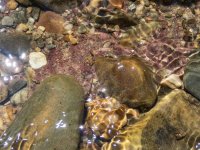
“The River of Garnet Sands”. July 7 to 10, 2024. Part 1 of 3. I’ve been home for a week from a week-long fishing trip with a friend. Our first stop would be “The River of Garnet Sands”. I have been fishing this river for almost 30 years. Its pseudonym is derived from the deposits of blood-red garnet sand that collect in shallow pockets.
Some visits have been short - a few days; others have been as long as a week. This has been a traditional rendezvous point for friends and family in mid-late July. I have rich memories of days stalking colorful cutthroats with dry flies, gorging on huckleberries collected on sun-kissed hills, and rowdy late-night sing-alongs by a roaring fire visible by the Space Station. This trip would be more subdued, just me and my friend Mike.
Due to scheduling constraints, this trip would be earlier than normal. And this would be stop 1 with a second stop at “Silex Creek” in Montana. With a below normal snow-pack, river flows were 2/3rds of the normal for this time of year. They would be more typical of later in the summer; this made for easier wading. The forecast for the whole week was for plus 90-degree temperatures in the afternoons. Low water levels plus high heat is a recipe for stressing the trout that we wanted to release unharmed. Mike checked the river temperatures several afternoons and they were in the high 60’s. But we know how to ensure that these fish are properly revived before we let them lose.
Sunday evening, Joad Hole. After putting together our rods and other fishing gear, we decided that we might as well fish the Joad Hole (we have our insider names for common fishing spots) versus traveling anywhere else for the evening. Streamside, there were some small midges and the occasional caddisfly flying around. Mike took the top half of the run and I waded down to the bottom half. I started with a traditional size 16 elkhair caddis.
I started to pick up a few smaller fish from the tailout. Mike picked a few from the middle and head of the pool. On a quartering downstream cast, I had a nice fish rise from below a standing wave, but it either missed the fly or aborted its attack. I tried this fish a few more times later and could see a flash underwater, but it never came to the surface. As the evening progressed, there were more bugs on the water, including a few mayflies, but it wasn’t a very heavy hatch. Mike and I switched places and I started to hit a few likely spots in the upper half. I landed a few fish on the elkhair caddis and missed a few smallish fish. One fish was hooked deep by the gill and I just cut the leader to the elkhair caddis to release the fish with minimum handling.
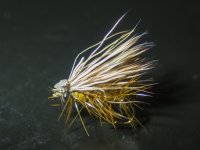
I switched to a cdc caddis pattern, a more heavily-winged version that I tie for better flotation.
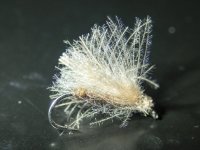
CDC caddis patterns are fast becoming my favorite fly pattern for small streams and rivers. A key advantage is that the fly rides right in the surface film and seem very buggy – like a crippled fly caught in the surface tension. The downside of a cdc fly is that it doesn’t handle rough water well (versus say a fly constructed of foam), though this more-heavily winged fly is a better floater than most cdc patterns.
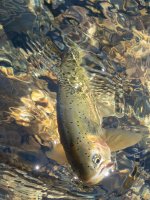
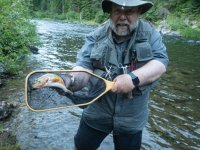
From years of fishing this run, I knew where the better fish were likely to be, just under the standing waves adjacent to the calmer water. Finally, a cast dropped into this transition zone was rewarded when a big snout rose casually to grab the cdc caddis fly. This was a quality fish and I did not try to horse it in. It rushed up and down the pool until it began to tire and I could bring it to the net, a nice 13-14” cutthroat with the orange belly of a pool boss. It recovered quickly after a few pictures and dashed back to deeper water.
That fish made my night and we decided to call it quits early.
Monday. My first choice of fishing spot this morning was the Guide Hole.
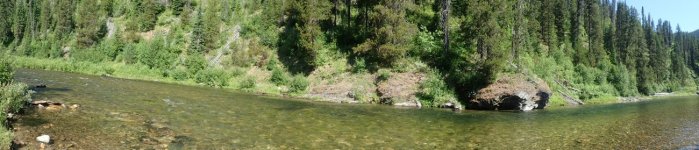
And fortunately, we got it. Again, we split the pool with Mike taking the lower half and I took the top. A few caddis adults were flying over the surface and a few were attempting to oviposit on the surface. I was using the same heavy-winged cdc caddis that I had ended up the previous evening. Per usual, I didn’t have much success in the fast water that leads into the deep pool by the rock in the middle of the run. I did have one small fish grab but then release the submerged fly as I retrieved the fly after the drift. I’m sure that there were trout in that pool, but they weren’t willing to come up to the surface.
I turned my attention to the faster tongue of water flowing along the far bank. I heard learned a few years earlier that some of the bigger fish in the pool would move up into the fast, shallow water against the far bank during the day even in the absence of a big hatch. I dropped the cdc caddis upstream into a calm pocket adjacent to the fast water. A nice trout rushed down from under the fast water to grab the fly. Game on. I walked it over to calmer water at the near bank to land it and to take a few pictures.
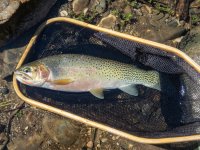
After swooshing my fly in the desiccant container to dry it off, I continued to prospect along this 50’ length of water. And my efforts were rewarded with several additional fish.
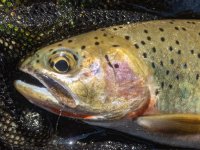
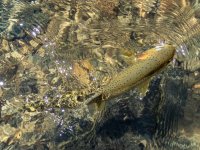
But I missed a bigger fish in this section. After a longer, quartering cast across and downstream, a large fish came up to my fly but it either rejected the fly or missed it. I periodically came back to this fish. It came up for the fly once more but then it went into a sulk. But I carefully noted its position.
I suspect that the fish at the head of this pool (practically rapids) find micro-refuges from the current in this shallow, faster water. Periodically, they emerge to snatch food from the conveyor belt of drifting insects. And for me, it means the fish must react quickly to my fly. If the fish feels threatened in the shallow water here, it knows that it can drop back into the relative safety of deep pool at the heart of this run.
Mike and I switched places. At my suggestion, he did pick up several nice fish from the fast water along the top of the run that I had been fishing. In the calmer waters of the tailout, I switched to a cdc caddis with a sparser wing and a biot-body (it looks segmented -very insectlike).
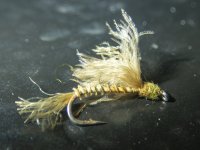
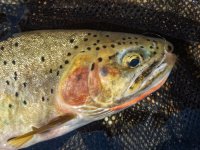
A few fish were sporadically rising, especially near some submerged boulders that served as breaks from the current. I could not see what they were taking, but at least they were looking up. And several of them liked the new cdc pattern.
And then I had a twenty-minute window of pure frustration. I had several fish rise to my fly but there was no hookup. My first thought was that these were either late refusals or just misses. I finally took a close look at the fly and saw that the hook bend had broken off, probably as I removed the hook for the last fish that I landed – oops…. Once I tied on a new cdc caddis fly, the harass and release continued again
until the surface action died down in late morning. It was fun to target specific rising fish versus blind casting.
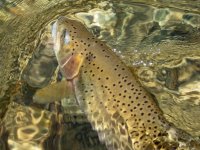
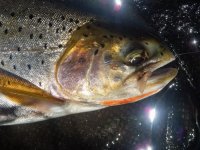
Mike decided to drift some nymph flies through the depths of the pool. While he did this, I waded back up to the top of the pool for another shot at my earlier nemesis. And this time, the cutthroat confidently sipped the fly as it drifted by the fish’s position. It bull-dogged me for a while as we battled back and forth. But eventually I guided it into the calmer water by the near bank and settled it into the net. After a few pictures, this nice cutt zipped off to the heart of the pool.
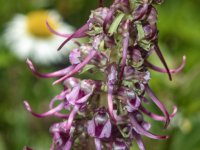
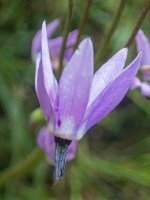
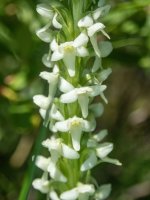
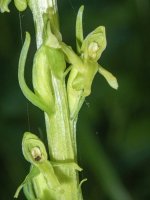
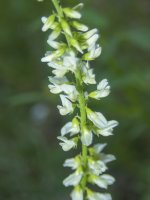
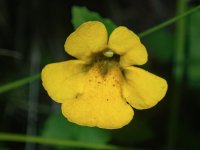
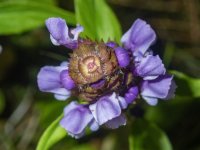
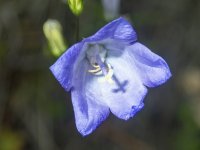
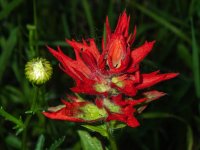
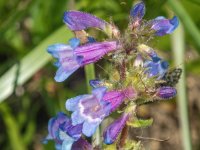
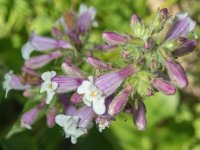
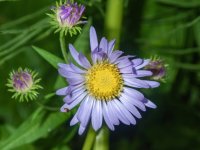
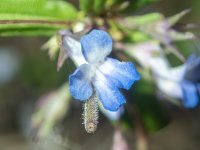
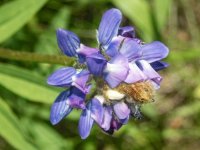
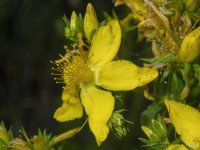
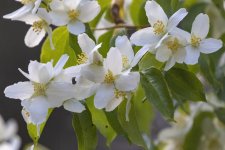
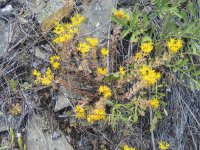
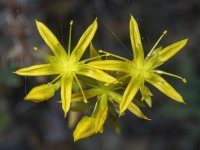
I spent a few minutes photographing the prolific wildflowers in the meadow before we drove a short distance upstream to another well-known spot.
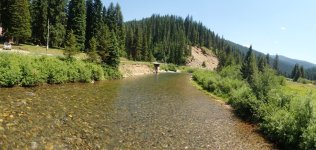 At this new location, the river makes a 60o bend into a placid straight-away. A side-creek enters just at the transition between the bend and the straight-away. Mike took the lower half, from the creek down and I took the top. While most of the river flow passes along the inside of the bend, the local topography creates a rock rim and then a calmer, deeper pool along the outside of the bend. The boulders delimiting the downstream edge of this pool are at the transition to where the creek enters the river. I waded across the fast inside water to a convenient position to cast into the pool. After a few empty casts toward the head of this pool, I let my fly drift down toward the boulders marking the tail of the pool. A nice trout sprinted from the base of a boulder to attack my fly. I carefully waded across the fast water to play the fish in some calmer water. Soon, it was in the net and back on its way.
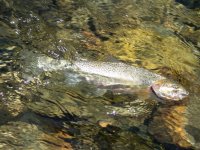
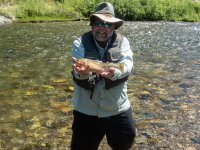
I turned my attention to the side creek. Its flow tumbles down a rapid before dumping into the main river. There is a pocket of deeper, calm water between this rapid and the main flow of the river. After a few casts into faster water, I dropped my cdc caddis into this pocket and an aggressive cutthroat charged downstream to grab it. After a short fight, I guided it into my net and took a hero shot.
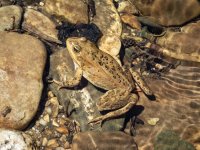
 As we walked along the river edge to the truck. I spied a Columbia spotted frog in the shallows. This is a reliable stretch to find this species. this individual was very cooperative.
With the temperatures rising, we headed back to camp for lunch and rehydration, some reading/relaxing, and some napping under the shade of the trees.
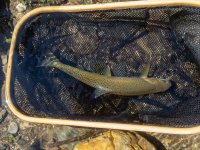
Tuesday. After coffee/hot chocolate and some breakfast, we discussed a plan for the day. While we talked about other morning options, we decided to try the Guide Hole again and it was available. There was much less bug activity today, perhaps as a result of the wilting heat the previous day. But we still managed to hook and land several fish. The cdc caddis was the ticket again for me.
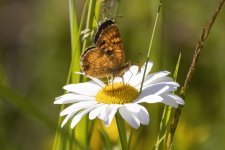
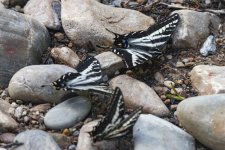
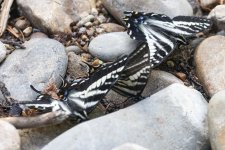
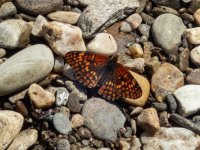
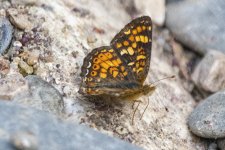
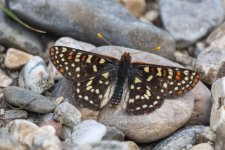
We drove back to camp for a late lunch and more lounging out of the heat. Later in the afternoon, I pulled out my cameras to stalk butterflies and to take some flower pictures.
While we knew that several folks had fished the Joad Hole through the afternoon, we decided to head back for the evening. Mike started in the upper half and I began in the bottom half. In the absence of much bug activity, the fish were not very surface-oriented, especially early on. I picked up one or two smaller cutts and missed on nicer one that rose to the cdc caddis in an area of standing waves but never hooked up. Another better fish chased the fly downstream and grabbed the fly, but the hook never stuck. Mike and I switched locations. I concentrated my casts near the head of the pool. As the evening progressed, the occasional smaller fish was rising. There were a few caddis flying around and a few yellow sally stoneflies. But again, it wasn’t a heavy hatch night. I caught and released a few 8-10” fish
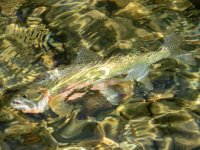
But I knew that there were better fish in the Joad Hole. The flows at the head of this pool are complex. The long rapid that dumps into this run is the start the “Norton Stomp”. I have snorkeled this whole run several times previously. The near (roadside) half of the Joad Hole transitions from a vigorous series of rapids to smoothish glide interrupted by scattered submerged boulders. The far side half consists of standing waves and turbulent water that lead into a deeper hole at the mid-point of the run. During a good evening hatch, the better fish from the deep hole will move into the smooth glide to pick up an easy meal at the surface. Other better fish will move up under the standing waves and rise to pick up bugs carried in the smooth water adjacent to this faster water. And one of these fish responded as I drifted my fly in that smooth water. It confidently slurped the fly. I set the hook. I knew right away that this was a nicer fish. I was going to take my time on this one. I waded back to the bank for better stability and kept the pressure on this fish. I was patient and let the fish blast around before I made efforts to guide it in closer. Finally, I slipped it into the net, a 13-14” cutt.
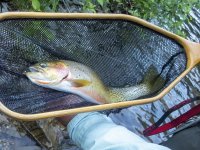
After a few pictures and some revival time, it burst off for the refuge of the deep pool. There was still some light, but I had caught this nice fish and it was a nice fish to end my time on the river.
The next morning, we packed up and headed east, but that’s another adventure.
Steve
Some visits have been short - a few days; others have been as long as a week. This has been a traditional rendezvous point for friends and family in mid-late July. I have rich memories of days stalking colorful cutthroats with dry flies, gorging on huckleberries collected on sun-kissed hills, and rowdy late-night sing-alongs by a roaring fire visible by the Space Station. This trip would be more subdued, just me and my friend Mike.
Due to scheduling constraints, this trip would be earlier than normal. And this would be stop 1 with a second stop at “Silex Creek” in Montana. With a below normal snow-pack, river flows were 2/3rds of the normal for this time of year. They would be more typical of later in the summer; this made for easier wading. The forecast for the whole week was for plus 90-degree temperatures in the afternoons. Low water levels plus high heat is a recipe for stressing the trout that we wanted to release unharmed. Mike checked the river temperatures several afternoons and they were in the high 60’s. But we know how to ensure that these fish are properly revived before we let them lose.
Sunday evening, Joad Hole. After putting together our rods and other fishing gear, we decided that we might as well fish the Joad Hole (we have our insider names for common fishing spots) versus traveling anywhere else for the evening. Streamside, there were some small midges and the occasional caddisfly flying around. Mike took the top half of the run and I waded down to the bottom half. I started with a traditional size 16 elkhair caddis.
I started to pick up a few smaller fish from the tailout. Mike picked a few from the middle and head of the pool. On a quartering downstream cast, I had a nice fish rise from below a standing wave, but it either missed the fly or aborted its attack. I tried this fish a few more times later and could see a flash underwater, but it never came to the surface. As the evening progressed, there were more bugs on the water, including a few mayflies, but it wasn’t a very heavy hatch. Mike and I switched places and I started to hit a few likely spots in the upper half. I landed a few fish on the elkhair caddis and missed a few smallish fish. One fish was hooked deep by the gill and I just cut the leader to the elkhair caddis to release the fish with minimum handling.
I switched to a cdc caddis pattern, a more heavily-winged version that I tie for better flotation.
CDC caddis patterns are fast becoming my favorite fly pattern for small streams and rivers. A key advantage is that the fly rides right in the surface film and seem very buggy – like a crippled fly caught in the surface tension. The downside of a cdc fly is that it doesn’t handle rough water well (versus say a fly constructed of foam), though this more-heavily winged fly is a better floater than most cdc patterns.
From years of fishing this run, I knew where the better fish were likely to be, just under the standing waves adjacent to the calmer water. Finally, a cast dropped into this transition zone was rewarded when a big snout rose casually to grab the cdc caddis fly. This was a quality fish and I did not try to horse it in. It rushed up and down the pool until it began to tire and I could bring it to the net, a nice 13-14” cutthroat with the orange belly of a pool boss. It recovered quickly after a few pictures and dashed back to deeper water.
That fish made my night and we decided to call it quits early.
Monday. My first choice of fishing spot this morning was the Guide Hole.
And fortunately, we got it. Again, we split the pool with Mike taking the lower half and I took the top. A few caddis adults were flying over the surface and a few were attempting to oviposit on the surface. I was using the same heavy-winged cdc caddis that I had ended up the previous evening. Per usual, I didn’t have much success in the fast water that leads into the deep pool by the rock in the middle of the run. I did have one small fish grab but then release the submerged fly as I retrieved the fly after the drift. I’m sure that there were trout in that pool, but they weren’t willing to come up to the surface.
I turned my attention to the faster tongue of water flowing along the far bank. I heard learned a few years earlier that some of the bigger fish in the pool would move up into the fast, shallow water against the far bank during the day even in the absence of a big hatch. I dropped the cdc caddis upstream into a calm pocket adjacent to the fast water. A nice trout rushed down from under the fast water to grab the fly. Game on. I walked it over to calmer water at the near bank to land it and to take a few pictures.
After swooshing my fly in the desiccant container to dry it off, I continued to prospect along this 50’ length of water. And my efforts were rewarded with several additional fish.
But I missed a bigger fish in this section. After a longer, quartering cast across and downstream, a large fish came up to my fly but it either rejected the fly or missed it. I periodically came back to this fish. It came up for the fly once more but then it went into a sulk. But I carefully noted its position.
I suspect that the fish at the head of this pool (practically rapids) find micro-refuges from the current in this shallow, faster water. Periodically, they emerge to snatch food from the conveyor belt of drifting insects. And for me, it means the fish must react quickly to my fly. If the fish feels threatened in the shallow water here, it knows that it can drop back into the relative safety of deep pool at the heart of this run.
Mike and I switched places. At my suggestion, he did pick up several nice fish from the fast water along the top of the run that I had been fishing. In the calmer waters of the tailout, I switched to a cdc caddis with a sparser wing and a biot-body (it looks segmented -very insectlike).
A few fish were sporadically rising, especially near some submerged boulders that served as breaks from the current. I could not see what they were taking, but at least they were looking up. And several of them liked the new cdc pattern.
And then I had a twenty-minute window of pure frustration. I had several fish rise to my fly but there was no hookup. My first thought was that these were either late refusals or just misses. I finally took a close look at the fly and saw that the hook bend had broken off, probably as I removed the hook for the last fish that I landed – oops…. Once I tied on a new cdc caddis fly, the harass and release continued again
until the surface action died down in late morning. It was fun to target specific rising fish versus blind casting.
Mike decided to drift some nymph flies through the depths of the pool. While he did this, I waded back up to the top of the pool for another shot at my earlier nemesis. And this time, the cutthroat confidently sipped the fly as it drifted by the fish’s position. It bull-dogged me for a while as we battled back and forth. But eventually I guided it into the calmer water by the near bank and settled it into the net. After a few pictures, this nice cutt zipped off to the heart of the pool.
I spent a few minutes photographing the prolific wildflowers in the meadow before we drove a short distance upstream to another well-known spot.
At this new location, the river makes a 60o bend into a placid straight-away. A side-creek enters just at the transition between the bend and the straight-away. Mike took the lower half, from the creek down and I took the top. While most of the river flow passes along the inside of the bend, the local topography creates a rock rim and then a calmer, deeper pool along the outside of the bend. The boulders delimiting the downstream edge of this pool are at the transition to where the creek enters the river. I waded across the fast inside water to a convenient position to cast into the pool. After a few empty casts toward the head of this pool, I let my fly drift down toward the boulders marking the tail of the pool. A nice trout sprinted from the base of a boulder to attack my fly. I carefully waded across the fast water to play the fish in some calmer water. Soon, it was in the net and back on its way.I turned my attention to the side creek. Its flow tumbles down a rapid before dumping into the main river. There is a pocket of deeper, calm water between this rapid and the main flow of the river. After a few casts into faster water, I dropped my cdc caddis into this pocket and an aggressive cutthroat charged downstream to grab it. After a short fight, I guided it into my net and took a hero shot.
As we walked along the river edge to the truck. I spied a Columbia spotted frog in the shallows. This is a reliable stretch to find this species. this individual was very cooperative.With the temperatures rising, we headed back to camp for lunch and rehydration, some reading/relaxing, and some napping under the shade of the trees.
Tuesday. After coffee/hot chocolate and some breakfast, we discussed a plan for the day. While we talked about other morning options, we decided to try the Guide Hole again and it was available. There was much less bug activity today, perhaps as a result of the wilting heat the previous day. But we still managed to hook and land several fish. The cdc caddis was the ticket again for me.
We drove back to camp for a late lunch and more lounging out of the heat. Later in the afternoon, I pulled out my cameras to stalk butterflies and to take some flower pictures.
While we knew that several folks had fished the Joad Hole through the afternoon, we decided to head back for the evening. Mike started in the upper half and I began in the bottom half. In the absence of much bug activity, the fish were not very surface-oriented, especially early on. I picked up one or two smaller cutts and missed on nicer one that rose to the cdc caddis in an area of standing waves but never hooked up. Another better fish chased the fly downstream and grabbed the fly, but the hook never stuck. Mike and I switched locations. I concentrated my casts near the head of the pool. As the evening progressed, the occasional smaller fish was rising. There were a few caddis flying around and a few yellow sally stoneflies. But again, it wasn’t a heavy hatch night. I caught and released a few 8-10” fish
But I knew that there were better fish in the Joad Hole. The flows at the head of this pool are complex. The long rapid that dumps into this run is the start the “Norton Stomp”. I have snorkeled this whole run several times previously. The near (roadside) half of the Joad Hole transitions from a vigorous series of rapids to smoothish glide interrupted by scattered submerged boulders. The far side half consists of standing waves and turbulent water that lead into a deeper hole at the mid-point of the run. During a good evening hatch, the better fish from the deep hole will move into the smooth glide to pick up an easy meal at the surface. Other better fish will move up under the standing waves and rise to pick up bugs carried in the smooth water adjacent to this faster water. And one of these fish responded as I drifted my fly in that smooth water. It confidently slurped the fly. I set the hook. I knew right away that this was a nicer fish. I was going to take my time on this one. I waded back to the bank for better stability and kept the pressure on this fish. I was patient and let the fish blast around before I made efforts to guide it in closer. Finally, I slipped it into the net, a 13-14” cutt.
After a few pictures and some revival time, it burst off for the refuge of the deep pool. There was still some light, but I had caught this nice fish and it was a nice fish to end my time on the river.
The next morning, we packed up and headed east, but that’s another adventure.
Steve