Prologue
My father-in-law, who we’ll just call FIL in this report, has a long-time friend who lives in Florida (we’ll just call him E) and who has spent the past 10 or 12 years fishing recreationally for tarpon, usually large tarpon, across the state, with a key focus on the giants of Homosassa. FIL has been going down there to fish with E for a number of years and after reading
Lords of the Fly by Monte Burke a couple years back, I asked FIL if I could tag along on one of these trips. I was allowed in, and booked my flights for the designated week to include a few days to hang out with family in the Atlanta area before driving down to Florida with FIL.
Tuesday 5/27
This was a travel day on which I hadn’t anticipated fishing, so I was pretty stoked to make it down not too long after noon, call up our “guide,” and hear that he’d found the fish up north and was seeing them fairly regularly at the turn of the tide, although they weren’t sticking around, it was glass calm, and fishing was challenging. All I heard was that he’d found fish and got busy purchasing my license via my phone while riding shotgun. Piece of cake, by the way. Kudos to Florida on that system. It was thirty bucks for a week of nonresident fishing. We told E that we’d meet him at the boat launch at 2pm.
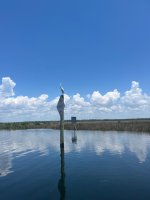
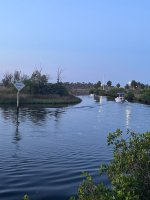
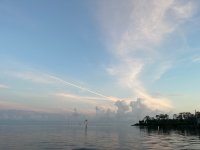
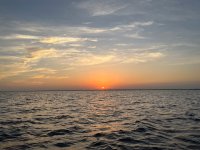
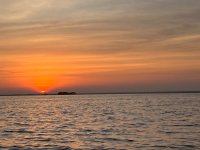
It was hot as hell at the boat launch, with barely a breath of wind. We changed into fishing clothes and I snapped a few shots of the local wading birds on the boat ride out (see above, or examples here:
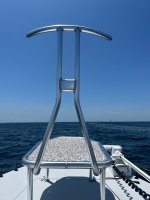
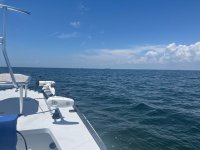
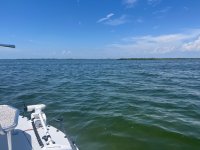
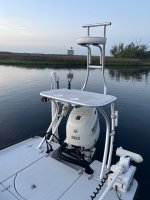
https://pnwflyfishing.com/forum/index.php?threads/got-any-bird-pics.1448/page-111#post-242399). Outside of the river and inshore area, there was a building breeze over the ocean, but the ride in E’s EVO 18’ flats boat out and up to the fishing grounds where the tarpon had been hanging out was comfortable.
We fished for 3 or 4 hours in about a 10-12 mph wind that created a substantial chop. That chop made spotting tarpon a challenge, even if they are huge. I do have a clear vision in my mind from that afternoon of wind drifting within about 20 feet of a laid-up tarpon of about 80-100 pounds. The fish was glued to the bottom in about 5 feet of water, upwind of the boat. I made a shitty cast and an okay cast, thankfully to the correct end of the fish (something I was just able to discern, but still asked E to confirm that it was facing to the right) and the fish disappeared as we drifted away. There was nothing particular remarkable about this encounter, but as the first giant tarpon I ever laid eyes upon, I don’t think I’ll ever forget it.
For the ride back to the boat ramp, that west wind blowing over the shallow seas had built up about a 2 to 3 foot chop, with a real short period. The result on the flats skiff’s hull was a pounding, and for me on the windward side of the bench seat, very wet ride. Warm sea water was a novel concept for this PNWer, however, so it wasn’t too bad all in all. I was fishing for giant tarpon was the main thing I was thinking about.
Wednesday 5/28
We had to fuel up in the morning and so we got to the fishing grounds at 6:50 am it was maybe an hour or so later than ideal. The tarpon are more active, and allegedly, grabbier in the early morning. This morning would be perhaps the best weather conditions for fishing that we would encounter. There was a high overcast that provided some refuge from the blazing subtropical sun, and a 3-5 mph breeze to put just a bit of riffle on the water’s surface, enough to give some cover to swimming denizens of the bay but not so much that we’d be challenged to see rolling or other active fish.
View attachment 156021
Fueling. I’m not sure how one would target these fish without the key tool of a flats boat.
But, in spite of the encouraging weather conditions, the fish were uncooperative. We saw very few rolling fish. Those we did see appeared to be single fish, and they were generally moving with some speed and usually never to be seen again. They’d roll once, and vanish. It’s hard to get a quality shot off in these conditions. And I was sharing the bow with FIL, so even though I definitely got a lot of deference in terms of bow time (having not yet hooked an adult tarpon), it wasn’t like every shot we got over the course of the day belonged to me.
According to E, these conditions were unusually tough. Usually, according to him, it is more common to see groups of fish, daisy-chaining fish, and fish that can be patterned and intercepted. As it was, it was like you had to be in the right place in the right time that a tarpon popped up in range and then you had to execute, real quick.
I already wrote about one experience above but it bears repeating. Around the turn of the tide, waiting off a point, I saw commotion in the water in front of the boat, downwind. It appeared to be heading toward us before I figured out that it was probably fish. It was just so large, I couldn’t compute. It was a school of tarpon heading out of the backcountry and on an intercept course within reach. I prepared and made a cast that seemed reasonable and worked the fly back but the school was just hauling ass. The sight was comparable to a huge school of salmon making their way upriver if you’ve ever seen that, but the waves were just a little larger, corresponding to the larger size of the fishes.
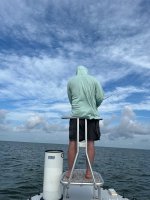
Standing on the bow platform in the heat and sun, scanning the monochromatic flats for tarpon for hours at a time, was surprisingly taxing in its own way, especially when not much, or just nothing, was happening. I was actually glad to have FIL take some shifts and have a chance to rest my legs a bit. Of course, no matter what, as soon as any sign of a fish was spotted, any hints of discomfort immediately disappeared.
View attachment 156022
Poor Mattie B’s widdle wegs got ti-ewd.
The wind picked up over the course of the day and finished at 10-12 mph from the west again. The ride home was slower, more pounding, and wetter than the one the prior afternoon. I put on a rain jacket, but it wasn’t really up to the task. When water was consistently blowing into the side of my sunglasses and causing salty sunscreen to drip into my eyes, I ended up just putting my head down and closing my eyes for a while. I actually almost dozed off at one point, in spite of the pounding.
Let’s talk about casting.
I made a mistake here. I consider myself a decent caster. I can usually get the fly where I want it (PS coho fishing excepted since they’re always 20 feet further out than my furthest cast). And a couple guides on previous saltwater trips overseas (bonefish, baby tarpon, roosters and Sierra mackerel) have told me I’m a good caster. Well, I wasn’t casting a 12 weight floating line on the windy tarpon flats in those cases.
For the most part, I used what E recommended on the tarpon grounds: his 12 wt G Loomis NRX+ paired with a Cortland Liquid Crystal Line wrapped on a Nautilus CCFx2 “Silver King” model. He also runs a long leader, about 14 feet long. I’ve been casting two hand rods, shooting heads with sink tips, and a little bit of chironomid fishing this Spring. For all those, I use a pretty slow, open stroke usually with bigger, open loops. Well, that don’t cut it on the tarpon grounds of Homosassa. The NRX+ is a capable rod, but I had to adjust my stroke significantly—focusing on higher line speed and a straight rod track, tightening it up, and aggressively snapping down with my left hand on the haul. I mostly got it down, but not soon enough in the trip, and I know I could do much, much better. I flubbed too many casts during a trip where every shot needed to count. Many times, a flubbed first cast meant I blew the shot; whether it was a “good” shot or not, with an overall paucity of shots, every single one needed to be capitalized on with an angler’s best effort. As it was, I didn’t do everything I could have in that regard. This stings even more because I should’ve known better; it’s not like I haven’t read “Practice Your Saltwater Flats Casting” a hundred times.
In a stroke of genius, my hosts had booked a rental with a small, screened in saltwater pool. A quick soak in the pool with a cold lime-laden Corona after a long hot day on the bow was a welcome refreshment that became a part of our post-fishing routine.
Coming Soon: Two more days of fishing. Can Mattie B get it done?