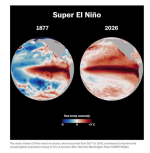
Back in the day the "computer models" were nowhere near as reliable. But after about five years, we would be expecting the next El Niño event. Tuna Crabs were a bad sign. Literally BILLIONS of them would show up in the kelp beds. Then came the "Sailors", first just a few, then millions of them.
Then came the weather. Huge swells, day after day, week after week, month after month..ripping out every kelp stalk and leaving the kelp bed to rot on the wave savaged beaches. The rocks of the reefs were tossed and turned with great harm to all the bottom dwellers.
But afterward, within few months the ocean began to heal itself. The fisherman could fish, the construction workers could build. But the threat of the next El Niño event was always understood to be just 5 to 7 years away.
One of the biggest threats to kelp beds, especially giant kelp (
Macrocystis pyrifera) in Southern California is the lack of nutrients that typically accompanies a strong El Niño. While giant kelp has the potential to
grow at an amazing rate (a foot or more per day), that growth rate requires ample supplies of nutrients, nitrogen and phosphorus especially. Unlike vascular plants, such as trees, kelps have little ability to transport nutrients from their holdfasts to their blades; blade growth depends on nutrient levels circulating around the blades near the ocean surface.
During a strong El Niño, the process of
upwelling is greatly reduced. During upwelling, winds traveling toward the equator along the West Coast (either of NA or SA) push warm, nutrient-poor surface water offshore (aided by the Coriolis effect). This water is replaced by cold, nutrient-rich deeper water from the aphotic zone (> 200' deep). This combination of light and nutrients supports explosive photosynthesis and growth by phytoplankton = single-celled algae (such as diatoms) and macroalgae (such as giant kelp). Upper levels of the food chain exploit this abundance.
Without upwelling and with the resultant low nutrient levels during a typical El Niño, phytoplankton and giant kelp densities are significantly reduced. Because these algae form the base of the food web, all other levels are reduced dramatically. For
example in Chile and Peru (origin of the name El Niño = the Christ Child because the impacts are seen in their summer), this lack of upwelling causes the anchoveta populations to crash. Higher food levels, like salmon and marine mammals, are severely impacted.
If the effects of a strong El Niño hit the Washington coast, the only "good" news might be the presence more tropical exotics (e.g., bluefin tuna, marlin, even mahi mahi) off the coast and perhaps shorter travel distances to reach albacore offshore. Otherwise, expect poor survival for out migrating salmon smolts (see
here). The survivors that migrate up to the Gulf of Alaska should be fine, but many fewer will make it (with cascading impacts on returns a few years later). Salmon populations off Central / Southern Oregon and California will be especially hard hit by the reduction in productivity as these populations do not migrate to the Gulf of Alaska. Higher rains in California may benefit in-stream survival.
Steve