

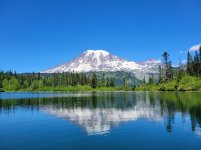
Thought I'd re-try one of the sub-alpine lakes I fished last summer to see if the Brookies had increased in size at all. I was worried that it might have winter-killed like so many of the high altitude lakes in Washington and BC. On this outing I landed and released 16 Brookies in the 12 to 14 inch range, most at 13 inches, so the same size as last summer. However, the main attraction of this lake are the views. Here's a photo of Mount Rainier:
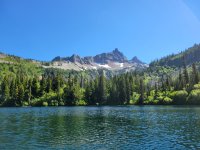
And of Unicorn Peak from the far side of the lake:
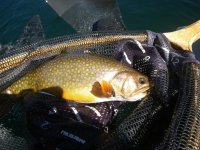
The Brookies were very plain-looking, although a couple of them had a little color, like this one:
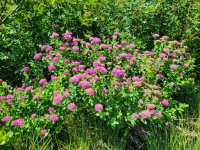
Lots of wildflowers were blooming, especially the spirea:
The Brookies were all down deep in the 24 to 32 foot depths. The takes were very, very subtle, with most of them indicated by just light pressure on the line.
Although I was the only float tuber out there on the lake yesterday, you won't find solitude there, as there are lots of hikers and campers visiting the lake all day. You'll end up spending a lot of time at the parking area, on the trail and at the lake answering questions from tourists and getting your photo taken. Now I know what it is like to be a celebrity float tuber.
Before fishing any lake or river in the Mount Rainier National Park, I recommend reading the park fishing regulations booklet carefully (can be downloaded online), as it differs considerably from the Washington state fishing regulations. For one thing, you don’t need a fishing license. There is also no limit (either size or number) on the fish you catch in a lake. In a lake, you can fish for spawning fish, and you are allowed to snag fish. This a quote from the regulations: “Retention or humane euthanization of non-native fish is encouraged to reduce competition and likelihood of hybridization with native fish, as well as to restore ecosystems for other native aquatic species. Euthanize fish as humanely as possible (i.e., a blow to the head followed by pithing or decapitation).”
In the parking area I spoke to one of the park rangers about this, and he said that they are trying to protect frogs. While I can technically understand why the park fisheries biologists want us anglers to either keep or kill the non-native fish, like the Brookies, Kokanee or westslope cutthroats, I just have a hard time killing those Brookies that I was catching. I released all the Brookies I landed. This does mean that continuing to fish when the water reaches 70°F or higher is ok, as any fish incidentally killed would help the park. However, I find it hard to believe that anglers alone can get rid a lake of populations of non-native fish, as it only takes a few fish to rapidly re-populate a lake. It also seems to me that rotting fish carcasses would ruin the pristine environment that the swimmers at this lake enjoy. In all my years of fishing, I have never seen a frog, toad or tadpole in a trout’s stomach (although I have seen a Tiger salamander), so I think fish predation on frogs is likely a rare occurrence. I can see how the small fry can compete with the tadpoles for insect food along the shorelines. It also seems to me that Brookies have naturalized over the years and have become natives. I am admittedly conflicted over this policy. You'll have to make your own decision on this matter, but it is something to think about prior to fishing any lake in the park.
Rex
And of Unicorn Peak from the far side of the lake:
The Brookies were very plain-looking, although a couple of them had a little color, like this one:
Lots of wildflowers were blooming, especially the spirea:
The Brookies were all down deep in the 24 to 32 foot depths. The takes were very, very subtle, with most of them indicated by just light pressure on the line.
Although I was the only float tuber out there on the lake yesterday, you won't find solitude there, as there are lots of hikers and campers visiting the lake all day. You'll end up spending a lot of time at the parking area, on the trail and at the lake answering questions from tourists and getting your photo taken. Now I know what it is like to be a celebrity float tuber.
Before fishing any lake or river in the Mount Rainier National Park, I recommend reading the park fishing regulations booklet carefully (can be downloaded online), as it differs considerably from the Washington state fishing regulations. For one thing, you don’t need a fishing license. There is also no limit (either size or number) on the fish you catch in a lake. In a lake, you can fish for spawning fish, and you are allowed to snag fish. This a quote from the regulations: “Retention or humane euthanization of non-native fish is encouraged to reduce competition and likelihood of hybridization with native fish, as well as to restore ecosystems for other native aquatic species. Euthanize fish as humanely as possible (i.e., a blow to the head followed by pithing or decapitation).”
In the parking area I spoke to one of the park rangers about this, and he said that they are trying to protect frogs. While I can technically understand why the park fisheries biologists want us anglers to either keep or kill the non-native fish, like the Brookies, Kokanee or westslope cutthroats, I just have a hard time killing those Brookies that I was catching. I released all the Brookies I landed. This does mean that continuing to fish when the water reaches 70°F or higher is ok, as any fish incidentally killed would help the park. However, I find it hard to believe that anglers alone can get rid a lake of populations of non-native fish, as it only takes a few fish to rapidly re-populate a lake. It also seems to me that rotting fish carcasses would ruin the pristine environment that the swimmers at this lake enjoy. In all my years of fishing, I have never seen a frog, toad or tadpole in a trout’s stomach (although I have seen a Tiger salamander), so I think fish predation on frogs is likely a rare occurrence. I can see how the small fry can compete with the tadpoles for insect food along the shorelines. It also seems to me that Brookies have naturalized over the years and have become natives. I am admittedly conflicted over this policy. You'll have to make your own decision on this matter, but it is something to think about prior to fishing any lake in the park.
Rex


