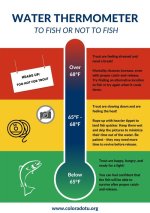
For stillwaters, I generally feel that a surface water temperature of 70 degrees is the upper limit for rainbows and browns, but it depends on a lot of other factors. If the lake is mostly fairly shallow or if the fish are mostly in shallow water, then I would lower that upper limit to 68 degrees. If the lake has good depth to set up a thermocline (30 feet or more), then 70 degrees. If there are strong underwater springs or inlet creeks that provide cooler water and oxygen, then 70 degrees. If the fish aren't fighting very well and many require reviving, or if you see a released fish floating on its side or go to the bottom and lie there on their side, then I would stop fishing no matter what the surface temperature, as the surface water temperature may be ok, but the dissolved oxygen in the water may be too low.
I also recommend using strong tippets (I use 2X or 3X) to quickly play and release the fish. A Measure Net is very useful for quickly measuring a fish with the least amount of handling. Limit the use of throat sampling to reduce stress on the fish. If you are going to take a photo, consider taking the photo of the fish in the net to reduce handling and to reduce the time a fish is out of the water.
I feel that most fly fishermen often overplay a fish, either due to using very fine tippets or lack of experience. How does one determine when a fish has been overplayed? A while back I wrote an article about a hypothesis I have on the fish's eye direction (see attached PDF file) which suggests an easy method to determine when one is overplaying a fish. After reading this article you might examine your past fish photos, as that will give you an idea if you are overplaying fish in general. You can also determine if you are overplaying a fish by the amount of time it takes to net the fish. On average, I hook, play, net, measure and release a fish in under one minute (for larger, stronger fish, up that to two minutes). In most cases, if you are playing a fish for more than 5 minutes, you are probably overplaying the fish and reducing its chances of survival.
In the summer months I try to go higher in elevation (like 3,000 feet or higher) to find cooler temperatures, or fish for species other than rainbows, like shad, bass, carp or Lahontans (which tolerate higher temperatures a lot better than rainbows). During odd years when the pink salmon are running in August to early September, targeting the pinks in the salt water or in the rivers is a good alternative to fishing for rainbows.
Rex