Stillwater Temps - At what temperature should we cease trout fishing?

Buzzy

I prefer to call them strike indicators.
Forum Supporter
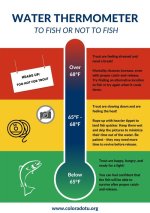
The LDR thread (https://www.pnwflyfishing.com/forum/index.php?threads/ldr.2398/) got me to thinking about water temperatures in our lakes (unrelated to trout loss while trolling). I've quit fishing trout in local lakes (Grant, Adams and a few other Basin counties) because the water temps have gotten too warm. For me, 70F is the cutoff temperature for rainbow and brown trout fishing.

(I don't know how to set up a poll or I might have temperature range categories.) At what water temperature do you consider not fishing for trout?
 
As a general rule I quit when the surface temp is ~65 degrees. I notice that it is harder on the fish bringing them up through the warmer temps (top 3 feet).

I also take into account the depth of the lake. The lake near me is 50' deep. There are two thermoclines. One at 20' with a temp of 55 and another at 35' with a temp of 45. If it is a deeper lake, then I may go above 65 degrees a bit since there are good cooler temps to help them recover...
 
Last edited:
Stocked fish in a lake.....never.

I understand this sentiment.

On P&T lakes with large populations of fisher people, it will be fished out this summer or there is a good chance of winter kill do what one is comfortable with. I personally go by what I said above.

On P&T lakes where there are a lot of fish, with lots of multi-year holdovers yielding a number of 20"+ fish or on C&R lakes I prefer to be way more prudent watching temps.
 
Last edited:
I use to have a list on what is good for the fish and what is not good for them. For the life of me, I dis-remember where it is at. Oh well this year is shot anyway. Probably won't ever make it out.
 
As a general rule I quit when the surface temp is ~65 degrees. I notice that it is harder on the fish bringing them up through the warmer temps (top 3 feet).

I also take into account the depth of the lake. The lake near me is 50' deep. There are two thermoclines. One at 20' with a temp of 55 and another at 35' with a temp of 45. If it is a deeper lake, then I may go above 65 degrees a bit since there are good cooler temps to help them recover...
That's interesting that you've mapped or are able to determine temperatures at depth and in various thermoclines. I know my observations are surface temperatures using a Fishin' Buddy.

For me, (for me), if I'm not taking the fish home for dinner, in otherwords, catch and release. I want the released fish to have a decent chance of survival which is why I asked the question. @Peyton00 - I wonder if there are any lakes in WA that aren't stocked - the obvious answer is yes but over here in Central WA, I doubt there are many so for me (for me again), I want to preserve the chance to catch fish.
 
@Buzzy - my wife and I were lake stewards at the nearby lake for 3-4 years. King County provided us with all the tools to take various types of samples. It included a device to take/sample water from specific depths. We went out every week or two for 6 months doing samples and provided the results to King County. Go here if you want to see the results:


Maybe your county has a similar program?
 
I stop fishing the lakes in the summer when the kings start rolling into the Puget Sound area!
Jan-July: fish for trout
July- September: fish for salmon (and keep!)
September - Jan: back on for trout
this is all a general rule for me....
 
I don't think there is any hard and fast rule. I guess surface temps of 68 to 70* is where I draw the line for myself. I'd never given it any thought until a friend and I were fishing a small natural pond for wild cutthroat. I noticed that some of the trout we released were laying on their sides on the bottom in about 12' of water. So I checked the water temp and it was 72*. We decided to snip the bends off some flies and finished out the day fishing for grabs prior to breaking camp and hiking out. That trip at least made me more attentive to summer water temperatures, so I don't fish trout water if it reaches 70*.
 
I missed out on any June fishing so scratched my itch 2 days in early July on a west side stocked but c&r lake. It was tough to get fish anywhere till I fished the edge of some weed beds then caught some very nice fish but water was 72. Each fish hit hard and after a run sort of gave up, a couple were pushing 20”. They al swam away but in cooler water these would have fought very hard.

While I get the reasoning that stockers are stockers. Left alone there will be some exceptional fall fishing and if less fish are killed now then it may be better then. Plus trout from warm water taste like shit from what I’ve tried a long time ago. So why bother? I see july Aug as the quiet time on the wet side or one should start thinking early am on the salt for the silvers that will kick off soon.

Dave
 
This has been a good thread. I've never really fished lakes this far into summer but with fuel prices and the river fishing being off this year I'm playing as long as I can. I need to bring my thermo next time out. The surface is quite warm, but the trout coming from the thermocline are still cool to the touch and fiesty. What usually puts me off is the plankton bloom, but that hasn't happened yet.
I still haven't touched anything with spines, but I've been spying on the gear guys getting some crappie and an occasional bass, maybe I'll just switch.
 
65 degree surface temp used to be a general rule since most of the fight and subsequent release occur in the warmer surface layer of the lake. @Triggw, thanks for the gauge! If a favorite lake is about 62 or 63 in the morning I wipe it off the list until September.
 
Been fishing on west-side lakes most of this summer. Water temps were great! Fishing was great also. Then this week hit. No more lake fishing for trout until September (?). I won't even go measure the surface temp. Not worth the effort.
 
For stillwaters, I generally feel that a surface water temperature of 70 degrees is the upper limit for rainbows and browns, but it depends on a lot of other factors. If the lake is mostly fairly shallow or if the fish are mostly in shallow water, then I would lower that upper limit to 68 degrees. If the lake has good depth to set up a thermocline (30 feet or more), then 70 degrees. If there are strong underwater springs or inlet creeks that provide cooler water and oxygen, then 70 degrees. If the fish aren't fighting very well and many require reviving, or if you see a released fish floating on its side or go to the bottom and lie there on their side, then I would stop fishing no matter what the surface temperature, as the surface water temperature may be ok, but the dissolved oxygen in the water may be too low.

I also recommend using strong tippets (I use 2X or 3X) to quickly play and release the fish. A Measure Net is very useful for quickly measuring a fish with the least amount of handling. Limit the use of throat sampling to reduce stress on the fish. If you are going to take a photo, consider taking the photo of the fish in the net to reduce handling and to reduce the time a fish is out of the water.

I feel that most fly fishermen often overplay a fish, either due to using very fine tippets or lack of experience. How does one determine when a fish has been overplayed? A while back I wrote an article about a hypothesis I have on the fish's eye direction (see attached PDF file) which suggests an easy method to determine when one is overplaying a fish. After reading this article you might examine your past fish photos, as that will give you an idea if you are overplaying fish in general. You can also determine if you are overplaying a fish by the amount of time it takes to net the fish. On average, I hook, play, net, measure and release a fish in under one minute (for larger, stronger fish, up that to two minutes). In most cases, if you are playing a fish for more than 5 minutes, you are probably overplaying the fish and reducing its chances of survival.

In the summer months I try to go higher in elevation (like 3,000 feet or higher) to find cooler temperatures, or fish for species other than rainbows, like shad, bass, carp or Lahontans (which tolerate higher temperatures a lot better than rainbows). During odd years when the pink salmon are running in August to early September, targeting the pinks in the salt water or in the rivers is a good alternative to fishing for rainbows.

Rex

 

Attachments

I think we should measure O2 not temp. I’ve looked and can’t find a single study in lakes for this subject. Quite a few in rivers with interesting methods to determine survivability, but none in lakes.
 
Back
Top