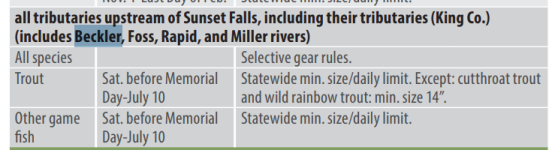
Here's a draft of a letter that I intent to send to the WDFW and I'd welcome any suggestions. I burned a lord knows how many tokens in a sustained dialogue with ChatGPT trying to understand the formal/written/quantitative basis for the WDFW's decision to close the Skykomish, skimmed the relevant documents (I have school-age children and life is short), cobbled together a rough-raft, and then asked Chat GPT to integrate my rough draft, the questions I'd presented during our dialogue, etc.
The tl;dr version is that I think the WDFW owes the public an explanation for its management decision that references models/data/management-plans recorded in public-facing documents that mandate the closure of the Skykomish given the return forecasts, an inability to monitor the fishery in accordance with documented requirements, or concedes that the closure was not based in either and - if so - clearly states what the actual basis for the closure was.
I certainly won't have my feelings hurt if the feedback is "Dude - that's a short novel. No way anyone at the WDFW is going to have the time to answer any two of those questions, let alone all of them," etc. If nothing else - maybe it can serve as raw-material that can be packaged into shorter, more digestible inquiries that the WDFW might actually answer.
Subject: Request for clarification and public documentation supporting 2026 Skykomish River closure
"Dear WDFW Staff,
I am writing to request clarification regarding WDFW’s decision to close the Skykomish River and related Snohomish Basin fisheries during the 2026 season, including fisheries that would otherwise target hatchery Chinook, hatchery summer steelhead, coho, pink salmon, trout, or other more abundant species.
I understand and support the need to conserve ESA-listed natural-origin Chinook salmon in the Snohomish Basin. My concern is not with the general conservation objective, but with the public explanation provided for the 2026 closure and whether that explanation is supported by publicly available quantitative standards, forecasts, and modeled fishery impacts.
WDFW’s public explanation appears to rely heavily on the statement that fewer than 3,500 natural-origin Chinook are forecast to return to the Snohomish Basin in 2026.[1] However, my review of the Snohomish River Biological Opinion, including the abundance and escapement data shown in Figure 3, Figure 4, and Table 7, suggests that there have been numerous years in which natural-origin Chinook escapement in the Snohomish Basin was at or below this approximate level without the same type of broad “all river / all fishing” closure being implemented.[2]
In addition, the 2022 Puget Sound Chinook Harvest Management Plan appears to identify a Snohomish low-abundance threshold of 3,250 natural-origin spawners, as well as population-specific lower-bound thresholds for the Skykomish and Snoqualmie populations.[3] As I read the plan, those thresholds do not appear to operate as a simple automatic closure trigger based solely on a preseason basin-wide return forecast. Rather, they appear to require an evaluation of projected escapement and allowable fishery impacts under a proposed fishing regime.
This distinction is important. A forecast of fewer than 3,500 natural-origin Chinook may be a serious conservation concern, but it does not by itself explain why all recreational fishing opportunity in the Skykomish system must be eliminated unless WDFW can also show that the proposed fisheries would exceed an allowable exploitation-rate, encounter-rate, release-mortality, or spawner-reduction limit.
This issue is made more confusing by the apparent disparity between 2025 and 2026. Based on the publicly available preseason forecast materials, the 2025 Snohomish natural-origin Chinook forecast appears to have been lower than, or at least comparable to, the 2026 forecast.[4][5] Yet in 2025, WDFW initially allowed limited monitored fisheries, including the lower Skykomish hatchery Chinook fishery below the Wallace River and other selective opportunities, before implementing in-season restrictions when encounters or impacts approached the agreed limit.[6] In 2026, by contrast, WDFW appears to have closed the system up front, including fisheries that could potentially be geographically limited below the Wallace River or managed with selective gear, retention restrictions, and in-season monitoring.[1]
Accordingly, I respectfully request that WDFW identify the specific public-facing document or documents that establish the quantitative basis for the 2026 closure. In particular, I would appreciate answers to the following questions:
- What is the 2026 return forecast for natural-origin Skykomish Chinook specifically, as distinct from the basinwide Snohomish natural-origin Chinook forecast?
- What specific provision of the 2022 Puget Sound Chinook Harvest Management Plan, the 2026 List of Agreed Fisheries, an ESA biological opinion, an NMFS approval letter, or another formal agreement required closure of the Skykomish River to all fishing in 2026?
- What was the modeled 2026 allowable impact budget for Snohomish/Skykomish natural-origin Chinook after accounting for preterminal fisheries, including Canadian, ocean, Puget Sound marine, tribal, and non-treaty impacts?
- What was the remaining allowable in-river impact budget for recreational fisheries in the Skykomish system?
- What encounter-rate and release-mortality assumptions were used to determine that lower Skykomish fisheries, including a potential selective fishery below the Wallace River—such as the June 10 to July 10 Wallace-to-mouth fishery conducted in 2025—could not be run without exceeding the wild-Chinook impact cap?
- Did WDFW model any geographically limited alternative, such as opening the Skykomish only from the mouth to the Wallace River while closing all reaches above the Wallace, with the exception of the portion near Reiter? If so, what did that model show? If not, why was that alternative not evaluated?
- What assumptions about Chinook encounter rates, incidental mortality, spawning distribution, and allowable impacts were used to justify closing the South Fork Skykomish above Sunset Falls to all angling for the entire summer?
- With respect to the South Fork Skykomish and the Chinook transported above Sunset Falls, why would more targeted conservation measures not have been adequate, such as closures focused on areas previously identified as primary Chinook spawning reaches, or time-limited closures corresponding with the expected peak spawning period?
- What changed between 2025 and 2026 that made limited monitored fisheries acceptable in 2025 but unacceptable in 2026, despite the apparent similarity between the preseason natural-origin Chinook forecasts?
- Was the 2026 closure required by NOAA/NMFS as a condition of ESA compliance, required by a specific term of the LOAF or co-manager agreement, or adopted by WDFW as a discretionary conservation measure?
If the closure was required by a formal quantitative standard, I respectfully request that WDFW cite the specific provision and provide the underlying calculation showing how the proposed fisheries exceeded the applicable limit.
If, instead, the closure was a discretionary WDFW management decision based on precaution, monitoring limitations, staff capacity, co-manager concerns, or a policy judgment that the remaining impact budget was too small to manage safely, I respectfully request that WDFW say so clearly. That may still be a defensible management decision, but it should not be presented to the public as though it were compelled by a specific ESA, NOAA, or LOAF requirement unless such a requirement can be identified.
I also want to acknowledge that WDFW is being asked to manage extremely complex fisheries under difficult budget conditions. I recognize that WDFW has faced significant fiscal constraints, staffing limitations, and reductions affecting monitoring, enforcement, hatchery operations, and other programs.[7][8] I am sympathetic to the practical difficulty of managing ESA-constrained fisheries when monitoring resources are limited. At the same time, that makes transparency even more important. If fishing opportunity is being lost because WDFW lacks the funding or staffing to monitor encounters adequately, that is materially different from saying that the fishery itself would necessarily exceed ESA impact limits.
Accordingly, I request clarification regarding the role of monitoring capacity. If WDFW determined that a limited lower-river fishery could theoretically be conducted within allowable Chinook impacts but could not be opened because WDFW lacked the funding or staffing to monitor encounters adequately, anglers and license buyers deserve to know whether opportunity is being lost because the biological impacts are too high, because the remaining impact budget is too uncertain, or because the agency lacks the resources to document and manage those impacts.
Finally, I ask that WDFW make the relevant forecast, FRAM or equivalent modeling outputs, encounter assumptions, release-mortality assumptions, spawning-distribution assumptions, and co-manager impact calculations available to the public in a form that allows anglers to understand the basis for the closure. The public explanation to date does not appear sufficient to distinguish between an ESA-mandated closure, a LOAF/co-manager requirement, a monitoring-capacity limitation, and a discretionary precautionary decision by WDFW.
I would welcome a response either directly to me or, preferably, in the form of a public statement, technical memorandum, or press release addressing these questions for the benefit of all affected anglers and license holders. If WDFW chooses to respond publicly rather than directly, I would appreciate receiving a link to that public response at my email address.
Thank you for your time and for your work managing Washington’s fisheries. I recognize that these are complex decisions involving ESA constraints, treaty co-management, uncertain forecasts, limited monitoring capacity, budget constraints, and competing conservation and opportunity goals. My request is simply that the agency provide a clear and quantitative explanation for why the 2026 Skykomish closure was necessary, particularly given historical return levels, prior management under the Snohomish River Biological Opinion, and the apparently different treatment of similar or lower forecast years.
Footnotes
[1] WDFW, “Snohomish Basin salmon, steelhead fisheries limited to protect wild Chinook,” June 2026.
[2] NOAA Fisheries, “Endangered Species Act Section 7(a)(2) Biological Opinion and Magnuson-Stevens Fishery Conservation and Management Act Essential Fish Habitat Response for Snohomish River Basin Salmonid Hatchery Programs,” including Figure 3, Figure 4, and Table 7.
https://wdfw.wa.gov/sites/default/f...r/Snohomish River NOAA Biological Opinion.pdf
[3] WDFW and Puget Sound Treaty Tribes, “Puget Sound Chinook Harvest Management Plan,” 2022.
https://wdfw.wa.gov/sites/default/files/publications/02309/wdfw02309.pdf
[4] WDFW, “2025 Puget Sound Chinook Forecasts,” Feb. 27, 2025.
https://wdfw.wa.gov/sites/default/files/events/2025-02/2025-2024-PS_Chinook_forecasts_27Feb2025.pdf
[5] WDFW, “2026 Puget Sound Chinook Forecasts,” Feb. 24, 2026.
https://wdfw.wa.gov/sites/default/files/events/2026-02/2026-2025-forecasts_24Feb2026_HC.pdf
[6] WDFW, “The Salmon Fishing Current Blog: Summer and Fall 2025 Edition,” including Snohomish/Skykomish in-season closure discussion.
[7] WDFW, “2026 Legislative Session: Budget Information.”
https://wdfw.wa.gov/about/administration/budget/update
[8] WDFW, “2025 Impacts and 2026 Session Budget Update,” June 24, 2025.
https://wdfw.wa.gov/sites/default/f...25-impacts-and-2026-session-budget-update.pdf"