Show Us Your Humpies !!!

The first gift of Fishmas!!!!

1753978211734.png

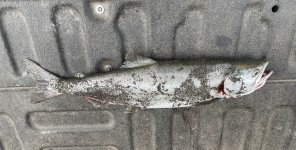
I was scouting the lower 'sack with the pup this morning.....checking to see if there was any sign of fishies. Saw nothing and heard only one hefty fish splash in the hour I walked along the river.

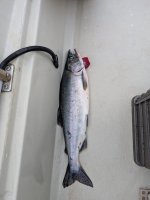
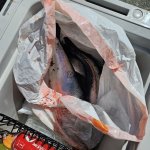
Just as I was about to leave a muddy bar, a tribal fisher comes along side and asks if I want a humpy.

Why Not ? So what if the river doesn't open until tomorrow....and the panko was free ;)

IMG_8804.jpeg

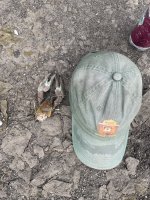
and check out this guy….I think it’s the largest half crayfish I’ve ever seen

IMG_8803.jpeg
 
Last edited:
95647bf6-5835-4a4c-b91c-7b005b787b80.png

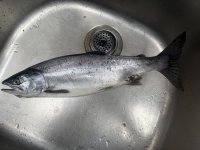
They have arrived here in God's Country, a lovely evening for a grilled meal with friends.
;)
 
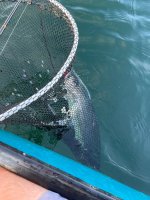
I only got to fish for about 90 minutes out of Grapeview. It was a great weekend with friends, but fishing wasn't really on the group agenda and I didn't want to be anti-social. 😁
I missed a good yank that was most likely a pink since it was right where the young guy that brought the other boat caught a limit of pinks the day before. He was trolling at 80' deep with a wiggle wart type thing and a hoochie below a flasher.
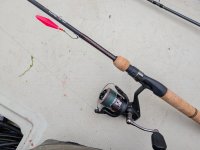
There was zero surface activity so I tried my 8wt Sonar Titan I/3/6 and was probably about 30' deep when I got that yank on a pink hoochie "fly".
Nothing to show!
 
Harsh!
The humpy hordes will have their revenge! They will superimpose their redds on top of the Chinook redds since the itty bitty PS Chinook can’t move big enough gravel or dig deep enough to avoid the humpageddon.
Ya' know, that's a good point. In years past, I've seen up to 3 humpy redds in a Skagit Chinook redd that was placed earlier. The pink redds don't disturb the Chinook eggs because they are buried deeper, and the pinks like the easier to move, pre-stirred gravel within a Chinook redd. Actually works, or used to work, out well for both species. With mini sized Chinook, this maybe isn't going to work out so well any longer.
 
Historically the Chinook and pink salmon had parsed the various spawning habitats (pinks using shallower and smaller gravels while the Chinook deeper and larger gravels/stones) for their spawning. This worked well for both species maximizing the collective success of both. While these strategies may work to some extent on the Skagit basin in other basins it has broken down completely will huge negative impacts on the success of natural spawning Chinook.

In basins like the Stillaguamish where the gravel size has been reduced to the point that both species are competing for many of the spawning site. The result is that are very limited unmolested spawning opportunity for Chinook. Even 3 decades it was common on the NF Stilli to see female Chinook that begins the process of spawning to be mobbed by dozens of pinks to the site with a negative impact on the success of that Chinook redd and its eggs. It has been a successful strategy for pinks to use mass spawning with waves of spawning fish. Each wave while digging up many of the eggs from previous spawners find gravels that have cleared of much of the finer sediments creating a better environment for the survival of those later eggs.

Historically it was common to see a female Chinook spend 10 days or so on her redd site. Much of that time was not in the redd construction process but rather in protecting that site from other spawning fish. This helped protect the redd and the buried eggs from the jostling from fish spawning on that site until the eggs had a chance to develop pass their most fragile stage where even minimal jostling would result in elevated egg mortality.

As the pinks mob a Chinook redd site (within the numbers potentially numbering a 100 or more fish) the female Chinook attempts to defend that redd site by chasing the pinks away. As the numbers of pinks increase this activity becomes a doomed exercise. Within 2 or 3 days the Chinook reaches a state of exhaustion and death leaving the redd site unprotected and its eggs vulnerable to increased mortalities.

Declining Chinook productivity in the Puget Sound region is likely influenced by the confluence of competition between species, decreased substrate stability and size, increased flooding, lower summer flows and decreased Chinook size and fecundity.

A further thought on pinks and Chinook, I find it interesting that on the NF Stillaguamish Chinook have not meet its escapement goal in at least 4 decades. Meanwhile the pinks which should be more vulnerable to flood impacts have consistently met or exceeded its escapement goals several times a decade. Meanwhile to the south on the Green, Puyallup, and Nisqually the Chinook remain in trouble while pink escapements are often an order of magnitude larger than historical goal. How can that be? Certainly, part of the answer is that ocean conditions favor the pinks. But an aspect rarely discussed is that once pinks hatch, they quickly migrate downstream and through the estuaries within days of hatching. While the Chinook require several months of rearing in the river and/or the estuary before successfully transition to a more marine environment. I think the fact the Chinook are not making that transition is a statement on the poor condition (at least for Chinook) of that freshwater and estuary habitat.

Curt

 
Great stuff as always Curt. It makes sense for species like Chinook and steelhead to be impacted by our metro area estuaries. It sucks since our upper river habitat is finally more than decent and ocean survival seems to be great right now.
My friend Ardi runs the Orca school in Everett and they find all sorts of unhealthy stuff in the Snohomish estuary during their many surveys.

Columbia fish don't seem to be struggling with this. Of course, they are also not competing for spawning grounds with pinks. Makes me wonder which is more impactful.
 
It’s important not to oversimplify and over generalize with these things. There are still lots of issues with mid and upper river habitats, too. It is simplified, the water is warm, there are still lots of fish passage barriers, and snowpacks are diminishing. And it doesn’t help that northern fisheries catch the Chinook in their ocean phase.

And yeah, there’s a lot of missing and poorly functioning estuary habitat, too. And the pinks. And, and and.
 
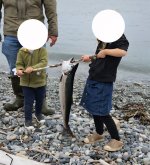
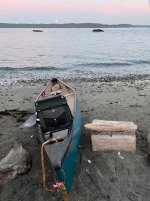
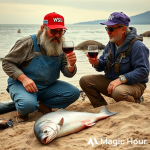
Stoney came out for a BBQ on the beach the other day, and showed me proper sand panko technique for a humpy, while I opened a nice bottle for dinner.

a6078977-612b-4b18-a05f-cba546368407.png

Monetizing the Humpy run has never been easy, but I think he's on to something here.
 
fyi-
Of all our salmon the lowly pink has the most "fragile" flesh which means for peak table quality they should be bled immediately, cleaned quickly, and put on ice (preferably with some belly packing). This is especially true for those in the salt that are still feeding.

Bright pinks (chrome with some loose scales and minimal hump) treated with this respect provide fresh table fare (on the grill that night) that IMHO exceeds that of Puget Sound Chinook or fall coho though not quite up to fresh resident coho or bright sockeye. Such fish will also produce top notch eating as a canned or smoked product.

Tight lines
 
Back
Top