Rocks

We visited Iceland, Finland, Norway back in 2019. From Porvoo, Finland we drove out here for a short hike. (Cut and pasted below).

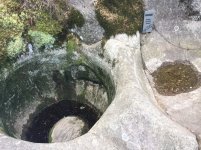
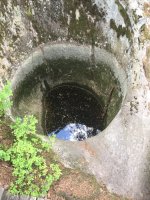
Also known as the Devil's Cauldrons, these 14 glacial potholes were created some 10,000 years ago by melt water from frozen glaciers and polished smooth by rotating rocks. Three of the potholes, including the largest, the Devil's Soup Bowl (15m deep with an 8m diameter), are the biggest of Finland's hundred-plus such formations. Metal staircases let you descend into several of the holes. The site is 25km southwest of Rovaniemi off Rd 926 on the slopes of Sukulanrakka at Rautiosaari.

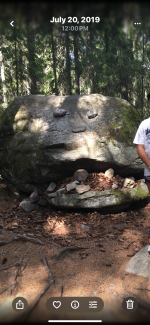
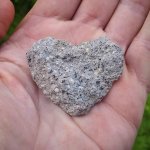
Big Happy Face boulder early in the hike.

IMG_4843.png
IMG_2264.jpegIMG_2263.jpeg
 
Last edited:
:unsure: I would be remiss if I didn't mention who Nick Zenter is. He is a Prof at CWU teaching the geology of the PNW to people of all ages.
He uses the phrase "German Chocolate Cake" to describe the Columbia Basalt lava flows.


Like I needed another rabbit hole... actually thanks. Watched that, Ancient Rivers of the PNW, Bridge of the Gods Landslide...
 
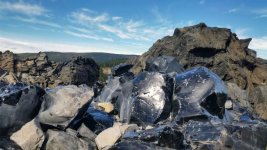
If yer interested, there's a 2.5+ sq km obsidian field in the Newberry Caldera in Oregon. It's pretty damn impressive to walk through, but Pro Tip - bring some footwear with thick soles and a steel shank. Razor-sharp glass has a tendency to shred cheap boots.
20250120_200030.jpg

Rocks are cool.
 
Amazing that tree was able to stop that boulder!!!

;)

I got a number of bathtub+ sized erratics and a bazillion "spuds" always working their way to the surface on my property.
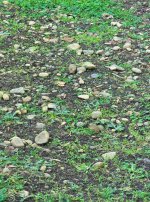
Were sitting on Missoula Flood deposits here in SWW. Pretty sure I've got some genuine Idaho spuds on our new place. Not looking forward to digging fence holes, deck footings, etc... but might prove distracting with all the different colors/ types of rocks. Our entire yard is this stuff.
20250122_121844.jpg
 
Were sitting on Missoula Flood deposits here in SWW. Pretty sure I've got some genuine Idaho spuds on our new place. Not looking forward to digging fence holes, deck footings, etc... but might prove distracting with all the different colors/ types of rocks. Our entire yard is this stuff.
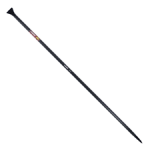
If you don't already have one, you're going to want to get a rock bar to go with your PhDs (post hole diggers).
1737580511925.png
 
If you don't already have one, you're going to want to get a rock bar to go with your PhDs (post hole diggers).
View attachment 139523

Oh yeah, its on my shopping list. Along with a cement mixer .. which I'm wondering if I can also use as a tumbler to clean the dirt and mineral stains off these spuds. Plenty of boring basalt, but some really pretty reds, a few greenish, and blond quartzites.
 
Oh yeah, its on my shopping list. Along with a cement mixer .. which I'm wondering if I can also use as a tumbler to clean the dirt and mineral stains off these spuds. Plenty of boring basalt, but some really pretty reds, a few greenish, and blond quartzites.
Sounds like a good way to clean off your rocks nicely and also f*ck up your mixer and send you back to the wheelbarrow with a hoe and a hose.

Edit: in a previous life I worked for a flag company and put up lots of flagpoles. I dug a lot of holes in those years. Big holes, little holes, deep holes…A lot of holes. And then I filled them back up with poles and concrete. Usually I had to mix the ‘crete. Sometimes I had a mixer, usually not. Point is, I’m not totally full of it on this topic.
 
Last edited:
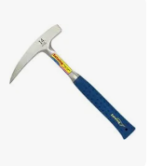
12 year old me's absolute prized possession? This guy:
1737649126880.png
I still have it, because, why wouldn't I? I mean it is basically the perfect instrument in terms of weight, ferocity, hand balance, strength, beauty, impact, design etc etc. I am partial to the wood handled ones, and for that matter, the general look and feel of classic ice axes...
 
Sounds like a good way to clean off your rocks nicely and also f*ck up your mixer and send you back to the wheelbarrow with a hoe and a hose.

Edit: in a previous life I worked for a flag company and put up lots of flagpoles. I dug a lot of holes in those years. Big holes, little holes, deep holes…A lot of holes. And then I filled them back up with poles and concrete. Usually I had to mix the ‘crete. Sometimes I had a mixer, usually not. Point is, I’m not totally full of it on this topic.

Well, other than your well-mannered, Mr smarty-pants sense of humor, can't say I've known you to be full of it on anything. ;)

So I'll nix that idea. Any ideas if pressure washing will purty them up for landscaping use? Would really like to find a way to convert this bumper crop of imported spuds from a major PITA to useful materials.
 
View attachment 139576
I still have it, because, why wouldn't I? I mean it is basically the perfect instrument in terms of weight, ferocity, hand balance, strength, beauty, impact, design etc etc. I am partial to the wood handled ones, and for that matter, the general look and feel of classic ice axes...

So basically, the perfect tool. The 6 wt of hammers...... ;)
SF
 
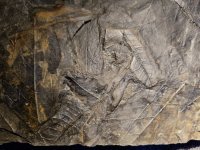
Maybe one day a gust of wind blew falling leaves into a lowland stream not very far from the coast. Downcurrent they drifted into an eddy, settled to the bottom, and were covered by silt. Time passed and as the offshore plate crashed into the continental plate over a hundred miles of land accreted to the west. What used to be the stream bed was thrust a mile skyward. And then, about 40 million years later, I wandered by.

Oregon's Blue Moutains.

AAC16EC9-366F-4550-A2C8-8DB470CD7038.jpeg


Oregon's Blue Mountains.
 
Last edited:
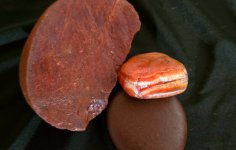
A couple of the red spuds, one freshly broken, and an agate from the yard. Missoula flood material. Any guesses as to what the red ones are?

View attachment 139827
Very Cool!
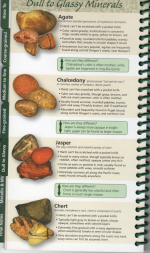
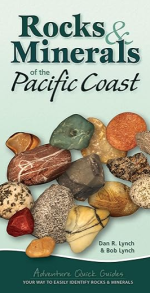
Looks like you could use a field guide with a localized focus like this.
1737911210453.png1737912678890.png

Also found this with a web search that seems to coincide with your general location and matches nicely with the book.
"Red agate can be found in Washington state, and is sometimes called carnelian. Carnelian is a solid red-orange chalcedony, while red agate is a banded chalcedony.
Locations
Lucas Creek: Located east of Chehalis
Salmon Creek: Located southeast of Toledo
Green Mt. Located in Kalama
Silver Lake: Located in Castle Rock
Valley C Ranch: Located in Tenino
Upper Toutle River: Located on the slopes of Mt. St. Helens
Damon Point State Park: Located in Grays Harbor
What is carnelian?
Carnelian is an orange gemstone that is not particularly rare, making it affordable
Larger, cleaner, and brighter reddish orange carnelian gemstones are more valuable

Looking at the book, the rust red stone on the left is probably Carnelian; solid red-orange chalcedony, possibly (I love) Jasper.

There are phone apps that allow you to snap a photo to make a match but my serious rockhounding brother doesn't find they work all that well. He prefers books containing identifying characteristics that can require high magnification and UV optics, and a hardness test kit.
 
Back
Top