
My first two tarpon fishing ventures went rather poorly. The first time, I did get a couple decent shots at migrating giants, but my guide's brand new lithium battery died about 2 hours in. We got a "jump" from another guide and headed in. Second try, the first of two planned days was cut extremely short when my guide's push pole snapped in the first place we stopped due to the high winds. The second day a "cold" front (high of 75 LOL) came through, which all Keys anglers know means fishing is a bust, so we didn't fish. I sensed my guide, who had been recommended by board member @albula , knew the fishery extremely well, so I decided to book a follow-up trip with him.
For sure, the weather was more conducive to fishing this time around, even if it was HOT!!. We got in a very full day yesterday, and we saw a lot of GIANT fish (100-lb.+). I got a few very exciting follows, but all resulted in the fish bugging out just before inhaling the fly. It was an awesome day, even without any catching.
After fishing, I returned to my motel room to shower and relax with a cold one (or four) before dinner, which was some delicious mahi tacos while watching a legendary Keys sunset. It had been a great day, and I was ready to crash. I woke up in the middle of the night to the brutal realization of just how dehydrated I had been. Both legs were cramped up right above my feet, and it took several minutes for them to relax. I thought I was drinking enough water during the day, but now I knew I would need to drink a lot more the next day. Stay hydrated, folks!
This morning, we got an early start (still dark) and ran 40 miles to the Everglades side of the bay. On the way out, we were greeted by a magnificent sunrise, and we saw all kinds of awesome wildlife (once it got light enough to see). When we arrived at our destination, I knew I was in for something special, fish or no fish. A seemingly endless maze of navigable channels amongst the most impressive mangrove forest I've seen got the stoke going big time.
Before long, while poking around in my guide's seemingly innumerable "spots," the water around us suddenly came to life. In every direction, there were tarpon tails slashing the surface. Apparently, that means they're very unhappy, and that was probably due to the fact we had just gone over them, but it was clear there was a big group of fish present, so we went to the trolling motor and snuck back above them. We posted up-current from where most of the fish were, and after a couple minutes, they started making "happy" rolls, meaning they were settled back in. Time to get after 'em!
Where the day before had been almost entirely sight-fishing in relatively clean water, this was a different deal. The visibility was about 2 feet, so there would be no sight fishing. Instead, I got to practice something very similar to the swing presentation we use for steelhead, casting across the current, letting the sink tip line bring the fly down for a few seconds, then swinging the fly through the fish until it got to the "hangdown" point (if nobody bit it before it completed the swing), and then transitioning to varying speed, two-handed strip retrieves.
Most of the fish in the Everglades this time of year are between about 20 and 70 pounds, and most of these particular fish were on the lower end of that scale. While those are all awesome fish here in the PNW, they are relatively small tarpon. While small tarpon tend to be more user-friendly than the giants, they are tricky to hook on the initial bite, because they have the same, hard mouths the giants do, but they don't take the fly as deep, and they don't have the weight to set the hook when they turn with it, so when you feel a "bump," the next move is to start stripping the fly in fast, ideally triggering a chase and proper eat. Sometimes, that initial bump is all you get, but other times, they chase the fly down and take it for real. It is hard for a long-time trout guy to resist setting with the rod, but I think the two-hand retrieve helps to prevent that, since neither hand is on the rod grip when you use a two-hand strip. It kind of forces you to strip set, which is what you should do.
On my second cast, I got "bumped," but I was a bit slow going to the strip, and the fish lost interest. Now I knew what to "feel" for, and on the next cast, I did my job and came tight to a nice fish. WHAT A BITE! Now I had another lesson to learn: how to hold onto a hooked tarpon while trying to get it on the reel. While I was fumbling with my grip (a lot of tarpon guides set their reels up right-hand retrieve, which is not my usual custom... more on that later), the fish ran toward the boat, and by the time I caught up, it was off. Bummer, but we were psyched, because it was starting to come together. A few casts later, I came tight to a fish and did better. It made a couple jumps, and I learned how to "bow to the silver king." When I got it to the boat, it ran under the boat and toward the motors and everything bad. After a crazy fire drill, I got it back to the bow, and it surrendered. Finally, my first tarpon!
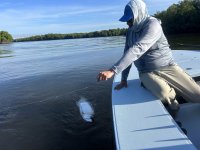
Before the tide stopped moving, I hooked a few more, to include about a 50-pounder that went airborne about 8 feet right after I stuck it. That fish got off, but I will be revisiting that jump in my dreams until the next time.
We fished a couple other spots that had fish, but they weren't interested. The sky in the distance started looking ugly around 10, and we bolted for home. Good thing; we barely beat a nasty thunderstorm back to port. On the way out, we spotted this guy:
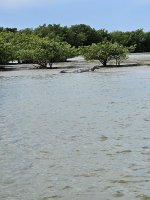
We went in for a closer look, and he turned to face us with an open mouthful of teeth. Didn't seem scared of us at all. Crocs are a little different from alligators that way. I thought I took a video of the encounter, but I must have forgotten to hit the record button or something, because I can't find it now.
Of course, we saw too much other wildlife to recount. The Everglades are an amazing wilderness. Wish I could go back tomorrow, but it will have to wait a while.
In closing, a few things I learned about tarpon fishing and associated lingo:
1. Tarpon have several distinct attitudes that indicate when and how you should approach them. They can be "happy," "stirred up," or downright "pissed." Happy ones seem to move slowly if at all and may roll occasionally. Fish them when you find them. When they're stirred up, they move around faster and bite poorly. When they're pissed, they slap their tails on the surface and won't bite at all.
2. Tarpon have several behaviors that anglers associate with different presentations and likelihood of success. Whether they're sitting, sliding, rolling, or free jumping, you want to approach them the right way, lest ye be disappointed.
3. While most freshwater anglers set up their reels so they hold the rod with their dominant hand and reel with the weaker one, many tarpon anglers set up to retrieve with the dominant hand, because when you're fighting a giant, you need to be able to keep up when they run toward you, and you need to be able to apply maximum pressure while fighting them. This was hard for me to get used to when I started hooking fish, but once I learned to make the fish "earn" the reel, like we do with other fish, the switch became less cumbersome.
4. A good guide who knows the area is critical to finding fish. When you're with a good guide, it seems like there are tarpon everywhere. Of course, that's not the case, and in a vast area like Florida Bay, it's especially crucial to know where they will be at various tide stages/times of day to be successful.
5. Current is crucial. Tarpon, like most fish in the Keys, are happiest when they have current to face into. Slack tides and weak exchanges generally make for slow fishing.
6. Boats matter. Flats skiffs are designed precisely for this type of fishing, where you have to navigate a lot of extremely shallow and otherwise perilous water. When I saw what the water we ran through in the dark looked like under the sun, I was shocked to find that most of the water we ran through was 2 feet deep or less. Indeed, we ran across a grass flat at low tide that would have been entirely inaccessible to any other style of boat. Better know where you're going and have a boat that can go there.
7. The obsession only gets stronger after you have some success. Get into this knowing you're probably starting a maddening, expensive habit.
For sure, the weather was more conducive to fishing this time around, even if it was HOT!!. We got in a very full day yesterday, and we saw a lot of GIANT fish (100-lb.+). I got a few very exciting follows, but all resulted in the fish bugging out just before inhaling the fly. It was an awesome day, even without any catching.
After fishing, I returned to my motel room to shower and relax with a cold one (or four) before dinner, which was some delicious mahi tacos while watching a legendary Keys sunset. It had been a great day, and I was ready to crash. I woke up in the middle of the night to the brutal realization of just how dehydrated I had been. Both legs were cramped up right above my feet, and it took several minutes for them to relax. I thought I was drinking enough water during the day, but now I knew I would need to drink a lot more the next day. Stay hydrated, folks!
This morning, we got an early start (still dark) and ran 40 miles to the Everglades side of the bay. On the way out, we were greeted by a magnificent sunrise, and we saw all kinds of awesome wildlife (once it got light enough to see). When we arrived at our destination, I knew I was in for something special, fish or no fish. A seemingly endless maze of navigable channels amongst the most impressive mangrove forest I've seen got the stoke going big time.
Before long, while poking around in my guide's seemingly innumerable "spots," the water around us suddenly came to life. In every direction, there were tarpon tails slashing the surface. Apparently, that means they're very unhappy, and that was probably due to the fact we had just gone over them, but it was clear there was a big group of fish present, so we went to the trolling motor and snuck back above them. We posted up-current from where most of the fish were, and after a couple minutes, they started making "happy" rolls, meaning they were settled back in. Time to get after 'em!
Where the day before had been almost entirely sight-fishing in relatively clean water, this was a different deal. The visibility was about 2 feet, so there would be no sight fishing. Instead, I got to practice something very similar to the swing presentation we use for steelhead, casting across the current, letting the sink tip line bring the fly down for a few seconds, then swinging the fly through the fish until it got to the "hangdown" point (if nobody bit it before it completed the swing), and then transitioning to varying speed, two-handed strip retrieves.
Most of the fish in the Everglades this time of year are between about 20 and 70 pounds, and most of these particular fish were on the lower end of that scale. While those are all awesome fish here in the PNW, they are relatively small tarpon. While small tarpon tend to be more user-friendly than the giants, they are tricky to hook on the initial bite, because they have the same, hard mouths the giants do, but they don't take the fly as deep, and they don't have the weight to set the hook when they turn with it, so when you feel a "bump," the next move is to start stripping the fly in fast, ideally triggering a chase and proper eat. Sometimes, that initial bump is all you get, but other times, they chase the fly down and take it for real. It is hard for a long-time trout guy to resist setting with the rod, but I think the two-hand retrieve helps to prevent that, since neither hand is on the rod grip when you use a two-hand strip. It kind of forces you to strip set, which is what you should do.
On my second cast, I got "bumped," but I was a bit slow going to the strip, and the fish lost interest. Now I knew what to "feel" for, and on the next cast, I did my job and came tight to a nice fish. WHAT A BITE! Now I had another lesson to learn: how to hold onto a hooked tarpon while trying to get it on the reel. While I was fumbling with my grip (a lot of tarpon guides set their reels up right-hand retrieve, which is not my usual custom... more on that later), the fish ran toward the boat, and by the time I caught up, it was off. Bummer, but we were psyched, because it was starting to come together. A few casts later, I came tight to a fish and did better. It made a couple jumps, and I learned how to "bow to the silver king." When I got it to the boat, it ran under the boat and toward the motors and everything bad. After a crazy fire drill, I got it back to the bow, and it surrendered. Finally, my first tarpon!
Before the tide stopped moving, I hooked a few more, to include about a 50-pounder that went airborne about 8 feet right after I stuck it. That fish got off, but I will be revisiting that jump in my dreams until the next time.
We fished a couple other spots that had fish, but they weren't interested. The sky in the distance started looking ugly around 10, and we bolted for home. Good thing; we barely beat a nasty thunderstorm back to port. On the way out, we spotted this guy:
We went in for a closer look, and he turned to face us with an open mouthful of teeth. Didn't seem scared of us at all. Crocs are a little different from alligators that way. I thought I took a video of the encounter, but I must have forgotten to hit the record button or something, because I can't find it now.
Of course, we saw too much other wildlife to recount. The Everglades are an amazing wilderness. Wish I could go back tomorrow, but it will have to wait a while.
In closing, a few things I learned about tarpon fishing and associated lingo:
1. Tarpon have several distinct attitudes that indicate when and how you should approach them. They can be "happy," "stirred up," or downright "pissed." Happy ones seem to move slowly if at all and may roll occasionally. Fish them when you find them. When they're stirred up, they move around faster and bite poorly. When they're pissed, they slap their tails on the surface and won't bite at all.
2. Tarpon have several behaviors that anglers associate with different presentations and likelihood of success. Whether they're sitting, sliding, rolling, or free jumping, you want to approach them the right way, lest ye be disappointed.
3. While most freshwater anglers set up their reels so they hold the rod with their dominant hand and reel with the weaker one, many tarpon anglers set up to retrieve with the dominant hand, because when you're fighting a giant, you need to be able to keep up when they run toward you, and you need to be able to apply maximum pressure while fighting them. This was hard for me to get used to when I started hooking fish, but once I learned to make the fish "earn" the reel, like we do with other fish, the switch became less cumbersome.
4. A good guide who knows the area is critical to finding fish. When you're with a good guide, it seems like there are tarpon everywhere. Of course, that's not the case, and in a vast area like Florida Bay, it's especially crucial to know where they will be at various tide stages/times of day to be successful.
5. Current is crucial. Tarpon, like most fish in the Keys, are happiest when they have current to face into. Slack tides and weak exchanges generally make for slow fishing.
6. Boats matter. Flats skiffs are designed precisely for this type of fishing, where you have to navigate a lot of extremely shallow and otherwise perilous water. When I saw what the water we ran through in the dark looked like under the sun, I was shocked to find that most of the water we ran through was 2 feet deep or less. Indeed, we ran across a grass flat at low tide that would have been entirely inaccessible to any other style of boat. Better know where you're going and have a boat that can go there.
7. The obsession only gets stronger after you have some success. Get into this knowing you're probably starting a maddening, expensive habit.


