Ditto for BellyburgWe had ashes on our vehicles and patio table in NW Whatcom county yesterday from the Vancouver Island fire. No smell of smoke though.

Follow along with the video below to see how to install our site as a web app on your home screen.
Note: This feature may not be available in some browsers.
Ditto for BellyburgWe had ashes on our vehicles and patio table in NW Whatcom county yesterday from the Vancouver Island fire. No smell of smoke though.


Dang! Your 40+ failed? Clean break? Truly shows the power of the pink salmon. Nothing can stop a humpyFun day out on the water with @Steve_S
Thank you for the invite.
There isn’t a lost and found forum that I could find, so I’m asking for members help.
If anyone happens to catch an approximately 5 lb male humpy with a slight case of diaper rash that has a small pink fly in its mouth, 8’ of 12 lb Maxima Ultragreen and 3-6” of a Airflo 40+ fly line, I’d appreciate getting my leader back.
Thanks
SF

Have you guys seen a big increase on the big red jellyfish in the sound?
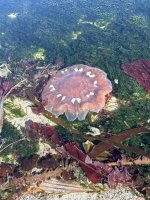

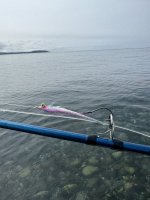

Yes Chris, I have never seen so many this year and they really screwed up the fishing. The trollers were not catching anything and when went to water were they clear we had good fishing. My last day they were gone and the fishing was awesome. Also we saw some jellyfish that were huge. If you were trolling and got down more than a foot you’re mono would be covered with brown slime. I have seen when the small clear jellyfish were around and the fishing was not impacted.View attachment 163446
If this is the type you’re thinking of it was in a tide pool along Dungeness Spit. Probably about eight inches across.

Interesting observation, @Denwor54. The clear jellyfishes, likely Aequoria victoria (crystal jelly) and Aurelia aurita (moon jelly), feed on very tiny plankton such as small copepods, ctenophores, and smaller jellyfish (see here and here). The nematocysts (stinging cells - tiny harpoons) on their tentacles are equipped with a toxin to help disable prey. But neither the harpoon nor the toxin is very strong, reflecting their feeble prey. You can handle them without any effect as the harpoons are not large / powerful enough to penetrate your skin.Yes Chris, I have never seen so many this year and they really screwed up the fishing. The trollers were not catching anything and when went to water were they clear we had good fishing. My last day they were gone and the fishing was awesome. Also we saw some jellyfish that were huge. If you were trolling and got down more than a foot you’re mono would be covered with brown slime. I have seen when the small clear jellyfish were around and the fishing was not impacted.

Thoughts as to why they moved off deep with the wind shift and tide change?In honor of Stones' fish hierarchy- shaker coho, sculpin and three pinks off the beach. Lots more pinks from the kayak, MA 9. I'll confess though, the wind had me switching to gear when over deeper water. All the beach fish were early in the am, wind shifts and tide changes from about 10 AM on had the rest of the pinks moving through water deeper than 30 feet.
They hugged the shore when the porpoise was lurking and when the seals showed they were off deeper. Then again the porpoise didn't hang for long, nor did the seals so maybe that observation is worthless.
Ended up basically waiting for a show up current, paddling to an anticipated spot where the school might be heading and casting ahead of the pack. White jellys and weed minimal, no red jellies, good vis water. When the hoochie was close, I'd let line out, so fun to watch the fish chase it down, typically three or four pinks would be vying for it. I didn't really bother much with any kind of aggressive set from the kayak, if you got a bump and wound up a little and there was nothing, you could just stop the wind, wait a little, jig it a little, and a bunch of times, not always, but enough to play around with that method, fish would be on.
Anyone else notice when you first hook a pink it takes almost an unreasonable amount of time to realize they might as well start fighting?

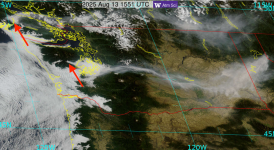
This image was taken Wednesday, H/T Cliff Mass blogI believe this might be smoke from the Bear Gulch fire up by Lake Cushman, which is now 5,000 acres. I could see it while I was fishing today but it looks like a lot more smoke than earlier.
SF
View attachment 163289
View attachment 163290
Slow afternoon tide on a whidbey beach, lots jumping but too far to fast to, called it when the wind picked up. Got to use a fly @Stonedfish kindly gave me a while back th
Slow afternoon tide on a whidbey beach, lots jumping but too far to fast to, called it when the wind picked up. Got to use a fly @Stonedfish kindly gave me a while back though!
That looks like where I was fishing. I fought the wind for about an hour waiting for the fish to move in range. Finally I figured I'd prefer to get skunked on a different beach. It was even windier there, but then it died down and my evil plan was foiled.Slow afternoon tide on a whidbey beach, lots jumping but too far to fast to, called it when the wind picked up. Got to use a fly @Stonedfish kindly gave me a while back though!
View attachment 163465
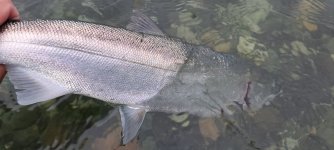
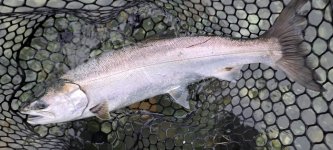

Came here to ask the same question. Experiencing the same on multiple MA9 beaches this last week. The only reasoning I could think of was that maybe it was still a bit early.Maybe it’s just me, but is anyone else seeing a lack of jumping fish close to the beaches so far this year? I’m seeing a good number of fish jumping, but they are all way out and well off the beaches.
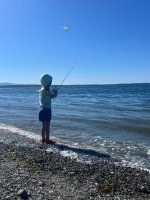
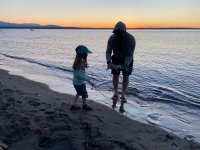
I think they were just loving the 5 foot backeddy dropoff along the beach that otherwise would be too shallow with the tide drop, plus it was gloomy and some very light drizzle that basically cleared by 11 am. A backeddy meeting the regular tide on drop-from-high can be a very productive site for any predatorThoughts as to why they moved off deep with the wind shift and tide change?

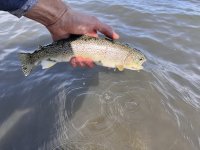

I am sure I missed opportunities last weekend as I was trying to fill the cooler because I was bleeding and gutting a fish instead of casting again while the passing sporadic schools were still in the vicinity. That is how important it is to me to properly treat a pink to eat. If you do it right, they're good. If you do it wrongly, they're not so good.I will say if you bleed, gut and ice a pre staging pink immediately they lack the fishy flavor.