SFR Poconos Pond Rehab

Sorta fishing-related

Canuck from Kansas

Aimlessly wondering through life
Forum Supporter
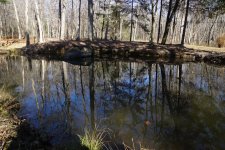
I hope to stock our pond at our new (old) home in the Poconos with bait fish next spring and perhaps a couple of grass carp. Ultimately hope to stock with some Brookies, so sort of fishing related.

The problem is, the pond has suffered years of neglect. There is between 1 and 2 feet of pond muck on the bottom. Don't really want to spend the 5 to 10K it would take to dredge it, so I have been doing it by hand - probably about a half ton of muck so far, but literally tons of work left. This forum is loaded with folks of great knowledge and experience in all kinds of fields; so I been wondering, has anyone done a pond rehab? Has anyone used biologicals (ie, muck remover bacterial pellets)? What's your experience? Do they work? Any other ideas/solutions to pond muck removal are welcome.

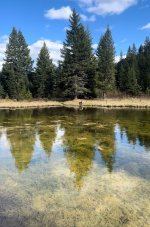
Our pond is not huge, about 100 ft by 40 to 50 ft. It is fed by an artesian well (currently not flowing due to drought) and a spring (still flowing), so we have really nice, cold, clear water, till the muck gets stirred up.

Thanks in advance,
 
FWIW, you probably need to manually excavate the muck, with machinery or muscle power. Once it's gone you can have a plan to prevent its return.

That's pretty much the plan (unfortunately, muscle power); the biologicals are advertised as being able to remove muck, but I think it's more a maintenance/preventive thing rather than large-scale removal.
 
Great topic. I have a spring fed pond at my place in Montana that has silted in with muck over the last hundred years and needs some rehab as well. I’ve decided to try to dredge it with a pump… will find out this summer how it works out. My idea is to float a gas—powered trash pump on a raft, wade around with the suction hose shoved down in the muck layer, and try to pump the some of the goo out. Basically like a gold dredge setup. I may need to run a splitter off the discharge to run a pressure hose down next to the suction hose to stir things up. It’s going to be a muddy mess for sure.

I’m trying to decide whether to route the discharge hose up to the meadow so the water can percolate back through the system, or below the dam so it ends up in the creek.

This is all highly speculative at this point since I don’t know if it’ll actually work, but I figured spending a few hundred bucks on a pump was worth trying before I kill myself trying to muck it by hand.

The other idea is to recruit a beaver by checking with the state to see if they have any in need of relocation. I’ll probably go that route also, since the pond has historically done best when beavers move in every decade or so. But even with periodic beaverage over the decades, some manual intervention appears needed and now that I’m retiring I figured it’s time to try.

I also expect to have to do some manual mucking but figured it would be easier if the water level is pumped down a few feet first.

IMG_6585.jpeg
 
Last edited:
Great topic. I have a spring fed pond at my place in Montana that has silted in with muck over the last hundred years and needs some rehab as well. I’ve decided to try to dredge it with a pump… will find out this summer how it works out. My idea is to float a gas—powered trash pump on a raft, wade around with the suction hose shoved down in the muck layer, and try to pump the some of the goo out. Basically like a gold dredge setup. I may need to run a splitter off the discharge to run a pressure hose down next to the suction hose to stir things up. It’s going to be a muddy mess for sure.

I’m trying to decide whether to route the discharge hose up to the meadow so the water can percolate back through the system, or below the dam so it ends up in the creek.

This is all highly speculative at this point since I don’t know if it’ll actually work, but I figured spending a few hundred bucks on a pump was worth trying before I kill myself trying to muck it by hand.

The other idea is to recruit a beaver by checking with the state to see if they have any in need of relocation. I’ll probably go that route also, since the pond has historically done best when beavers move in every decade or so. But even with periodic beaverage over the decades, some manual intervention appears needed and now that I’m retiring I figured it’s time to try.

I also expect to have to do some manual mucking but figured it would be easier if the water level is pumped down a few feet first.

View attachment 133242
Nice pond, looks significantly larger than ours. My tendency would be to discharge upstream into the meadow and let the water drain back in the meadow - I will be composting the muck and leaves, etc, should make for some nice soil - good luck with your project.

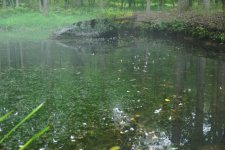
Our bottom looks somewhat similar, though we have a lot of oak and maple leaves, which I've steadily been scooping out.

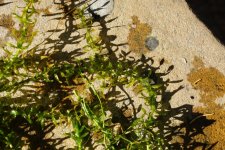
I've also thought of one of those vacuum pumps, just don't know if they can really handle the volume of muck. Also don't think they handle the vegetation very well. I have raked up a lot of elodia, which seems to be the main weed species we have, though want to keep some for cover for the frogs and food for ducks.

What I believe is elodia canadensis (those dam Canadians):

1732034895964.jpeg

Bed of elodia late this summer (with Mallard feathers):

1732035805995.jpeg


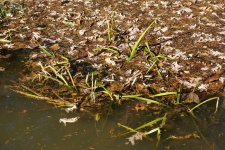
Leaves on the elodia bed this fall:
1732035910917.jpeg

After some clean up:

1732035964522.jpeg

Cheers
 
Is it possible to divert the inflow around the pond? I would think you could pump it down, rent an excavator and hog the thing out in a couple of days. That way you could dig some deep runs on one side, contour some different subsurface areas and be done with it in a jiffy.
 
While it won't help with the organic deposition removal that exists you might look into aluminum sulfate treatment after you somehow remove all that detritus. It will 'lock up' the bioavailable phosphorus, which is usually the limiting nutrient in pond and lake systems. How much of the pond's water column is above the muck? If there's quite a bit above the organic material the alum treatment (which is frequently used for lake rehabilitation) may suffice without dredging the pond. Some gentle aeration (without resuspending the muck) may also help...nothing good happens in an anaerobic pond or lake.


Last edited:
Is it possible to divert the inflow around the pond? I would think you could pump it down, rent an excavator and hog the thing out in a couple of days. That way you could dig some deep runs on one side, contour some different subsurface areas and be done with it in a jiffy.
Not sure if this is for me or for @Starfish, but can't really divert our spring water, though have thought about the possibility stirring up the muck and then releasing water from your small dam, but that might screw up the little creek.

Have thought about excavator, but it would have to have a long reach, just not sure it would be able to do the job for the money - we have already spent a small fortune on rehabbing our new home, so trying to do this on the cheap - think it will be all my manual labor.
 
While it won't help with the organic deposition removal that exists you might look into aluminum sulfate treatment after you somehow remove all that detritus. It will 'lock up' the bioavailable phosphorus, which is usually the limiting nutrient in pond and lake systems. How much of the pond's water column is above the muck? If there's quite a bit above the organic material the alum treatment (which is frequently used for lake rehabilitation) may suffice without dredging the pond. Some gentle aeration (without resuspending the muck) may also help.


Strange, the link did not show up in you message but does in my reply.


Our water clarity/quality is actually very good, did not have algae issues during our first summer here. The muck seems to settle quite quickly after it becomes disturbed during removal, but I will definitely keep this one in mind - thanks!!
 
Not sure if this is for me or for @Starfish, but can't really divert our spring water, though have thought about the possibility stirring up the muck and then releasing water from your small dam, but that might screw up the little creek.

Have thought about excavator, but it would have to have a long reach, just not sure it would be able to do the job for the money - we have already spent a small fortune on rehabbing our new home, so trying to do this on the cheap - think it will be all my manual labor.
Your back is strong…light work…
You got this 💪🏼 😁👍🏼
 
Nice pond, looks significantly larger than ours. My tendency would be to discharge upstream into the meadow and let the water drain back in the meadow - I will be composting the muck and leaves, etc, should make for some nice soil - good luck with your project.

Our bottom looks somewhat similar, though we have a lot of oak and maple leaves, which I've steadily been scooping out.

I've also thought of one of those vacuum pumps, just don't know if they can really handle the volume of muck. Also don't think they handle the vegetation very well. I have raked up a lot of elodia, which seems to be the main weed species we have, though want to keep some for cover for the frogs and food for ducks.

A trash pump can handle pretty large solids. The pump I bought from Harbor Freight for $350 is semi-trash and says it can handle solids up to 3/4”. A full trash pump that can handle up to 1-1/4” solids was $900 so I figured I’d try this one first. At the very least it’ll pump the level down (at least I assume the springs won’t keep up with a 290 gpm pump).

I agree with the preference to discharge to the meadow - but it’ll take a lot more discharge hose so I might do some of each depending on which part of the pond I’m at. This is definitely going to take some experimentation. The only thing I’m certain of is that I don’t have the gumption to move this much muck completely by hand.
 
Strange, the link did not show up in you message but does in my reply.


Our water clarity/quality is actually very good, did not have algae issues during our first summer here. The muck seems to settle quite quickly after it becomes disturbed during removal, but I will definitely keep this one in mind - thanks!!
The real issue isn't the clarity but rather the seasonal senescence (winter die-back and leaf shedding) of the aquatic plants to continue to contribute to the nutrients trapped in the pond...alum renders those nutrients unavailable to provide annual regrowth....essentially slowing down the inevitable conversion of the pond to a little meadow.

Just as deciduous trees grow tremendous masses of leaves through photosynthesis and shed in the fall an aquatic plant builds huge nutrient bearing biomass that annually accumulates on the pond's bottom...only to release nutrients for spring and summer regrowth.

I guess it depends how long you intend to own your place with the pond...and how many times you want to mechanically remove the accumulated biomass.
 
Last edited:
On a practical level, if there's any length of stream downstream of this or that pond that you have plans for, keep in mind that dewatering and nuking the pond is one thing, but if you want to help the critters that live in the streams downstream of the ponds, it might be better to pump water to those reaches so they don't dewater, too.

I wouldn't recommend releasing a whole bunch of muddy/mucky water all at once. That would be hard on the receiving water and the critters living there.
 
The real issue isn't the clarity but rather the seasonal senescence (winter dying) of the aquatic plants to continue to contribute to the nutrients trapped in the pond...alum renders those nutrients unavailable to provide annual regrowth....essentially slowing down the inevitable conversion of the pond to a little meadow.

Just as deciduous trees grow tremendous masses of leaves that through photosynthesis and shed in the fall an aquatic plant builds huge nutrient bearing biomass that annually accumulates on the pond's bottom...only to release nutrients for spring and summer regrowth.

I guess it depends how long you intend to own your place with the pond...and how many times you want to mechanically remove the accumulated biomass.

Ahh, thanks, helpful information.
 
On a practical level, if there's any length of stream downstream of this or that pond that you have plans for, keep in mind that dewatering and nuking the pond is one thing, but if you want to help the critters that live in the streams downstream of the ponds, it might be better to pump water to those reaches so they don't dewater, too.

I wouldn't recommend releasing a whole bunch of muddy/mucky water all at once. That would be hard on the receiving water and the critters living there.
Agreed, not sure what the critter life is in the outflow creek (more like a ditch), haven't seen much, but sure there must be some frogs in some of the swampier areas. It does run through some neighbor's properties as well, and apparently the previous owner did dewater the crick at one time, without warning anyone - neighbors weren't happy, apparently killed a Koi pond. That won't be me.
 
You're probably lucky you don't live in the state of Washington...they're rather fussy about 'waters of the state' because they've suffered so much abuse from the goddamn developer community altering wetlands and watershed structure. Quick buck and they're gone.
 
Other than a “Weekend at Canucks”.. everyone bring your waders get together, one thought came to mind. The geographic location you currently reside in is peppered with golf courses in nearby Poconos and there might be a local or nearby course maintenance manager whose forte’ may be managing reclaimed free flowing water hazards. Water hazards are great ball magnets and what Pro wants an ugly mucky eyesore?
@krusty makes a great point about the deciduous trees and leaves though having lived in the NE for decades I learned to love my two giant red oaks and the leaves they dropped each fall. Still miss them and our relationship. Good Luck on what you decide.
 
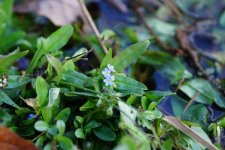
Calling @Mossback or any other horticultural experts, we have this in our outflow creek, it is rooted but in the water, any idea what it is (still flowering - this picture taken today) - I have transplanted some to some other swampy spots next to the pond and it seems to be doing well, obviously needs wet feet.

0D86D320-ED8B-4E76-8265-98DA437F2728.jpeg

Thanks in advance,

cheers
 
Back
Top