I haven’t fished rivers / streams in almost two years, so I was looking forward to a 10-day trip to Montana and Idaho. A friend and I headed first to “Petra Creek”. Another friend and his wife had purchased a cabin on this creek several years ago; they generously offered to let us stay in two of their small cabins (actually, their neighbor’s small one-person cabins).
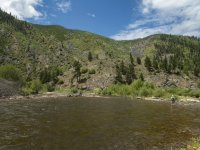
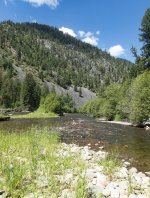
“Petra Creek” is a popular fishery, but as one skilled Montana local remarked, it can be a very technical creek.
 A01
A01
Adding to the challenge, water levels were 35% higher than the median. That would make wading across the creek to the other bank riskier than normal on a river known for a slippery river bottom. As a leftie, I always prefer to fish near right bank as my casts are mostly over the water and I’m less likely to hook flies in the riparian vegetation. That usually means that I’m crossing the river at least twice. [Why do all my favorite streams have their access roads to the left of the river???]
We fished during late-morning/early afternoon and headed out again in the evening. I’m not a nympher and without a major daytime hatch (and limited water access to boot), I didn’t have high expectations and that was about right. But “Petra Creek” often turns on in the evening with a mix of ovipositing bugs and newly emerging bugs.
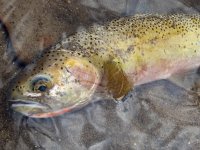
During the day, I primarily relied on a size 18 EHC, a reliable searching bug, and there were a few caddis flying around. My casts into likely spots into the heart of the main pools were largely ignored or rejected after a brief inspection. What little success that I had during the day occurred when I dropped casts into small pockets that had some cover from the current, such as submerged boulders or a shrub dislodged by higher water and dropped into a side channel. Most of the strikes were from cutthroats, bless their surface-fly loving hearts, but two small browns grabbed the EHC too.
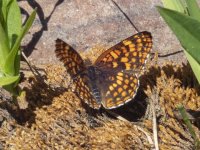
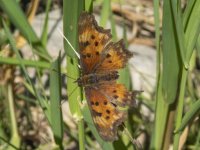
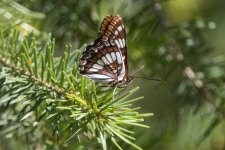
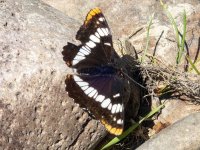
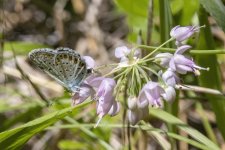
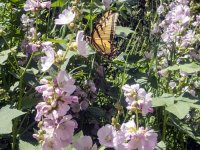
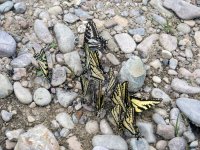
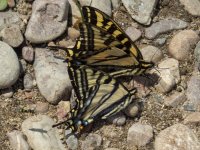
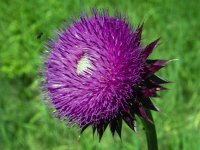
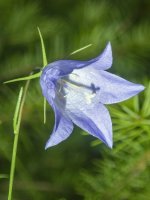
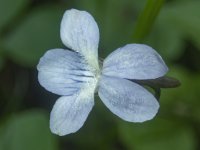
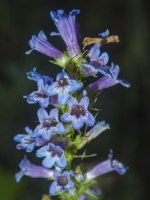
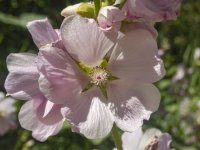
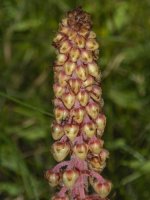
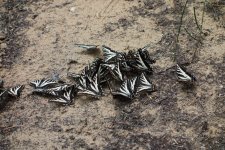
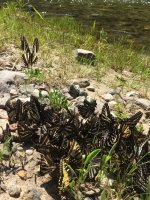
The slow fishing left ample time to be diverted by the abundant butterfly activity and the profusion of wildflowers on the banks [more later]. In spite of the calendar indicating mid-July, the hillsides were a vivid green and the wildflowers were in full bloom [more later too].
It was a different story in the evening. I had a delightful night at one of my favorite drifts. The top of the drift has the expected white water and standing waves. But as the water travels into the middle of the pool, the current drops and the depth increases – perfect holding water for fish looking for insects in the evening. This drift has a shallower, wadable spine up the center from the tailout; this spine splits the drift into deeper water left and right. River left shallows quickly and holds smaller fish at best. To the right of the spine, the water deepens until it is only a few feet of the grassy bank. Larger submerged rocks deflect water and provide holding spots for trout.
Because it is easier to wade, many folks tend to fish this section from the central spine, but this means casting perpendicularly across several complicated current seams to drop a cast to the edge of the right bank. I have enough mass (…), that I could wade upstream into the middle of the deeper section of river right. From this position, many of my casts were quartering upstream and over fewer disparate current seams. And even if I were to cast perpendicular to the flow or to the bank, my fly line/leader was across far fewer seams. This riskier wading position made a big difference as I had a great evening but a friend who fished from the spine was blanked.
I started out with the same EHC that I had used successfully during the day. I picked up several 8-10” fish from likely locations: a foam line that was created by submerged boulders and in pockets tight to the bank. There were some ovipositing caddis and crane flies flying around.
At one point, I lost the EHC; I had intended to tie on a PMD as that should have been the emerging mayflies. But when I opened my miscellaneous fly box, a size 14, gray Callibaetis biot-bodied parachute caught my eye.
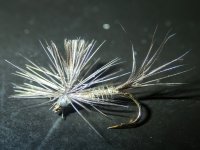
I have great confidence in this fly when fishing lakes, but it just looked so buggy that evening. The fish agreed as I caught three fish in three cast: an 8” brown, a 10” rainbow, and a 12” cutthroat. I continued to drop blind casts to likely spots and directed casts to the vicinity of any recent rise. Quite frequently, I was rewarded with a strike, including two fish that literally jumped out of the water for the fly.
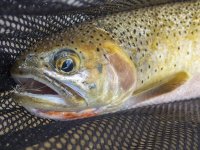
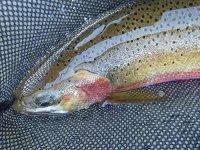
The best fish of the evening was a gorgeous 14”ish cutthroat. In response to a rise, I dropped a cast just upstream of the position. The rise was very subtle, but I could tell from the initial run that this was a nice fish. It initially ripped off line upstream and then turned and blasted downstream. My challenge was that I couldn’t easily wade into shallower, slower flows for the fight and landing; I was stuck here in the faster flow. With the fish down-current of me, I had to be careful that I didn’t put too much pressure on this fish and pull out the hook. I caught a break as the fish swam upstream on its own volition until it was positioned between me and the bank. I reached around my back to grab my net and got the fish’s head up out of the water. I missed netting the fish on the first pass, but the second was successful. This was a gorgeous fish with great markings and the characteristic orange belly of a “pool boss”. With my rod tucked under my right armpit and my net in my left hand, I managed to take a few pictures of this fish before I set it on its way.
I picked up a few other fish before the action started to die down. The decline might have been because the hatch was petering out or it could have been that I had already hooked most of the fish in this section. It was a wonderful evening.
Steve
“Petra Creek” is a popular fishery, but as one skilled Montana local remarked, it can be a very technical creek.
A01Adding to the challenge, water levels were 35% higher than the median. That would make wading across the creek to the other bank riskier than normal on a river known for a slippery river bottom. As a leftie, I always prefer to fish near right bank as my casts are mostly over the water and I’m less likely to hook flies in the riparian vegetation. That usually means that I’m crossing the river at least twice. [Why do all my favorite streams have their access roads to the left of the river???]
We fished during late-morning/early afternoon and headed out again in the evening. I’m not a nympher and without a major daytime hatch (and limited water access to boot), I didn’t have high expectations and that was about right. But “Petra Creek” often turns on in the evening with a mix of ovipositing bugs and newly emerging bugs.
During the day, I primarily relied on a size 18 EHC, a reliable searching bug, and there were a few caddis flying around. My casts into likely spots into the heart of the main pools were largely ignored or rejected after a brief inspection. What little success that I had during the day occurred when I dropped casts into small pockets that had some cover from the current, such as submerged boulders or a shrub dislodged by higher water and dropped into a side channel. Most of the strikes were from cutthroats, bless their surface-fly loving hearts, but two small browns grabbed the EHC too.
The slow fishing left ample time to be diverted by the abundant butterfly activity and the profusion of wildflowers on the banks [more later]. In spite of the calendar indicating mid-July, the hillsides were a vivid green and the wildflowers were in full bloom [more later too].
It was a different story in the evening. I had a delightful night at one of my favorite drifts. The top of the drift has the expected white water and standing waves. But as the water travels into the middle of the pool, the current drops and the depth increases – perfect holding water for fish looking for insects in the evening. This drift has a shallower, wadable spine up the center from the tailout; this spine splits the drift into deeper water left and right. River left shallows quickly and holds smaller fish at best. To the right of the spine, the water deepens until it is only a few feet of the grassy bank. Larger submerged rocks deflect water and provide holding spots for trout.
Because it is easier to wade, many folks tend to fish this section from the central spine, but this means casting perpendicularly across several complicated current seams to drop a cast to the edge of the right bank. I have enough mass (…), that I could wade upstream into the middle of the deeper section of river right. From this position, many of my casts were quartering upstream and over fewer disparate current seams. And even if I were to cast perpendicular to the flow or to the bank, my fly line/leader was across far fewer seams. This riskier wading position made a big difference as I had a great evening but a friend who fished from the spine was blanked.
I started out with the same EHC that I had used successfully during the day. I picked up several 8-10” fish from likely locations: a foam line that was created by submerged boulders and in pockets tight to the bank. There were some ovipositing caddis and crane flies flying around.
At one point, I lost the EHC; I had intended to tie on a PMD as that should have been the emerging mayflies. But when I opened my miscellaneous fly box, a size 14, gray Callibaetis biot-bodied parachute caught my eye.
I have great confidence in this fly when fishing lakes, but it just looked so buggy that evening. The fish agreed as I caught three fish in three cast: an 8” brown, a 10” rainbow, and a 12” cutthroat. I continued to drop blind casts to likely spots and directed casts to the vicinity of any recent rise. Quite frequently, I was rewarded with a strike, including two fish that literally jumped out of the water for the fly.
The best fish of the evening was a gorgeous 14”ish cutthroat. In response to a rise, I dropped a cast just upstream of the position. The rise was very subtle, but I could tell from the initial run that this was a nice fish. It initially ripped off line upstream and then turned and blasted downstream. My challenge was that I couldn’t easily wade into shallower, slower flows for the fight and landing; I was stuck here in the faster flow. With the fish down-current of me, I had to be careful that I didn’t put too much pressure on this fish and pull out the hook. I caught a break as the fish swam upstream on its own volition until it was positioned between me and the bank. I reached around my back to grab my net and got the fish’s head up out of the water. I missed netting the fish on the first pass, but the second was successful. This was a gorgeous fish with great markings and the characteristic orange belly of a “pool boss”. With my rod tucked under my right armpit and my net in my left hand, I managed to take a few pictures of this fish before I set it on its way.
I picked up a few other fish before the action started to die down. The decline might have been because the hatch was petering out or it could have been that I had already hooked most of the fish in this section. It was a wonderful evening.
Steve
Last edited: