Now The Shad Are Causing Problems

GAT

Dumbfounded
Forum Supporter
As if the native anadromous species don't have enough problems making their way upstream in the Columbia, now the non-native shad are causing problems.

 
"The Army Corps is devising ways to control shad above Lower Granite, Holdren said. However, there’s no concrete solution yet."
Apparently Courtney Flatt has a sense of humor.
 
Priest Rapids Dam is a barrier to shad migration. The upper sections of the fish ladders at Priest Rapids utilize only submerged orifice flow whereas most of the ladder utilizes overflow and a submerged orifice. Shad only ascend using the overflow portion of the ladder.

At one point in history the owners of Priest Rapids Dam were asked to look at methods of passing this non-native fish. The Utility installed submerged lights (if I remember correctly) to show shad the way. It didn't work; shad didn't utilize the lighted submereged orifices. Shad but true.
 
"The Army Corps is devising ways to control shad above Lower Granite, Holdren said. However, there’s no concrete solution yet."
Apparently Courtney Flatt has a sense of humor.
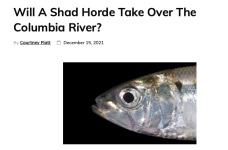
And apparently OPB really likes that one photo of shad.

1734464140448.png
1734464155519.png
1734464170405.png
 
Maybe an opportunity to stop netting so many salmon and go after these guys. Besides eating, probably could make a lot of fertilizer. We can adapt too.
 
  • Like
Reactions: JS
Maybe pickled shad?
Or a chance for the chefs in the foodie culture in Portland to develop ways to use an abundant local resource and generate interest in and a market for the fish.
 
Or a chance for the chefs in the foodie culture in Portland to develop ways to use an abundant local resource and generate interest in and a market for the fish.

If any chef's can do that, PDX chef's can. They are very good as well as creative.
 
I once went to a meeting about Lake Tahoe’s invasive crayfish. The discussion amongst the panelists was whether to create a market for crayfish harvested for food, to bring down the numbers in the lake. (They cause the lake to lose clarity via crayfish poo and their decomposition) There was a lot of concern that creating the market would lead to an increase of illegal stocking of crayfish elsewhere, as well as the creation of a constituency that will advocate on behalf of Lake Tahoe’s invasive crayfish in later years. Different than the shad scenario but maybe some similarities.
 
Priest Rapids Dam is a barrier to shad migration. The upper sections of the fish ladders at Priest Rapids utilize only submerged orifice flow whereas most of the ladder utilizes overflow and a submerged orifice. Shad only ascend using the overflow portion of the ladder.

At one point in history the owners of Priest Rapids Dam were asked to look at methods of passing this non-native fish. The Utility installed submerged lights (if I remember correctly) to show shad the way. It didn't work; shad didn't utilize the lighted submereged orifices. Shad but true.
How interesting, thanks for that info!!!
 
Priest Rapids Dam is a barrier to shad migration. The upper sections of the fish ladders at Priest Rapids utilize only submerged orifice flow whereas most of the ladder utilizes overflow and a submerged orifice. Shad only ascend using the overflow portion of the ladder.

At one point in history the owners of Priest Rapids Dam were asked to look at methods of passing this non-native fish. The Utility installed submerged lights (if I remember correctly) to show shad the way. It didn't work; shad didn't utilize the lighted submereged orifices. Shad but true.
Does anyone know why they are like that? And is it just American shad or are the other river herrings like this too?

I tried to look up studies but only found this "They are also somewhat reluctant to immediately pass under darkened areas of open channels (e.g., under low bridges or strong shadows, or where there is a strong light transition)." source

Would a channel spanning log be enough to impede migration? How are culverts designed for them? Maybe they were just only in large rivers where it wouldn't have been a problem pre-development, or maybe it'd be fine at night but not during the day.

It must be a nightmare for Eastern fish conservation orgs to try and restore passage for them if shadows can get in the way.

Also semi-unrelated but, although obviously ecologically bad, I think it would have been cool if the other river herrings had been transplanted to the West coast alongside shad. Their runs seem fun to see and I wonder if we would similarly outshine the East coast in numbers as we have with shad.
 
Back
Top