

Here's an article on how dam removal is increasing in the USA after passage of the bipartisan $1T infrastructure bill in 2021. The article itself talks about the Shulls Mill Dam on the Watauga River in NC. This dam removal was more for the protection of the awesomely named (but extremely weird looking) "Hellbender" salamander than fish. But with a name like that, I'm on board.

 apnews.com
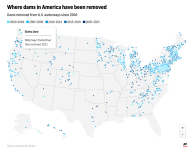
There's a neat interactive map on the article showing all dams removed in the USA over the past 25 years. You can hover over each dot to see the name and date of removal. Here's a non-interactive screenshot.
Any time an outdated or badly designed dam comes down, I view it as a victory. No, I'm not against all dams, at least not until we sort out clean energy to replace hydro power and the other things that dams do give us. But I tend to believe in the ideas that UW professor David Montgomery talks about in the DamNation video that Felt Soul Media did a few years back:
I rewatch this last section of DamNation from time to time because it gives me hope that we'll see more rivers run free in our lifetimes.
Federal infrastructure funding is fueling a push to remove dams and restore river habitat
An infusion of hundreds of millions of dollars from the federal infrastructure law is helping expedite efforts to remove dams around the country.
apnews.com
There's a neat interactive map on the article showing all dams removed in the USA over the past 25 years. You can hover over each dot to see the name and date of removal. Here's a non-interactive screenshot.
Any time an outdated or badly designed dam comes down, I view it as a victory. No, I'm not against all dams, at least not until we sort out clean energy to replace hydro power and the other things that dams do give us. But I tend to believe in the ideas that UW professor David Montgomery talks about in the DamNation video that Felt Soul Media did a few years back:
"Like all constructed things, dams have a finite lifetime. And it's not time to pull out every dam in the country, that would be economically foolish. But it would be just as foolish not to rethink every dam in the country and try and decide which are the ones that actually make sense in the 21st century. And which are those that we can get more value out of, both economically and culturally, aesthetically, morally, and ecologically, out of a river system, by sending it partway back to the state it was in naturally."
I rewatch this last section of DamNation from time to time because it gives me hope that we'll see more rivers run free in our lifetimes.


