NFR Lamprey Rescue thread starter

Non-fishing related
Like some of the posters above, growing up in Minnesota lampreys were something to be loathed in the Lake Superior tribs; these were the invasive sea lamprey. MN actually has five different native lampreys, but my bias has been deeply embedded.

A question: Do the adult Pacific lampreys pose a threat to our anadromous populations? If not, what are they eating in fresh water?
 
Like some of the posters above, growing up in Minnesota lampreys were something to be loathed in the Lake Superior tribs; these were the invasive sea lamprey. MN actually has five different native lampreys, but my bias has been deeply embedded.

A question: Do the adult Pacific lampreys pose a threat to our anadromous populations? If not, what are they eating in fresh water?
The juvenile phase of Pacific lamprey is spent in the sediment of the river bottom. When they mature enough to migrate to the ocean they begin to attach themselves to fishes. I’ve heard from the operators of the smolt barges on the Snake River that they know when the lamprey are migrating because the juvenile salmon and steelhead in the barge get “nervous” and jump out of the water to escape. After a year or two feeding in the ocean they return to fresh water and quit feeding. Because they have a cartilage skeleton, they shrink while migrating back to spawn. A lamprey measured at Bonneville Dam might lose 25% of its length by the time it overwinters and eventually arrives at Priest Rapids Dam.
 
The juvenile phase of Pacific lamprey is spent in the sediment of the river bottom. When they mature enough to migrate to the ocean they begin to attach themselves to fishes. I’ve heard from the operators of the smolt barges on the Snake River that they know when the lamprey are migrating because the juvenile salmon and steelhead in the barge get “nervous” and jump out of the water to escape. After a year or two feeding in the ocean they return to fresh water and quit feeding. Because they have a cartilage skeleton, they shrink while migrating back to spawn. A lamprey measured at Bonneville Dam might lose 25% of its length by the time it overwinters and eventually arrives at Priest Rapids Dam.
Great info @troutpocket ! Do you suppose the 2 p. lamprey I found were possibly kelts? I have seen larger ones in the Fall..hmm. These were seemingly 4-6 inches shorter than the ones I recall seeing in the rivers. This time of year is not the best time to be pushing up through the heavy flood season waters, but a fast trip out to the ocean!
 
Last edited:
Great info @troutpocket ! Do you suppose the 2 p. lamprey I found were possibly kelts? I have seen larger ones in the Fall..hmm. These were seemingly 4-6 inches shorter than the ones I recall seeing in the rivers. This time of year is not the best time to be pushing up through the heavy flood season waters, but a fast trip out to the ocean!
I don’t know. One scenario is they are overwintering and will continue their spawning migrations come spring. I’m not aware that adults kelt after spawning …but lamprey are super interesting!

An adult Pacific lamprey was caught in the North Pacific Ocean off the coast of Russia by a commercial fishing crew. They implanted a PIT tag and released it along with 100 or so others during a cod fishing season maybe 10 years ago. Two years later one of the tagged lamprey was detected passing Bonneville Dam and eventually in the lower Deschutes. Pretty wild.
 
For sure they do not seem designed to cover a ton of distance, it is incredible how mobile they are to cover those ocean runs. I know when I grabbed the two I found in field they were shockingly solid, dense heavy muscle. I expected a spongier, softer fish.
 
Their heads are mostly olfactory organs. A ton of work has been done over the last 10 years to improve the salmon-centric fish ladders in the big dams for lamprey passage. Metal ramps and plating have been added so that lamprey can “latch” on and rest between swimming bursts. The lamprey avoid the new metal surfaces but use them like crazy after a couple years soaking in the river getting coated in algae and sediment. They avoid human scent in the water as well.
 
In the PNW we have 3 native lamprey species; the pacific, the river and western brook. The Pacific lamprey is one that we most often see (I have only seen one river lamprey). They typically spend several years (up to 6 years) in the ammocete or larvae stage before morphing into the parasitic adult stage. Most of our Pacific lampreys are anadromous though we sometimes see smaller landlock forms (including places like Lake Washington). We see the "smolt" stage (usually 5 or 6 inches long migrating downstream in our rivers at spring of the year like most of the salmonids. Once at sea they typically spend 1.5 to 3 years in the marine waters before returning to spawn. Here on the north Sound systems we see them spawning in May or early June. It is now thought that some of those spawners survive. During the mid-1980s those spawning lamprey were pretty common often spawning in the same sort of habitats that we see steelhead. They are mass sapwners (have seen up to a couple dozen on a single "redd". While their redd look similar to a steelhead because of differences in how that redd is constructed there are subtle differences.. They construct the redd by getting a hold of the stone with their sucker like mouth and packing the stone downstream away from the redd site. Because of the size of the lamprey there is a limit to the size of rocks they can move (usually around fist size) thus the subtle redd differences. The spawn over the redd broadcasting their eggs in small batchers (a few hundred at a time) covering the small eggs (1 mm) with small pebbles and sand. An individual female can have 10,000s of eggs to as 1/4 millions.

The other common PNW lamprey is the brook which in non-parasitic. with only a freshwater life history. The ammocetes transform to that non-feeding stage to only spawn.

Just a couple of our interesting native fishes.

BTW in light to another ongoing thread those Pacific lamprey "smolts" are bull trout candy and I typically have couple lamprey smolt flies in my bull trout box.

curt
What color are they?
 
When I first moved to this side of the cascades, the coastal rivers I fished were full of lamprey and honestly freaked me out. I never saw such a critter when fishing the rivers of NE Oregon ... I thought they must be some manner of invading species.

Jump forward 50 years and one of my friends is a fish biologist and doing a study of lamprey. As per his studies, I found that the lamprey are an indicator species and as their population dwindles, the reason also effects the other anadromous lifeforms so their populations also decline.

These days, I hardly ever see a lamprey in the rivers that were once invaded by them in mass. Once I found out that they are supposed to be in the rivers and when they are gone, so are the salmon, steelhead and SRC.

For something that once freaked me out when I saw them while fishing, now it freaks me out that I don't see them.
 
WW -
A gun metal color with a long (5 or 6 inches) thin body.

GAt -
With the lamprey's extended freshwater period of rearing there dependent on that habitat more than most anadromous fish and yet also spend several years in the salt so yes a great indicator species

curt
 
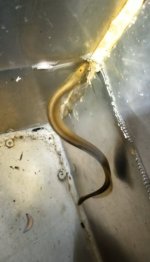
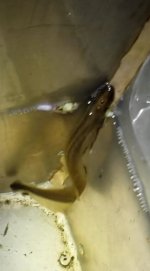
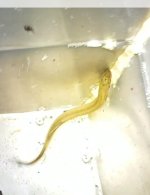
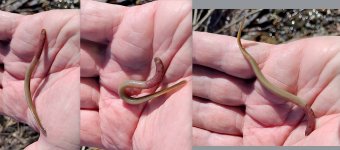
I don't know the species, and it was moving too fast to get a good look at its ugly mug...but I'm assuming lamprey of some kind. These are stills from a video I shot of this guy in a kokanee fry trap on a Lk Samm trib one night a couple years ago.
About 6" long
Screenshot_20220208-134740_Video Editor.jpgScreenshot_20220208-134621_Gallery.jpgScreenshot_20220208-134420_Gallery.jpg
 
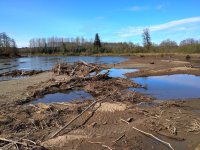
Back to rescuing lampreys... tide pool drying up and these ammocoetes were going to be cooking (about 15 of them). I assume Pacific lamprey. Need to look up western brook as well.

riverpools.jpeg

ammocoetechehlsrvrapr5th2025.jpg


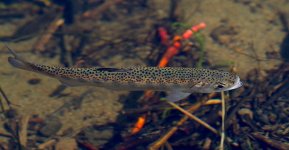
Hatchery steelhead smolt (7 inches) was stuck in a tide pool but seemed safe until high tide
stelllle.jpeg

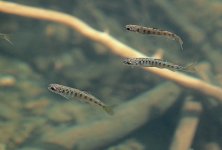
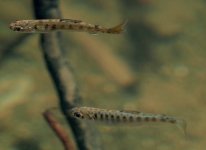
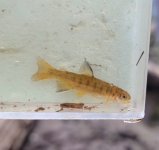
Chinook fingerlings below?
fingerlings.jpeg


fingelringsssss.jpeg
 
Last edited:
There’s something here for the lumpers and the splitters:

“Third, to further disrupt the species taxonomy, they demonstrated that western brook lamprey (Lampetra richardsoni) and western river lamprey (Lampetra ayresii) cannot be distinguished based on genetic information - meaning they are the same species. This is interesting since they have two different life forms: western river lamprey are migratory and parasitic as adults, whereas western brook lamprey are resident (non-migratory) and remain non-parasitic as adults.”

 
Thanks for reviving this thread. Learned a lot. Hard to get past the looks of them, but opened my eyes. Always have to respect all of nature's critters.
 
Chinook fingerlings below?

View attachment 148346
Coho (upper), chinook (lower).
Large falcate (sickle-shaped) anal fin with white leading edge is a coho trait, as is the Parr mark spacing/separation - on a coho, you can typically "fit" a Parr mark in the interstices between them with no overlap, but not on chinook.
Also, chinook typically have a clear "windowpane" adipose fin with a dark rim. Coho have opaque adipose fins.

Typical age-0 coho, with its almost comically oversize fins
20250406_083810.jpg
 
Coho (upper), chinook (lower).
Large falcate (sickle-shaped) anal fin with white leading edge is a coho trait, as is the Parr mark spacing/separation - on a coho, you can typically "fit" a Parr mark in the interstices between them with no overlap, but not on chinook.
Also, chinook typically have a clear "windowpane" adipose fin with a dark rim. Coho have opaque adipose fins.

Typical age-0 coho, with its almost comically oversize fins
View attachment 148373
Excellent information. Thank you !
 
Back
Top