Invasive Species Concerns

Dave G

Steelhead
Forum Supporter
My sweetie just bought really slick new Patagonia waders (I'm somewhat jealous), and included with the packaging was a card warning about the dangers of transferring invasive species from one fishery to another.

We have never done the whole bleach bath thing (for wading boots) nor do we typically wash our waders before fishing different waters.

Is this irresponsible? Should we be concerned? (We live in Hood River.)
 
It’s mainly a concern for jet-setting anglers and, being honest here, some of the biggest vectors of all, biologists who work in different watersheds or different parts of watersheds and move between them frequently. Living in Hood River, I think your main concerns would be noxious weed seeds.
Don’t stay in the water at Lake Powell for 72 hours straight so quagga mussels can cling to the waders and then go fish the Columbia. That’d be bad. Otherwise I think WW’s advice is solid and reasonable for most anglers.
 
But then there is rock snot that can be more readily transferred on boots, waders
Best available info says didymo aka “rock snot” is native to the PNW and other cool waters of North America (it’s already present and has been a long time) and appears unlikely to become a problem here.
 
Best available info says didymo aka “rock snot” is native to the PNW and other cool waters of North America (it’s already present and has been a long time) and appears unlikely to become a problem here.
Which means you could possibly take it out of state to other waters.
Or is it present in every cool water stream nationwide
 
Which means you could possibly take it out of state to other waters.
Or is it present in every cool water stream nationwide
Well, like I replied to the OP who lives in Hood River:
"It’s mainly a concern for jet-setting anglers and, being honest here, some of the biggest vectors of all, biologists who work in different watersheds or different parts of watersheds and move between them frequently. Living in Hood River, I think your main concerns would be noxious weed seeds."
Everyone needs to figure out their own risks and possible hazards and adjust accordingly. There is no one single universal correct and practical response. It is important to be aware and adjust behaviors accordingly. Some people get extremely active and some are extremely lazy/negligent.

I recommend you read up on didymo if you have the time. It's pretty interesting and not as cut-and-dried of an "invasive species" story as you might assume based on early reporting, especially from NZ.
 
The easiest way to eliminate the issue of invasive species transfer is to put your boots in the freezer for 48 hours.
While that is easy, it is not effective at eliminating a whole suite of species that, depending on where you live, you might need to be concerned about. It's complicated. I think people ought to be concerned and they also ought to do their research. In my opinion it's good practice to ask yourself:

1) Where are you fishing? What invasive species are present, or may be present?
2) What are the characteristics of those invasive species? What's the risk level of being a vector?
3) Are you moving between watersheds or different parts of a watershed? If so, see (1) and (2) above.
4) Given (1) - (3), what do you need to do to alter behavior or effectively reduce or to the extent practicable, eliminate risk of being a vector spreading invasive species.
 
Drying your stuff (waders, especially boots, boats, etc) is the first, best step. If there’s no time, remove all dirt/debris and sanitize with a dilute bleach or ammonia solution (one or the other, not both, 2.5 oz/gallon of water) and you’ll be okay. In both cases wash off any debris or dirt. Little snail or other organisms are picked up easily but its really not much work to deal with it.
 
For didymo, Formula 409 spray is supposed to work.
I keep a bottle of it in my truck and spray waders and boots when I take them off. It soaks in on my ride home where I rinse them off with the garden hose before hanging up.
So far no noticeable problems with the fabric or glues on waders and boots. Been doing this for three seasons.
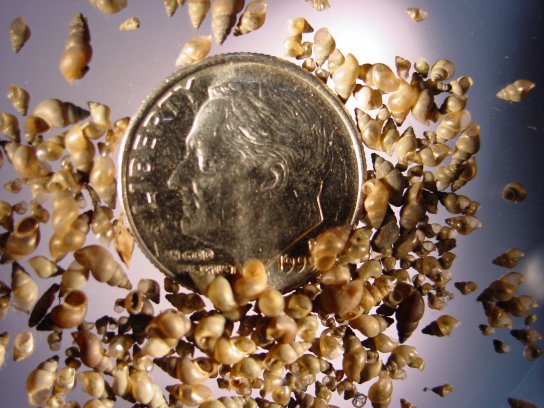
Not sure if it works for things like mud snails.
 
Clean off mud and debris first and then soak boots etc. in 409 degreaser for 30 minutes or so to kill NZ mud snails. Soaking in a 2% (w/v) Virkon Aquatic disinfectant solution works very well too. Virkon comes as a powder and is much easier to store than the 409. Equipment should be thoroughly rinsed away from streams, lakes etc. before use.

We also had a designated chest freezer at work for overnight freezing of waders, boots and equipment because we did work from time to time in watersheds known to be infested by NZ mud snails.
 
Just a guess, but I would think an Isopropyl alcohol based solution would work reasonably well, then evaporate without damaging boots/waders, or leaving toxic residue like bleach would.
 
Just a guess, but I would think an Isopropyl alcohol based solution would work reasonably well, then evaporate without damaging boots/waders, or leaving toxic residue like bleach would.
Isopropanol might get rid of some of the other invasive critters, but not the NZ mud snails. They are remarkably resistant to a lot of stuff. When they close up their shells, they can withstand a lot of chemicals and weeks of dessication. This is an older paper but I doubt if the findings have changed much.
 
Isopropanol might get rid of some of the other invasive critters, but not the NZ mud snails. They are remarkably resistant to a lot of stuff. When they close up their shells, they can withstand a lot of chemicals and weeks of dessication. This is an older paper but I doubt if the findings have changed much.
Have they been seen anywhere around here?
 
I’ll say something unpopular… bass… when I take the kids to Whatcom Falls and they catch a spiny fin, they die a painful death on the bank. Used to be great cuttie fishing when I was a kid.
 
Back
Top