

Navigation
Install the app
How to install the app on iOS
Follow along with the video below to see how to install our site as a web app on your home screen.
Note: This feature may not be available in some browsers.
More options
Style variation
You are using an out of date browser. It may not display this or other websites correctly.
You should upgrade or use an alternative browser.
You should upgrade or use an alternative browser.
Non-Fly Interesting PS catch
- Thread starter troutpocket
- Start date




Uptonogood
PNW raised
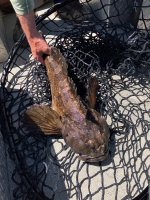
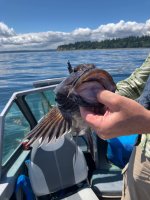
The one I caught had green flesh that fried up white and was absolutely delicious!


I, Cabezon (and a sculpin / cottid scientist since 1977), know that that fish is a cabezon. The diet dominated by crabs is very typical, especially Telmessus cheiragonus (helmet crab). Like some ling cods and other greenlings, a subset of cabezon (and a few other sculpins) have bluish-green meat. The blue/green color is due to biliverdin pigment, an intermediary product in the breakdown of the heme component of hemoglobin. In some human bruises, there may be a temporary phase where the bruise turns green (as part of the breakdown of blood in the bruise) and then yellowish (=bilirubin). There has been little detailed scientific research on why some of these fish have this color, just some correlations. Hypotheses include diet, sex, age, as a sunscreen against ultraviolet radiation, etc. (see here).
Steve
Steve

Despite being one of the least fun fish to cut, I agree. Interesting texture and a very crab/shellfish-like flavor.They are good eating...

Yeah just fillet it out. I say "just" but it's not nearly as easy as a lingcod. Their skin is really tough and rubbery. Very hard to cut through. Then there's the massive ribcage with very thick bones you have to cut around, which takes way longer than you'd expect.The internet says Cabezon organs are toxic. I don’t eat a lot of fish organs myself so I suppose that’s not a problem if you’re just eating filets? Do you filet a Cabezon? Not @Cabezon , just a generic theoretical Cabezon to consume.
I had never heard that the organs of cabezon are toxic. The eggs are poisonous (see case here) and ingestion triggers acute gastrointestinal toxicity (chills, non-bloody diarrhea, vomiting, nausea, abdominal pain and cramping). The suspected toxic compound is an unusual phospholipid, dinogunellin. This toxin is found in a few other fish.The internet says Cabezon organs are toxic. I don’t eat a lot of fish organs myself so I suppose that’s not a problem if you’re just eating filets? Do you filet a Cabezon? Not @Cabezon , just a generic theoretical Cabezon to consume.
Steve

Phil Fravel
Steelhead
Definitely a cabezon. Very tasty

We skinned the tails of smaller ones and used them for bait for summer steelhead and SRC.
Uptonogood
PNW raised
Steve, you are an incredible resource on this forum. Thanks!I, Cabezon (and a sculpin / cottid scientist since 1977), know that that fish is a cabezon. The diet dominated by crabs is very typical, especially Telmessus cheiragonus (helmet crab). Like some ling cods and other greenlings, a subset of cabezon (and a few other sculpins) have bluish-green meat. The blue/green color is due to biliverdin pigment, an intermediary product in the breakdown of the heme component of hemoglobin. In some human bruises, there may be a temporary phase where the bruise turns green (as part of the breakdown of blood in the bruise) and then yellowish (=bilirubin). There has been little detailed scientific research on why some of these fish have this color, just some correlations. Hypotheses include diet, sex, age, as a sunscreen against ultraviolet radiation, etc. (see here).
Steve

Another interesting “catch” from yesterday in 10. Struck out fly fishing and jigging so ended up trolling flies around on divers. @Kfish rod goes off on a decent sized salmon which runs into the other rod’s line/diver. We stop the boat, let the second rods diver sink to the bottom so we can land the salmon. We do that, untangle the line and I start reeling in the second rod. Damn, snagged on the bottom. Oh, wait, it’s moving. That’s a fish and a large one.
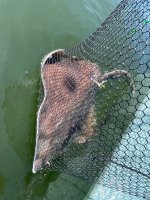
A few minutes later this comes net.
Pacific Big Skate @Cabezon?
Anyway. I’m
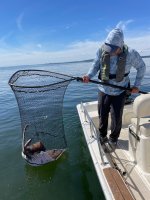
In the end he was not hooked in the mouth. We did not realize the second rod got hit by a shaker which was dragged to the bottom by the diver. Based on how it was hooked (and the pinned shaker to the skate) we assumed it tried to eat the struggling shaker stuck on the bottom when it was hooked as I reeled in. It was a big skate. Lou in the net for scale.
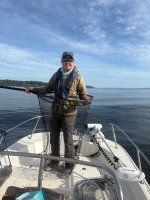
BTW if anyone lost this giant net in PS, let me know. We found it floating and picked it up.
A few minutes later this comes net.
Pacific Big Skate @Cabezon?
Anyway. I’m
In the end he was not hooked in the mouth. We did not realize the second rod got hit by a shaker which was dragged to the bottom by the diver. Based on how it was hooked (and the pinned shaker to the skate) we assumed it tried to eat the struggling shaker stuck on the bottom when it was hooked as I reeled in. It was a big skate. Lou in the net for scale.
BTW if anyone lost this giant net in PS, let me know. We found it floating and picked it up.
Last edited:


