How do you rig 2 flies?

How do you rig a chironomid and a leech?

  • 1. Leech as the upper fly and midge on the bottom.

    Votes: 9 31.0%
  • 2. Midge as the upper fly and leech on the bottom.

    Votes: 13 44.8%
  • 3. Do both and don't think it makes much a difference.

    Votes: 7 24.1%

  • Total voters
    29
understanding every lake is different in how it fishes best, observations from a fave lake channel (6'-10') that features outstanding visibility most of the time and has plenty of large fish on tap (consider 18" and up large).
-the fish nuzzling the bottom are either oblivious or in full ignore mode of presentations only a foot or two over their head. Dropping the presentations to literally hug the bottom only occasionally induces a take.
-the biters are on the move, actively doing laps around their sector, 'mowing the lawn' in their search for food.
-the biters usually use two lanes, one several feet off the the bottom and the other a couple feet below the surface.
-the lower biters are most susceptible to leech patterns and chironomids.
-the upper biters are more susceptible to at least checking out a large attractor such as a Hippie Stomper or Chubby with a small midge (fave an #18 Dark Assassin). If they didn't go for the surface fly they would often swim off a bit, U-turn and come back and make a pass at the lower fly.
 
I’ve always kind of dogmatically fished my flies 2-3’ apart from each other. I might try rigging up a 4-6’ gap, I like that thinking.
 
About 60-40 in favor of the leech.
Ok, so not 50/50, but not far from it.

So the next question, as with any still-water fishing, is how close to the bottom?

Other variables-
1) Leech was deeper than his other fly so maybe more in the zone.
2) Leech might have been slightly more effective because there was no mid hatch.
3) The fish weren't picky on pattern that day....which takes us back to presentation and that means depth.

You mentioned "several differences in our rigging". Did this include a difference in depth being fished? What about presentation? Is he twitching or moving the bobber more than you?

There can be a lot more going on than leech on the top vs the bottom. Another good thread Steve. Don't leave this time! :)
 
Last edited:
This separation topic is interesting. I've observed when fishing my three fly loch style setup, 3-4' between flies is far more productive than 2'. Also when fishing my three leech rig (or willy, simi-leech, bugger) on an S6, more separation is more productive.
 
I’ve always tied a chromie or chironomid above a micro leech…..or two chironomids. The top fly is 6x and 7x to the bottom fly. I usually have at least 14”-18” between so the lighter tippet has stretch. 90% are caught on the bottom fly…..interesting post about having 6” or so between the flies, but that short of a tippet to the bottom fly would seem to be a break off problem even using 6x on both…..might be worthwhile experimenting…..I’ve also wondered about switching the flies top to bottom when the bites hot….but never have yet because if it ain’t broken……..
 
After reading a book written by a noted tournament lake flyfisher, if fishing in an average of 8' to 12' of water I rig my top fly 6' above my bottom fly, and find it produces more takes than when I spread the flies only a couple of feet apart.
I likely read the same book. Not much mention of indicatoring in the book. His distance was more geared toward washing lines if I remember correctly. For indicators, I’ve played with larger gaps with very little success. I mostly stay around 3’.
 
I likely read the same book. Not much mention of indicatoring in the book. His distance was more geared toward washing lines if I remember correctly. For indicators, I’ve played with larger gaps with very little success. I mostly stay around 3’.
 

Attachments

  • IMG_20250422_141224222.jpg
    IMG_20250422_141224222.jpg
    631.5 KB · Views: 16
  • IMG_20250422_141315419.jpg
    IMG_20250422_141315419.jpg
    424.9 KB · Views: 16
Same book, but that’s about it for talking about indicator efforts, and nothing about distance between bugs. But that’s ok with me, the book is overly informational in other areas to make up for it. He is also focused on competitive techniques, and indicators are not allowed in international competitions.

As for the 6’ gap, again, he talks about casting and stripping or wind drifting. That creates more of a horizontal situation that then in reality only separates out the depth of the flies by a couple of feet. Vertical presentations under indicators don’t require the same gap because the depth difference is accomplish differently.
 
Here's my usual plan if fishing a lake with no recent trips or intel-
Start with a #10 or 12 bruised leech (balanced or jigged) as my top fly. Bloodworm or mid 16" below that. My reasoning is the leech is easier to see when the fish look up. So even if my mid is only 6-12" off the bottom and possibly "in the zone" the fish can easily see the leech above.
Put that bottom fly a 6" to a foot off the bottom and work my way up a foot at a time over the next 10-15 casts.

If I catch a few fish in a row all on the bottom bloodworm or mid then I'll usually take the leech off and go with 2 mids.
If the bloodworm was working then I'll put a mid pattern above that. And go right back to that depth.

If nothing steady, but some fish, all on the leech, then I'll reverse the top with bottom and keep the leech at the same depth and now there's a mid 16" above the leech. If that gets hot then I'll cut off the leech and put on another mid or bloodworm as the bottom/point fly. Again, keeping the depth of whatever was hot. That's the most important thing.

Is there a nice chop? If no, then definitely giving plenty of tug-tug-tug, then sit, tug-tug-tug, then sit. All the way until I'm only a few feet off the boat.

If nothing steady after a reasonable amount of fly changes then the type 3 comes out and we're kickin & strippin. And I'll pay attention to the depth of the strikes.
 
Same book, but that’s about it for talking about indicator efforts, and nothing about distance between bugs. But that’s ok with me, the book is overly informational in other areas to make up for it. He is also focused on competitive techniques, and indicators are not allowed in international competitions.

As for the 6’ gap, again, he talks about casting and stripping or wind drifting. That creates more of a horizontal situation that then in reality only separates out the depth of the flies by a couple of feet. Vertical presentations under indicators don’t require the same gap because the depth difference is accomplish differently.
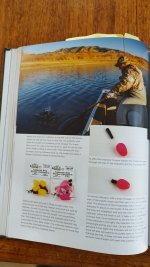
book has 5 pages on indy fishing...his typical indy rig uses three flies spread 2' to 3' apart. Personally find three fly rigs a PITA that tend to end up in a tangle after a C&R of a decent fish, so prefer using 2 . As it is, the book is just more info to add to that which we've gained through observation and experience.
 
book has 5 pages on indy fishing...his typical indy rig uses three flies spread 2' to 3' apart. Personally find three fly rigs a PITA that tend to end up in a tangle after a C&R of a decent fish, so prefer using 2 . As it is, the book is just more info to add to that which we've gained through observation and experience.
Figuring out how to net doubles and triples when the flies are 6-8 feet apart is the PITA. Worth it for the grin factor though.
 
book has 5 pages on indy fishing...his typical indy rig uses three flies spread 2' to 3' apart. Personally find three fly rigs a PITA that tend to end up in a tangle after a C&R of a decent fish, so prefer using 2 . As it is, the book is just more info to add to that which we've gained through observation and experience.
To be fair, I have not finished the whole book, so there is that. I did flip through quickly before I bought it to see what indicator information there was and remember not seeing much.

But if he is saying 2’ to 3’, my point is made.

I completely agree with the three fly rig under indicators being a PITA!
 
To be fair, I have not finished the whole book, so there is that. I did flip through quickly before I bought it to see what indicator information there was and remember not seeing much.

But if he is saying 2’ to 3’, my point is made.

I completely agree with the three fly rig under indicators being a PITA!
good conversation...his 3 fly spread of 2' to 3' = a 6' to 9' offering, my two fly spread at 6' is in there. With that said, if I find fish are consistently taking the upper fly I will reduce that 6' spread to 2' or 3'...all these 'formula's are just starting points, the fish will let us know what actually is working that session.
Regarding wash lines which I've yet to use...saw a guy using one last year generate non-stop action while the rest of us anchored in the same area were just muttering to ourselves...
 
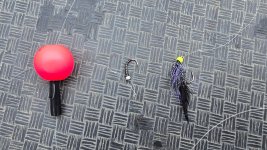
This is my standard leech up top rigging. Non-slip loop to the top pattern, improved clinch in the eye and whatever seems right on the bottom pattern. 3x fluoro most of the time. View attachment 149924
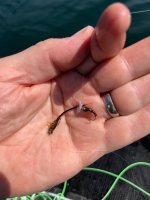
So today I had an ASB red wire rib chironomid rigged up top like this (Indi down to loop knot, then an orvis knot to the bottom fly on a loop) and my bastardized version of your jigged stillwater nymph underneath that. The flies were disturbingly close together—16 inches. It worked good…real good. Both flies caught fish. Most of the fish took the wiggly bottom fly. My best tactic was fishing at 10 feet in 13-16 feet of water which might have something to do with them coming up for the bottom fly. IMG_3874.jpegIMG_3871.jpeg
 
Back
Top