Industry standards are established to ensure interoperability between different manufacturer’s products when it is required for consistent and safe application of those products. When the AFFTA (American Fish Tackle Association) adopted the Fly Reel Seat standard it did it for good reason. Prior to the standard there was no guarantee that the reel you bought for your fly rod would actually fit as both rod and reel manufacturers could build a product with any size reel seat they wanted. Another example of both interoperability and safety is the simple electrical plug. No matter who manufactures the plug or receptacle it must need both configuration and dimensional standards. It they didn’t, they wouldn’t work together very well, and even if they did connect, they might be made in a way that was unsafe for the consumer. In the case of a fish hook, it is an independent product that does not require precise interoperability with any other product to function well or safely. Before we had hook eyes, tippets were successfully tied to the shank of the hook. Hook eyes improved ease of use, but no specific hook eye size or configuration was required for the hook to function.
As far as “respect for customers” as a rationale for an industry standard, I think it might be pretty difficult to dictate what the standard might be. I’ll challenge you to suggest a hook sizing standard that would satisfy the majority of consumers.
Thanks very much for this additional info, Mike. I appreciate you giving examples of standards, especially with electrical connectors. My old brain often needs to have examples.
I've been fishing for over 65 years. Until the last 15 or so years, all the hooks I bought had pretty well matching sizes among brands; at least I never noticed any variation. Mind you, back then, there were only a few hook companies here in Canada (maybe the same in the U.S.?); Mustad, Wright & McGill, and those cheaper hooks sold at gas stations or department stores, tagged with the store brand, or no name tag at all. Then Tiemco hooks became available, which also had compatible sizing to our North American hooks.
In the last 15 years or so, we've had so many new hook brands on our market, coming from Europe and Asia mainly, I guess. That's when I started seeing some hook sizes that differed widely from our usual brands.
Up until then, I never needed to use my hook gauge to check sizes. I have a hook/hackle gauge like Dave shows in his first post, and also one marked "Cliff Outdoors The Top Shelf." Both of their hook sizes are identical. Considering that, and the fact that hook sizes between makers that I used back in the day had matching sizes, I wonder if there actually is a hook sizing standard, somewhere?
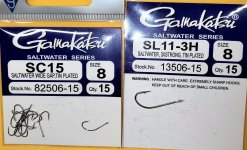
The hooks that I've had bad size matching with, are a couple of the newer ones on the market. For example, I have some Gamakatzu L11S-3H #10. On my hook gauges, and also comparing to my older hooks, they are a #6. Luckily, I bought them in person, when we had a fly shop in town, so I could see they were about #6, which is the size I wanted. More recently, I bought some Gammy SL45 Bone Fish #10, and they match all my #10 references.
My biggest concern is with Hanak H450BL Jig Supreme hooks. They are a good two sizes larger than marked. Their #14's are actually #10's, their #12's are a #8, and their #10's are a large #6. I had a nasty surprise using tungsten bead nymphs tied on their #10's. Riding point up, this style of fly often penetrates up into the roof of a fish's mouth, or the upper lip. Some smaller trout got the hook point up into their eye from inside their mouth, and bled quite badly. I felt very bad, and won't be using those hooks again.
This is an example of why, in my previous post, I had mentioned that standard hook sizing can be a matter of respect for customers. Lots of folks don’t have a fly shop nearby, where they can see products. Those Hanaks were very expensive, and I had to order them in by mail, sight unseen. If Hanak had matched the sizing of the vast majority of the hooks on the market, or maybe listed the measurement between shank and point, I would have been able to purchase them with some confidence.



 when it's in the 1/0 and above.. maybe ok.