Hook sizing is confusing, and more importantly can be frustrating if one does not understand the basis of it. Hook sizing is not based on any dimensional standard within the industry as there is no compelling market reason for a dimensional standard. Hook sizing is based on a long standing convention (at least a century) of proportional comparison between hook sizes of the same style/model of hook from a single manufacturer. Usually starting with a base size hook whose dimensions, shape and material are all of the manufacturers choosing, hooks smaller or larger are sized PROPORTIONALLY to the base model. Thus a #14 hook is proportionally smaller and a #10 hook is proportionally larger than that models #12 hook. The actual dimensions of that model line of hooks is entirely at the discretion of the manufacturer. There is a sound commercial reason there is no standard for a #14 hook (or any other size for that matter) as there is no compelling reason for one. Standards are established primarily for interoperability and safety reasons. Neither of those reasons have any relevance to hook sizes. The only relevant standards in the fly fishing industry are fly line weights (very loosely applied) and reel seat dimensions (interoperability).
So fuss all you will about hook sizing, but in the last decade there has been tremendous innovation by many hook manufacturers, especially in the realm of barbless hooks. That never would have occurred if there had been some draconian hook sizing standard that said all #14 hooks had to have the same dimensions. Use whatever hooks in whatever size you need, but don’t complain that another manufacturer‘s comparable hook isn’t identical. If one really believes there should be a hook size standard I challenge them to make the interoperability or safety case for that standard and who should set that standard? — Mustad, Daiichi, Firehole, Core, Tiemco, Gamakatsu, Hanak, Ahrex, Fulling Mill, Partridge. Nothing ruins innovation more than unnecessary standards.


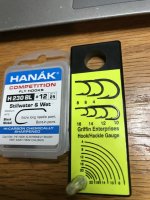
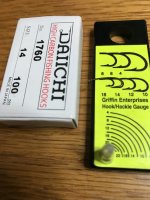
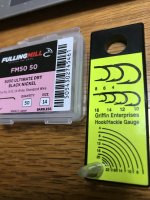
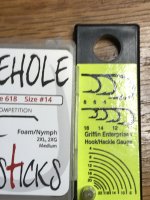
 The 618 sz 14 was a ten but onto Fulling Mill who I also like the 14 was a 12 and the Hanak 12 is a 10 WTF??? Finally the tried and trusted Diachi 1760 was an honest 14.