
LolYou work out for two hours every day?
I have a physical job...outside and moving all day everyday...but probably only 3-4 hours a day on the weekends.
I get plenty of exercise...treadmill every morning starts my day.


Follow along with the video below to see how to install our site as a web app on your home screen.
Note: This feature may not be available in some browsers.
LolYou work out for two hours every day?

I take 5 different pills from my health checkups. 2 blood pressure pills, One for Cholesterol, one for gout, and one for hand cramps. Plus vitamins. I have excellent blood pressure My numbers in Cholesterol are in the ball park. I feel fine for an old man.If you weren't so darn heart healthy you would already know.
Salt and sex, I'm totally going on this dietYes, I lowered mine, I don't remember the #'s to many years ago.
Eat OG thick rolled oak meal for breakfast, with raw honey, or OG maple syrup.
Himalayan sea salt on all food you would put salt on, also a teaspoon in a 8 oz glass of filtered water on an empty stomach first thing in the AM.
Don't smoke cigs anymore if ya do/did. Cut back, way back on booze/beer or just stop altogether.
More sex helps also

tasty food doesn't have to go. If you want to lose calories, eat 300-400 fewer calories than you burn. This deficit will force your body to burn your fat. If you want to lower cholesterol, you only need to change the way you eat. There are so many good options, check out this cookbook by Greg Doucet. He was a professional bodybuilder and powerlifter and he knows his stuff. I hope this helps as this book has a ton of amazing recipes that are good for you. I myself have been involved in fitness since 15, it is a fun and highly beneficial trait to implicate into your life.200 in 3 months??? Wow. Ok looks like my youth is over.. Goodbye tasty food
I've had high cholesterol and taken statins for 30 years ... so has my older brother and my younger brother never bothered to be tested. So for all I know, and suspect, the cholesterol thing is hereditary ... It's just the way we are.
At first, I freaked and went through the change in diet and after about a year of eating what I didn't really like and not eating what I really do, I decided why? Why try to live a longer life when you don't enjoy it? So I said heck with it and did not become a vegetarian ... but I've always exercised and while I'd like to lose some weight, I'm not really all that much overweight. My doc has never said anything about my weight.
My numbers go up and down. I did change to a different statin and the numbers dropped like a rock ... so if lower numbers what my doc was after, that he got.
But again, if you're not living a life you enjoy, why take steps to make it last longer? Besides, as one doctor once said, if you want to live a long, happy, healthy life, chose your parents well...
+1Luckily I hate most people and no longer give a shit what anyone thinks of my life or lifestyle...


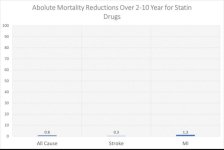

Evaluating the Association Between Low-Density Lipoprotein Cholesterol Reduction and Relative and Absolute Effects of Statin Treatment A Systematic Review and Meta-analysis - JAMA March 14, 2022
Question What is the association between statin-induced reductions in low-density lipoprotein cholesterol (LDL-C) levels and the absolute and relative reductions in individual clinical outcomes, such as all-cause mortality, myocardial infarction, or stroke?
Findings In this meta-analysis of 21 randomized clinical trials in primary and secondary prevention that examined the efficacy of statins in reducing total mortality and cardiovascular outcomes, there was significant heterogeneity but also reductions in the absolute risk of 0.8% for all-cause mortality, 1.3% for myocardial infarction, and 0.4% for stroke in those randomized to treatment with statins compared with control, with relative risk reductions of 9%, 29%, and 14%, respectively. A meta-regression was inconclusive regarding the association between the magnitude of statin-induced LDL-C reduction and all-cause mortality, myocardial infarction, or stroke.
Meaning The study results suggest that the absolute benefits of statins are modest, may not be strongly mediated through the degree of LDL-C reduction, and should be communicated to patients as part of informed clinical decision-making as well as to inform clinical guidelines and policy.
Abstract
Importance The association between statin-induced reduction in low-density lipoprotein cholesterol (LDL-C) levels and the absolute risk reduction of individual, rather than composite, outcomes, such as all-cause mortality, myocardial infarction, or stroke, is unclear.
Objective To assess the association between absolute reductions in LDL-C levels with treatment with statin therapy and all-cause mortality, myocardial infarction, and stroke to facilitate shared decision-making between clinicians and patients and inform clinical guidelines and policy.
Data Sources PubMed and Embase were searched to identify eligible trials from January 1987 to June 2021.
Study Selection Large randomized clinical trials that examined the effectiveness of statins in reducing total mortality and cardiovascular outcomes with a planned duration of 2 or more years and that reported absolute changes in LDL-C levels. Interventions were treatment with statins (3-hydroxy-3-methylglutaryl coenzyme A reductase inhibitors) vs placebo or usual care. Participants were men and women older than 18 years.
Data Extraction and Synthesis Three independent reviewers extracted data and/or assessed the methodological quality and certainty of the evidence using the risk of bias 2 tool and Grading of Recommendations, Assessment, Development and Evaluation. Any differences in opinion were resolved by consensus. Meta-analyses and a meta-regression were undertaken.
Main Outcomes and Measures Primary outcome: all-cause mortality. Secondary outcomes: myocardial infarction, stroke.
Findings Twenty-one trials were included in the analysis. Meta-analyses showed reductions in the absolute risk of 0.8% (95% CI, 0.4%-1.2%) for all-cause mortality, 1.3% (95% CI, 0.9%-1.7%) for myocardial infarction, and 0.4% (95% CI, 0.2%-0.6%) for stroke in those randomized to treatment with statins, with associated relative risk reductions of 9% (95% CI, 5%-14%), 29% (95% CI, 22%-34%), and 14% (95% CI, 5%-22%) respectively. A meta-regression exploring the potential mediating association of the magnitude of statin-induced LDL-C reduction with outcomes was inconclusive.
Conclusions and Relevance The results of this meta-analysis suggest that the absolute risk reductions of treatment with statins in terms of all-cause mortality, myocardial infarction, and stroke are modest compared with the relative risk reductions, and the presence of significant heterogeneity reduces the certainty of the evidence. A conclusive association between absolute reductions in LDL-C levels and individual clinical outcomes was not established, and these findings underscore the importance of discussing absolute risk reductions when making informed clinical decisions with individual patients.
View attachment 8946
If your risk of disease is 10% and a treatment lowers it to 5%, then that is an absolute risk reduction of 5%, but a relative risk reduction of 50%.What is the difference between relative and absolute risk?
Yes, being lazy but figure I’m probably not the only one who doesn’t know.


