Got any bird pics?

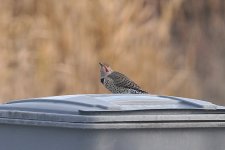
I saw a Flicker . . .
DSC02026.JPG
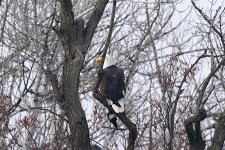
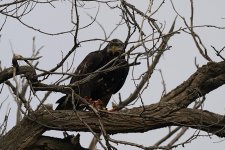
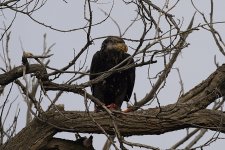
and shortly thereafter found a Double Eagle!
DSC02025.JPG
DSC02049.JPGDSC02054.JPG
 
This time of year eagles of various age classes will roost together
There was a juvenile near the adult, but it was so obscured by branches that I couldn't get a clear shot without getting closer, and I wouldn't do that. The juvie in my post was feeding a mile or so away.
 
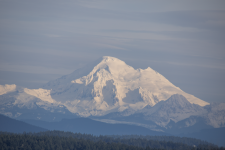
San Juan Island, Xmas 2025: Eagles. My wife and I house-sat for some friends on San Juan Island over the holidays. We have fulfilled this role many times and always enjoy exploring the wildlife on the islands. When the weather cooperates, you have a great view of the snow-covered majesty of Mt. Baker from the house and at other points on San Juan
A00MtBaker2C2A1404.png
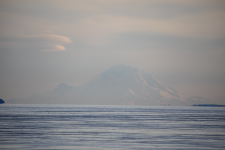
and on a very clear day, Mt. Rainier looms massively to the south through the haze 120+ miles away.
A00MtRainierFromCattlePoint2C2A1488.png
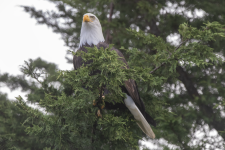
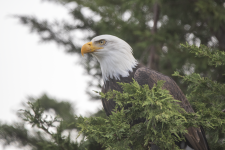
The San Juan Islands are a great place to see bald eagles. The eagles thrive on the diversity of food resources. Bald eagles are effective scavengers; when the invasive European hares exploded in numbers on San Juan Island in the 1980s, you would often see eagles by the side of the road as they cleaned up the carcasses of rabbits that had been hit by cars in the night. Until quite recently, scientists downplayed the role of smell in the lives of birds, but recent research (see here and here, for example) has identified an important role of olfaction in the biology of many bird species. I suspect that bald eagles (as has been proven for turkey vultures) have an acute sense of smell to seek out fresh carcasses. During a drive to Cattle Point from Friday Harbor, we spooked up an eagle that was feeding on a road-kill raccoon lying in a ditch by the road. It didn’t want to abandon this carrion and so it perched on a nearby tree and waiting for us to leave.
A01BaldEagle2C2A0516.png
A02BaldEagle2C2A0509.png
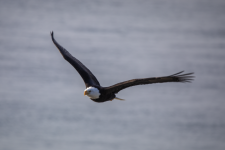
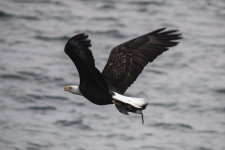
We visited Cattle Point several times in the week and had the local pair of adult bald eagles buzz by the lighthouse several times.
A03BaldEagleInFlight2C2A1036.png
At one point, an eagle flew out to the tide rips off Cattle Pass to harass the alcids and gulls that were feeding there, but without success.
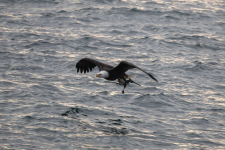
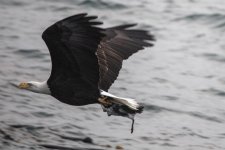
However, we did witness a successful hunt at Lime Kiln State Park. We were scanning the offshore waters for seabirds, especially alcids. My attention was drawn to a large bird that was making a beeline offshore. Once focused on the bird, it was clear that this was a bald eagle flying just a few feet over the surface. Several hundred feet offshore, it struck something at the surface. It immediately flew back toward us. We could see that it was carrying a bird, probably a common murre, in its talons. It practically came to us before veering off the nearby Deadman Bay.
A04EagleWMurre2C2A0568.png
A05EagleWMurre2C2A0575.png
A06EagleWMurre2C2A0577.png
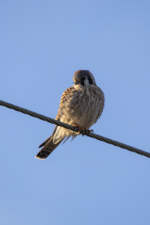
And while the bald eagles get most of the attention, we know several spots where American kestrels can be seen consistently.
A07AmericanKestrel2C2A1354.png

Steve
 
What a photographer's dream that area must be!
 
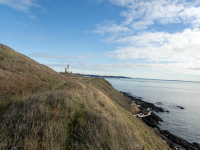
San Juan Island, Xmas 2025: Diving Ducks, Part 1. The Cattle Point Lighthouse marks the southernmost tip of San Juan Island.
B01CattlePtLighthousePC270029.png
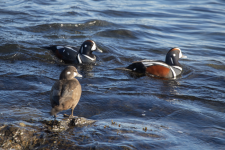
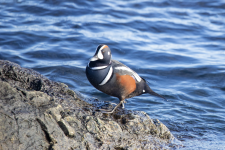
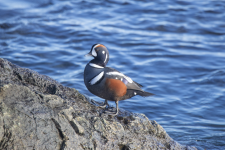
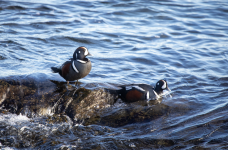
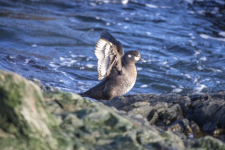
The strong currents running over sills between San Juan Island and Lopez Island in Cattle Pass draw up food resources that attract marine birds and mammals. The rocky shores at Cattle Point are a great place to see harlequin ducks in winter. They dive along the shoreline for food, explore the water’s edge for nibbles, and haul out to warm up and dry off.
B02HarlequinDucks2C2A0947.png
B03HarlequinDrake2C2A0920.png
B03HarlequinDrake2C2A0924.png

B03HarlequinDrakes2C2A0902.png
B04HarlequinHen2C2A0911.png
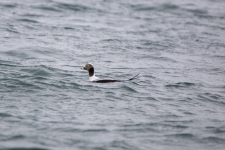
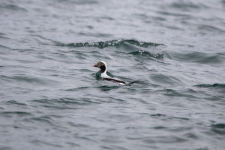
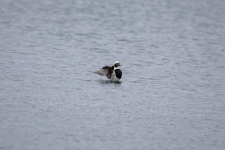
And while harlequins are always a delight to see, we had several great views of long-tailed ducks on this trip. These were the BEST views that I have ever had of this species. More typically, I have views from far off as this species prefers to dive in deep water. While we were exploring the wildlife off the docks at Roche Harbor, I spotted a lone long-tailed duck drake diving between the outer dock and Pearl Island.
C05LongTailedDuckDrake2C2A0752.png
C05LongTailedDuckDrake2C2A0760.png
C05LongTailedDuckDrake2C2A1244.png
C05LongTailedDuckDrake2C2A1258.png
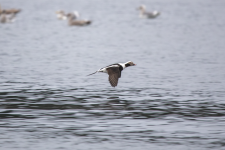
C05LongTailedDuckInFlight2C2A1285.png
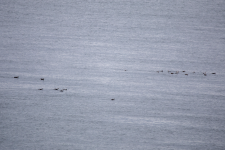
This is a striking duck, perhaps in my top 5. While this is the “breeding” season plumage in winter when they are actually at their sharpest. Males have long tail feathers. It was still there on a second visit later in the week. And on our last visit to Cattle Pt. Lighthouse, I spotted a flock of 20+ long-tailed ducks diving off the kelp bed in the Strait of Juan de Fuca. Their dives were coordinated and they stayed down for a minute or more.
C06LongTailedDuckFlock2C2A1446.png
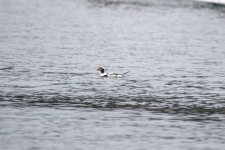
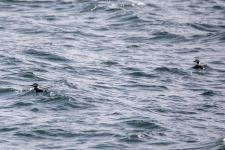
Finally, our ferry passed a group of three immature long-tailed ducks as our ferry approached the dock at Anacortes
C07LongTailedDucks2C2A1671.png
I have never seen this many long-tailed ducks and so well.
Steve
 
Last edited:
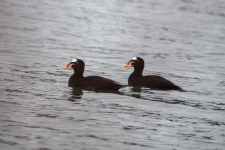
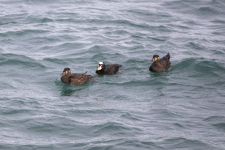
San Juan Island, Xmas 2025: Diving Ducks, Part 2. Flocks of surf scoters (and white-winged scoters) are quite common along the shore.
D01SurfScoterDrakes2C2A0663.png
D02SurfScoters2C2A0536.png
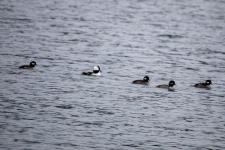
Buffleheads dive in freshwater ponds and along the shore, especially in more protected areas.
D03BuffleheadFlock2C2A0722.pngWhile I encounter them more commonly in Puget Sound and Hood Canal, goldeneyes, like this common goldeneye drake,
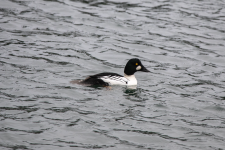
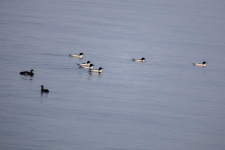
D04CommonGoldeneyeDrake2C2A0792.png
are frequently seen along the shore as well.
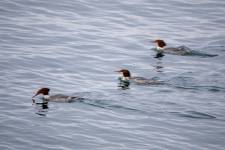
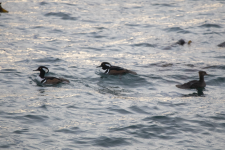
In past winter visits, we have often seen small flocks of common mergansers foraging in some of the freshwater ponds and red-breasted mergansers foraging in salt water. But on this visit, we encountered mixed flocks of several hundred mergansers, including all three species off San Juan County Park along the west side of San Juan Island. From the bluffs overlooking the Strait of Georgia, we could see common merganser drakes (with some loons)
D05CommonMerganserDrakes&Loons2C2A1150.png
and aggregations of common merganser hens.
D06CommonMerganserHens2C2A1117.png
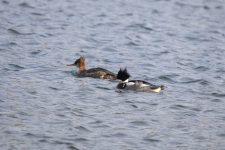
Red-breasted mergansers were even more common.
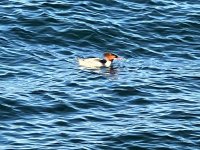
D07RedBreastedMerganserPair2C2A0477.png
There was even a small tight flock of six hooded mergansers attracted to all the commotion caused by their larger cousins.
D08HoodedMergansers2C2A0598.png
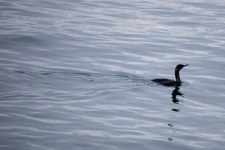
Around the edges of all these mergansers were cormorants, like this pelagic cormorant,
D09PelagicCormorant2C2A1140.png
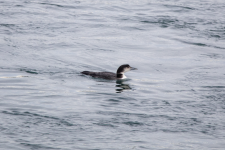
and loons, like this common loon.
D10CommonLoon2C2A1490.png
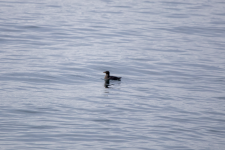
Small flocks of common murres and a few rhinoceros auklets
D11RhinocerosAuklet2C2A1148.png
were in the area but did not appear to be coordinating with the mergansers.
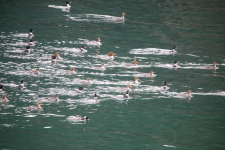
Groups of 20-30 mergansers would coordinate their dives to trap a school of baitfish against the shore.
D12MixedMerganserHuntingFlock2C2A1211.png
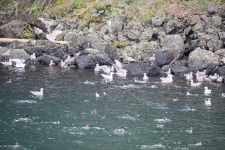
This action attracted gulls, primarily glaucous-winged / “Olympic” gulls, that lined up along the shore in the hope that some of the fish would be driven close enough for them to partake.
D13Mergansers&Gulls2C2A1168.png
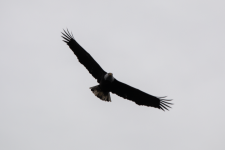
All of this commotion attracted the attention of a pair of adult bald eagles that flew over the mixed flocks several times
D14BaldEagleInFlight2C2A1184.png
before retreating to a tall Douglas fir overlooking the water.
Steve
 
Those pictures make me "homesick" for the San Juan Islands. Been there twice.
 
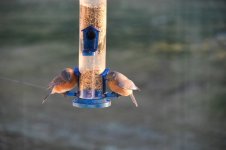
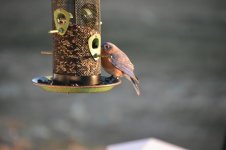
in the Poconos as they will attract as many bears as they will birds.
Here it's squirrels. "That's why we can't have nice things." Entertaining, but very determined little acrobatic critters.
 
Here it's squirrels. "That's why we can't have nice things." Entertaining, but very determined little acrobatic critters.
In Bend and North Carolina, we hung ours on about 4 feet of very thin wire - could probably use 3x tippet material - squirrels could look and scrounge underneath, but not touch.

Cheers
 
Wonderful.

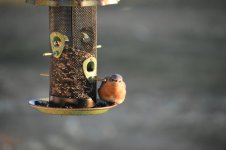
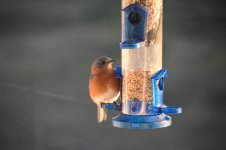
We've been advised against feeders here in the Poconos as they will attract as many bears as they will birds.
Checked with a couple of F&B and local folks and they said it’s good to go from Christmas until March or so. Told though the damn deer will knock them down looking for food during winter. Spoke to one of the local carpenters Friday asked him how his hunting season has gone. “Only eight so far, …have a couple more tags.”
Heard a THUNK yesterday morning around 830 peered around the corner in the sun room looked out and looking back was a beauty of a Redtail hawk staring back at me roosting on the railing……but not for long. May have to reset the feeders due to the flight approaches. In NC had a couple of Redtails that loved the doves and occasional pigeons that came to the feeder…judging by the feathers scattered about.
 
I posted a photo in the hunting pics thread of my daughter with a banded Canada goose she had recently harvested. The bird was locally banded at a state wildlife area I used to manage. While I was gainfully employed, we banded westerns throughout NE California and the Oregon Klamath Basin each summer. Goose roundups occurred usually during the last week of June to the first week of July. There was a narrow window where adults were flightless and goslings were big enough to be handled.

thumbnail_IMG_3558.jpg

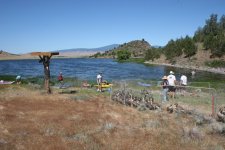
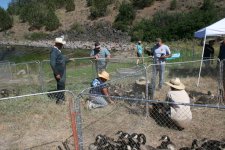
The birds were rounded up using watercraft to herd the birds into pens. Sometimes, an airboat is used if the water body is large enough. This capture was at Shasta Valley Wildlife Area and we utilized kayaks for bird herding.

thumbnail_IMG_3566.jpg

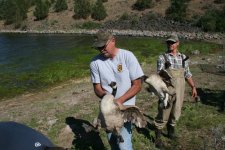
The birds are sorted - goslings are separated to prevent crushing by the adult birds.

thumbnail_IMG_3601.jpg

The birds are aged, sexed and leg bands are attached. The banding data goes into a nationwide database. Banding returns are used to monitor populations and help regulate harvest. Western Canada geese really expanded their range and population during my 35 year career. The NE CA/Southern OR population is mostly non migratory though extreme winters and drought can move birds around - usually not more than a few hundred miles.
 
Last edited:
Back
Top