Navigation
Install the app
How to install the app on iOS
Follow along with the video below to see how to install our site as a web app on your home screen.
Note: This feature may not be available in some browsers.
More options
Style variation
You are using an out of date browser. It may not display this or other websites correctly.
You should upgrade or use an alternative browser.
You should upgrade or use an alternative browser.
Got any bird pics?
- Thread starter Wadin' Boot
- Start date


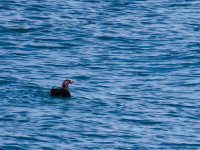
Loonatic…. Loons are one of my favorite photographic subjects. Their diving behavior is very deliberative (and menacing, especially with their red eyes, if you are on the menu). Unlike other birds that have hollow bones filled with air sac extensions of their lungs, the bones of loons (and penguins) are solid, adding to their density. They can squeeze the air that is often trapped between the feathers of diving birds. These adaptations mean that loons are less buoyant than most diving birds, as you can see by how low they sit in the water when at the surface. With a quick exhalation, they easily slip below the surface.
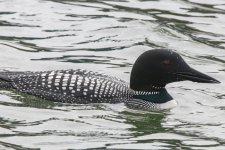
Their breeding plumages are amazing, as you can see in these pictures of a common loon.
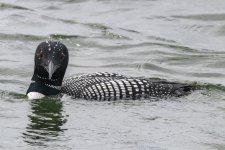
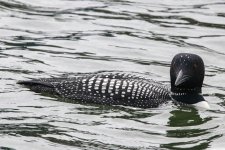
Their winter plumages are far more subdued.
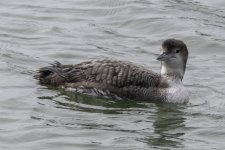
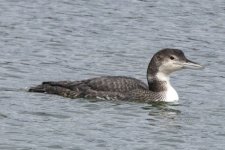
Before migrating to their breeding lakes in the late spring, they molt into their breeding plumage. During a recent visit to Westport, I saw two individuals that were in this process, one about midway
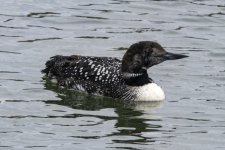
and another that had just about completed the process (except around the eye).
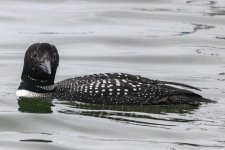
Common loons will not start breeding until they are at least five years old. During their first few years, subadults will not migrate from their coastal overwintering areas. Their plumage is most similar to the winter plumage of an adult, except the back and side feathers are tipped in white. After this non-migratory period, they will start to migrate north in the spring, though they may still not breed for several more years.
Steve
Their breeding plumages are amazing, as you can see in these pictures of a common loon.
Their winter plumages are far more subdued.
Before migrating to their breeding lakes in the late spring, they molt into their breeding plumage. During a recent visit to Westport, I saw two individuals that were in this process, one about midway
and another that had just about completed the process (except around the eye).
Common loons will not start breeding until they are at least five years old. During their first few years, subadults will not migrate from their coastal overwintering areas. Their plumage is most similar to the winter plumage of an adult, except the back and side feathers are tipped in white. After this non-migratory period, they will start to migrate north in the spring, though they may still not breed for several more years.
Steve

Gyrfalcon22
Legend
Nice shots @Cabezon Steve of the loons. And the Common/Yellow-billed are very BIG birds to boot!
I am sort of a snob when it comes to drabby songbirds. I'll likely never chase an immature or female plumaged individual of a songbird species no matter how rare. I like something very large or eye-catching to take my eyes of off raptors or waterfowl- like Steve's loons. (Well, I do really like Savannah sparrows. And could list a dozen or two other small birds I really enjoy as well..)
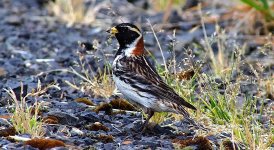
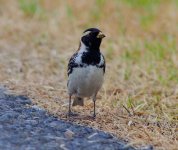
This really spiffy bird fits the bill as my kind of songbird, however! Even has one of the coolest names-a Lapland Longspur. My first in WA. Breeds on the Arctic tundra. He better be scooting along soon.
I am sort of a snob when it comes to drabby songbirds. I'll likely never chase an immature or female plumaged individual of a songbird species no matter how rare. I like something very large or eye-catching to take my eyes of off raptors or waterfowl- like Steve's loons. (Well, I do really like Savannah sparrows. And could list a dozen or two other small birds I really enjoy as well..)
This really spiffy bird fits the bill as my kind of songbird, however! Even has one of the coolest names-a Lapland Longspur. My first in WA. Breeds on the Arctic tundra. He better be scooting along soon.
Last edited:
That is a very impressive songbird. Great pictures too.Nice shots @Cabezon Steve of the loons. And the Common/Yellow-billed are very BIG birds to boot!
I am sort of a snob when it comes to drabby songbirds. I'll likely never chase an immature or female plumaged individual of a songbird species no matter how rare. I like something very large or eye-catching to take my eyes of off raptors or waterfowl- like Steve's loons. (Well, I do really like Savannah sparrows. And could list a dozen or two other small birds I really enjoy as well..)
This really spiffy bird fits the bill as my kind of songbird, however! Even has one of the coolest names-a Lapland Longspur. My first in WA. Breeds on the Arctic tundra. He better be scooting along soon.
View attachment 154120
View attachment 154121
Steve
Birds of the shore. Even with the longer daylight of spring, there just doesn’t seem to be enough hours in the day for all my interests: flyfishing, wildlife especially birds, and wildflowers (and let’s not forget the image processing time). The spring migration brings new shorebird species to our area, at least temporarily, and some of our residents spruce up their plumages to attract members of the opposite sex. Here are some of the better, more interesting pictures of these birds from recent adventures that ranged from Semiahmoo Spit to Westport/Tokeland, and Nisqually NWR.
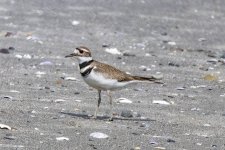
Plovers have distinctive movement patterns that identify them to me even at a distance or in bad light. Ethologists describe this as saltatory foraging. An individual moves a short distance, stops and scans for prey, and then moves a short distance again often in a random direction.
We’ve all seen killdeer employing this foraging strategy on a lawn. Robins have the same search strategy too.
Cute semipalmated plovers perform the same saltatory foraging behavior as they refuel in the outer coast mud flats during their fall and spring migrations.
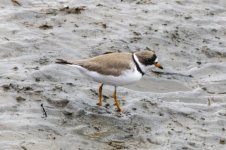
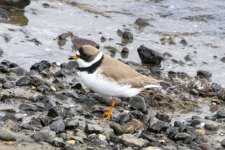
The largest plover in our area, the black-bellied plover, forages the same way. While most black-bellied provers overwinter farther south (as far as southern South America), few black-bellied plovers overwinter along the Washington coast. These overwintering birds are in their subdued non-breeding plumage: gray back, white neck and belly (but retain the same black arm pits).
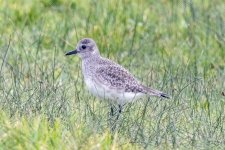
In spring, they molt into their more dramatic breeding plumage. In males, this breeding plumage consists of a black face, neck, and breast. This contrasts with a white cap, neck, and mantle. The back feathers transition from gray to mottled black, white, and tan.
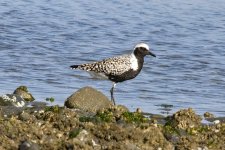
For females, the transition from winter to breeding plumage is similar, but not quite so extreme.
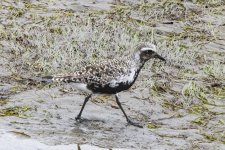
In the spring, the local populations of black-bellied plovers swell with migrating birds from farther south that are refueling en route to their breeding habitat in the tundra along the coast of the Arctic Ocean.
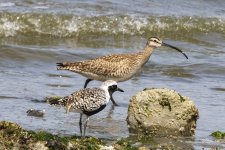
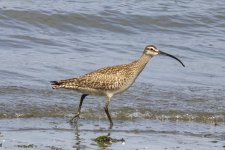
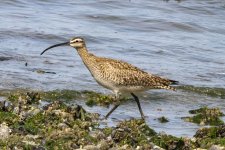
Whimbrels are not a common overwintering shorebird in Washington. Most birds migrate from their breeding areas in Alaska and Northern Canada to the warmer coasts of the U.S., Mexico, and Central America. In a single week this spring, I managed to find whimbrels at Tokeland, Nisqually, and Semiahmoo Spit. This is a large shorebird with a long, curved bill. The genus name of whimbrels and curlews, Numenius, derives from the Greek words for “new” and “moon”, a reflection of their curved bills.
Willets are another of the larger shorebirds. A small flock has overwintered at Tokeland and one or two were still present when I last visited. In their mottled gray plumage, they are not the most striking shorebird (not that much change between breeding and non-breeding plumage).
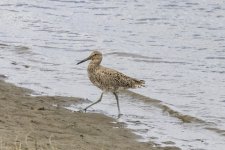
But their striking white and black wing patterns and their high pitched alarm calls will definitely identify them even at a distance.
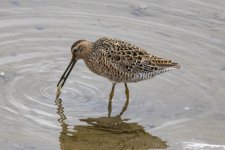
Smaller shorebirds can be a challenge to identify. One of easier species to identify are dowitchers due to their feeding behavior, repeated, methodical probing into the sediment which everyone describes as “like a sewing machine”. The drab dowitchers that overwintered at Tokeland are primarily short-billed dowitchers (whose bills are really not short and only slightly shorter on average than a long-billed dowitcher). The breeding plumage of a short-billed dowitcher has a lighter cinnamon coloration on the breast and on the back when compared to darker cinnamon breast and black/white/cinnamon back of a breeding-plumage long-billed dowitcher.
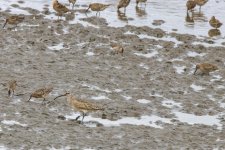
When I visited Tokeland near a high tide, the short-billed dowitchers and other shorebirds like whimbrels were initially foraging in the mud flats along the bay.
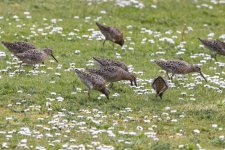
But as the high tide covered the muddy shores, a flock of dowitchers moved to the grassy field in the Tokeland Marina campground and continued their probing foraging there.
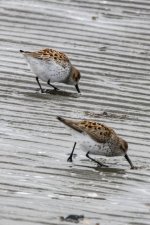
Sandpipers can be particularly difficult to identify. Some birders simply lump them all together as “peeps”. But there are some features that can help with species-level identification. Chunky western sandpipers exchange their light gray/black winter plumage for a rusty cap and eye streak, and rusty mottling along the back. Their thick bills have a slight curve.
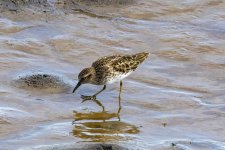
Least sandpipers are slightly smaller than western sandpipers, but least sandpipers have yellow legs (versus black in western sandpipers) which helps separate them from other sandpipers. Their breeding plumage is a bit darker than that of a western sandpiper with a more heavily streaked throat and breast, and least sandpipers lack rusty caps. The bill of a least sandpiper is thinner than that of a western sandpiper and its curve is much slighter.
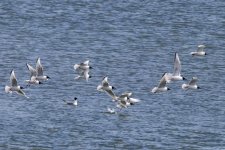
Of course, there are more birds along the shore than “shorebirds”. The order Charadriiformes includes the waders (suborders Charadii and Scolopaci) and the auks/alcids/gulls/skuas/terns (suborder Lari). When visiting Semiahmoo, my wife and I encountered a flock of delicate Bonaparte’s gulls. These are quite acrobatic gulls. Their flying skills are consistent with their habit of plucking tiny plankton from the water’s surface while in flight or even hawking insects at their breeding grounds. Almost all of these Bonaparte’s gulls were in breeding plumage (black heads and bright red legs).
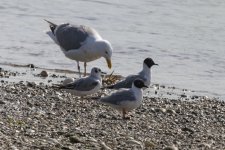
But we did encounter one bird in the flock that still had its winter plumage: a white head with a dark spot behind its eye and pink legs.
These birds were in transit to the boreal forest of Alaska and Northern Canada to breed (many nesting in trees!!!).
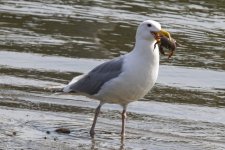
Identifying large gulls in the Salish Sea area is a nightmare because of the presence of many hybrid individuals. The Washington coast and the southern Salish Sea is a stable hybrid zone between Western gulls (that are more common to the south) and glaucous-winged gulls (that are more common to the north). Hybrids between these two species even have their own common name, the “Olympic gull”. A pure glaucous-winged gull would have a light gray wing primaries, and back feathers. A pure Western gull would have a dark gray wing primaries, and back feathers. The wing primaries and back feathers of a hybrid “Olympic gull” are darker than that of a pure glaucous-winged gull and lighter than that of a pure Western gull. Because of breeding among hybrids, you can find all sorts of gradations between the parent species. The larger gull in the picture with the Bonaparte’s gulls and in the below picture (same individual with a soft-shelled crab) appears to be an “Olympic gull” (wing primaries slightly darker than mantle), but on the glaucous-winged side of the continuum.
 Frankly, after agonizing over identifying larger gulls from pictures this winter, I’m hopelessly confused and frustrated. And I don’t even bother with juvenile gulls with their myriad plumages.
Our last seabirds, the cormorants, are not in the Order Charadriiformes. Recent molecular studies indicate that cormorants (family Phalacrocoracidae = “bald” “ravens”) are most closely related to gannets and boobies, pelicans, and penguins. When I first started birding in the PNW 40+ years ago, the most common cormorant species that you would see in the Salish Sea were double-crested cormorants with their distinctive orange throat (gular) pouch. Any cormorant in freshwater is always a double-crested. Pelagic cormorants were rare and Brandt’s cormorants were found exclusively at the coast.
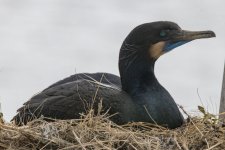
Today, Brandt’s cormorants are still restricted to the coast. There is typically a large flock at the end of the rock jetty at Westport. Two pairs had constructed nests at the end of the wooden walkway/breakwater protecting the entrance to the Westport marina. The incubating birds showed off the blue gular patches, blue eyes, and dark bills that characterize Brandt’s cormorants.
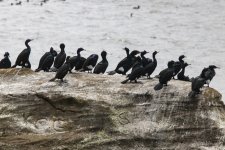
In my experience, pelagic cormorant numbers have increased greatly in the Salish Sea over the last 40+ years (though data indicate that overall numbers throughout their range appear to be declining). They readily exploit the new style WSDOT ferry pilings as nesting sites. A pelagic cormorant is smaller than the other two cormorant species. Its bill is thinner and its gular pouch is much smaller and red if you can see it. In breeding plumage, a pelagic cormorant will often show a white patch on other side of flanks as you can see in many of the cormorants in this picture.
As they dive, a powerful flip of the tail lifts the back half of the bird slightly out of the water while the head dive below – a “hop”.
Steve
Plovers have distinctive movement patterns that identify them to me even at a distance or in bad light. Ethologists describe this as saltatory foraging. An individual moves a short distance, stops and scans for prey, and then moves a short distance again often in a random direction.
We’ve all seen killdeer employing this foraging strategy on a lawn. Robins have the same search strategy too.
Cute semipalmated plovers perform the same saltatory foraging behavior as they refuel in the outer coast mud flats during their fall and spring migrations.
The largest plover in our area, the black-bellied plover, forages the same way. While most black-bellied provers overwinter farther south (as far as southern South America), few black-bellied plovers overwinter along the Washington coast. These overwintering birds are in their subdued non-breeding plumage: gray back, white neck and belly (but retain the same black arm pits).
In spring, they molt into their more dramatic breeding plumage. In males, this breeding plumage consists of a black face, neck, and breast. This contrasts with a white cap, neck, and mantle. The back feathers transition from gray to mottled black, white, and tan.
For females, the transition from winter to breeding plumage is similar, but not quite so extreme.
In the spring, the local populations of black-bellied plovers swell with migrating birds from farther south that are refueling en route to their breeding habitat in the tundra along the coast of the Arctic Ocean.
Whimbrels are not a common overwintering shorebird in Washington. Most birds migrate from their breeding areas in Alaska and Northern Canada to the warmer coasts of the U.S., Mexico, and Central America. In a single week this spring, I managed to find whimbrels at Tokeland, Nisqually, and Semiahmoo Spit. This is a large shorebird with a long, curved bill. The genus name of whimbrels and curlews, Numenius, derives from the Greek words for “new” and “moon”, a reflection of their curved bills.
Willets are another of the larger shorebirds. A small flock has overwintered at Tokeland and one or two were still present when I last visited. In their mottled gray plumage, they are not the most striking shorebird (not that much change between breeding and non-breeding plumage).
But their striking white and black wing patterns and their high pitched alarm calls will definitely identify them even at a distance.
Smaller shorebirds can be a challenge to identify. One of easier species to identify are dowitchers due to their feeding behavior, repeated, methodical probing into the sediment which everyone describes as “like a sewing machine”. The drab dowitchers that overwintered at Tokeland are primarily short-billed dowitchers (whose bills are really not short and only slightly shorter on average than a long-billed dowitcher). The breeding plumage of a short-billed dowitcher has a lighter cinnamon coloration on the breast and on the back when compared to darker cinnamon breast and black/white/cinnamon back of a breeding-plumage long-billed dowitcher.
When I visited Tokeland near a high tide, the short-billed dowitchers and other shorebirds like whimbrels were initially foraging in the mud flats along the bay.
But as the high tide covered the muddy shores, a flock of dowitchers moved to the grassy field in the Tokeland Marina campground and continued their probing foraging there.
Sandpipers can be particularly difficult to identify. Some birders simply lump them all together as “peeps”. But there are some features that can help with species-level identification. Chunky western sandpipers exchange their light gray/black winter plumage for a rusty cap and eye streak, and rusty mottling along the back. Their thick bills have a slight curve.
Least sandpipers are slightly smaller than western sandpipers, but least sandpipers have yellow legs (versus black in western sandpipers) which helps separate them from other sandpipers. Their breeding plumage is a bit darker than that of a western sandpiper with a more heavily streaked throat and breast, and least sandpipers lack rusty caps. The bill of a least sandpiper is thinner than that of a western sandpiper and its curve is much slighter.
Of course, there are more birds along the shore than “shorebirds”. The order Charadriiformes includes the waders (suborders Charadii and Scolopaci) and the auks/alcids/gulls/skuas/terns (suborder Lari). When visiting Semiahmoo, my wife and I encountered a flock of delicate Bonaparte’s gulls. These are quite acrobatic gulls. Their flying skills are consistent with their habit of plucking tiny plankton from the water’s surface while in flight or even hawking insects at their breeding grounds. Almost all of these Bonaparte’s gulls were in breeding plumage (black heads and bright red legs).
But we did encounter one bird in the flock that still had its winter plumage: a white head with a dark spot behind its eye and pink legs.
These birds were in transit to the boreal forest of Alaska and Northern Canada to breed (many nesting in trees!!!).
Identifying large gulls in the Salish Sea area is a nightmare because of the presence of many hybrid individuals. The Washington coast and the southern Salish Sea is a stable hybrid zone between Western gulls (that are more common to the south) and glaucous-winged gulls (that are more common to the north). Hybrids between these two species even have their own common name, the “Olympic gull”. A pure glaucous-winged gull would have a light gray wing primaries, and back feathers. A pure Western gull would have a dark gray wing primaries, and back feathers. The wing primaries and back feathers of a hybrid “Olympic gull” are darker than that of a pure glaucous-winged gull and lighter than that of a pure Western gull. Because of breeding among hybrids, you can find all sorts of gradations between the parent species. The larger gull in the picture with the Bonaparte’s gulls and in the below picture (same individual with a soft-shelled crab) appears to be an “Olympic gull” (wing primaries slightly darker than mantle), but on the glaucous-winged side of the continuum.
Frankly, after agonizing over identifying larger gulls from pictures this winter, I’m hopelessly confused and frustrated. And I don’t even bother with juvenile gulls with their myriad plumages.Our last seabirds, the cormorants, are not in the Order Charadriiformes. Recent molecular studies indicate that cormorants (family Phalacrocoracidae = “bald” “ravens”) are most closely related to gannets and boobies, pelicans, and penguins. When I first started birding in the PNW 40+ years ago, the most common cormorant species that you would see in the Salish Sea were double-crested cormorants with their distinctive orange throat (gular) pouch. Any cormorant in freshwater is always a double-crested. Pelagic cormorants were rare and Brandt’s cormorants were found exclusively at the coast.
Today, Brandt’s cormorants are still restricted to the coast. There is typically a large flock at the end of the rock jetty at Westport. Two pairs had constructed nests at the end of the wooden walkway/breakwater protecting the entrance to the Westport marina. The incubating birds showed off the blue gular patches, blue eyes, and dark bills that characterize Brandt’s cormorants.
In my experience, pelagic cormorant numbers have increased greatly in the Salish Sea over the last 40+ years (though data indicate that overall numbers throughout their range appear to be declining). They readily exploit the new style WSDOT ferry pilings as nesting sites. A pelagic cormorant is smaller than the other two cormorant species. Its bill is thinner and its gular pouch is much smaller and red if you can see it. In breeding plumage, a pelagic cormorant will often show a white patch on other side of flanks as you can see in many of the cormorants in this picture.
As they dive, a powerful flip of the tail lifts the back half of the bird slightly out of the water while the head dive below – a “hop”.
Steve

Cannot express how much I enjoy these posts. Thank you.Birds of the shore. Even with the longer daylight of spring, there just doesn’t seem to be enough hours in the day for all my interests: flyfishing, wildlife especially birds, and wildflowers (and let’s not forget the image processing time). The spring migration brings new shorebird species to our area, at least temporarily, and some of our residents spruce up their plumages to attract members of the opposite sex. Here are some of the better, more interesting pictures of these birds from recent adventures that ranged from Semiahmoo Spit to Westport/Tokeland, and Nisqually NWR.
Plovers have distinctive movement patterns that identify them to me even at a distance or in bad light. Ethologists describe this as saltatory foraging. An individual moves a short distance, stops and scans for prey, and then moves a short distance again often in a random direction.
We’ve all seen killdeer employing this foraging strategy on a lawn. Robins have the same search strategy too.
View attachment 154132
Cute semipalmated plovers perform the same saltatory foraging behavior as they refuel in the outer coast mud flats during their fall and spring migrations.
View attachment 154133
View attachment 154134
The largest plover in our area, the black-bellied plover, forages the same way. While most black-bellied provers overwinter farther south (as far as southern South America), few black-bellied plovers overwinter along the Washington coast. These overwintering birds are in their subdued non-breeding plumage: gray back, white neck and belly (but retain the same black arm pits).
View attachment 154135
In spring, they molt into their more dramatic breeding plumage. In males, this breeding plumage consists of a black face, neck, and breast. This contrasts with a white cap, neck, and mantle. The back feathers transition from gray to mottled black, white, and tan.
View attachment 154136
For females, the transition from winter to breeding plumage is similar, but not quite so extreme.
View attachment 154137
In the spring, the local populations of black-bellied plovers swell with migrating birds from farther south that are refueling en route to their breeding habitat in the tundra along the coast of the Arctic Ocean.
Whimbrels are not a common overwintering shorebird in Washington. Most birds migrate from their breeding areas in Alaska and Northern Canada to the warmer coasts of the U.S., Mexico, and Central America. In a single week this spring, I managed to find whimbrels at Tokeland, Nisqually, and Semiahmoo Spit. This is a large shorebird with a long, curved bill. The genus name of whimbrels and curlews, Numenius, derives from the Greek words for “new” and “moon”, a reflection of their curved bills.
View attachment 154138
View attachment 154139
View attachment 154140
Willets are another of the larger shorebirds. A small flock has overwintered at Tokeland and one or two were still present when I last visited. In their mottled gray plumage, they are not the most striking shorebird (not that much change between breeding and non-breeding plumage).
View attachment 154141
But their striking white and black wing patterns and their high pitched alarm calls will definitely identify them even at a distance.
Smaller shorebirds can be a challenge to identify. One of easier species to identify are dowitchers due to their feeding behavior, repeated, methodical probing into the sediment which everyone describes as “like a sewing machine”. The drab dowitchers that overwintered at Tokeland are primarily short-billed dowitchers (whose bills are really not short and only slightly shorter on average than a long-billed dowitcher). The breeding plumage of a short-billed dowitcher has a lighter cinnamon coloration on the breast and on the back when compared to darker cinnamon breast and black/white/cinnamon back of a breeding-plumage long-billed dowitcher.
View attachment 154142
When I visited Tokeland near a high tide, the short-billed dowitchers and other shorebirds like whimbrels were initially foraging in the mud flats along the bay.
View attachment 154143
But as the high tide covered the muddy shores, a flock of dowitchers moved to the grassy field in the Tokeland Marina campground and continued their probing foraging there.
View attachment 154144
Sandpipers can be particularly difficult to identify. Some birders simply lump them all together as “peeps”. But there are some features that can help with species-level identification. Chunky western sandpipers exchange their light gray/black winter plumage for a rusty cap and eye streak, and rusty mottling along the back. Their thick bills have a slight curve.
View attachment 154145
Least sandpipers are slightly smaller than western sandpipers, but least sandpipers have yellow legs (versus black in western sandpipers) which helps separate them from other sandpipers. Their breeding plumage is a bit darker than that of a western sandpiper with a more heavily streaked throat and breast, and least sandpipers lack rusty caps. The bill of a least sandpiper is thinner than that of a western sandpiper and its curve is much slighter.
View attachment 154146
Of course, there are more birds along the shore than “shorebirds”. The order Charadriiformes includes the waders (suborders Charadii and Scolopaci) and the auks/alcids/gulls/skuas/terns (suborder Lari). When visiting Semiahmoo, my wife and I encountered a flock of delicate Bonaparte’s gulls. These are quite acrobatic gulls. Their flying skills are consistent with their habit of plucking tiny plankton from the water’s surface while in flight or even hawking insects at their breeding grounds. Almost all of these Bonaparte’s gulls were in breeding plumage (black heads and bright red legs).
View attachment 154147
But we did encounter one bird in the flock that still had its winter plumage: a white head with a dark spot behind its eye and pink legs.
View attachment 154148
These birds were in transit to the boreal forest of Alaska and Northern Canada to breed (many nesting in trees!!!).
Identifying large gulls in the Salish Sea area is a nightmare because of the presence of many hybrid individuals. The Washington coast and the southern Salish Sea is a stable hybrid zone between Western gulls (that are more common to the south) and glaucous-winged gulls (that are more common to the north). Hybrids between these two species even have their own common name, the “Olympic gull”. A pure glaucous-winged gull would have a light gray wing primaries, and back feathers. A pure Western gull would have a dark gray wing primaries, and back feathers. The wing primaries and back feathers of a hybrid “Olympic gull” are darker than that of a pure glaucous-winged gull and lighter than that of a pure Western gull. Because of breeding among hybrids, you can find all sorts of gradations between the parent species. The larger gull in the picture with the Bonaparte’s gulls and in the below picture (same individual with a soft-shelled crab) appears to be an “Olympic gull” (wing primaries slightly darker than mantle), but on the glaucous-winged side of the continuum.
View attachment 154149Frankly, after agonizing over identifying larger gulls from pictures this winter, I’m hopelessly confused and frustrated. And I don’t even bother with juvenile gulls with their myriad plumages.
Our last seabirds, the cormorants, are not in the Order Charadriiformes. Recent molecular studies indicate that cormorants (family Phalacrocoracidae = “bald” “ravens”) are most closely related to gannets and boobies, pelicans, and penguins. When I first started birding in the PNW 40+ years ago, the most common cormorant species that you would see in the Salish Sea were double-crested cormorants with their distinctive orange throat (gular) pouch. Any cormorant in freshwater is always a double-crested. Pelagic cormorants were rare and Brandt’s cormorants were found exclusively at the coast.
Today, Brandt’s cormorants are still restricted to the coast. There is typically a large flock at the end of the rock jetty at Westport. Two pairs had constructed nests at the end of the wooden walkway/breakwater protecting the entrance to the Westport marina. The incubating birds showed off the blue gular patches, blue eyes, and dark bills that characterize Brandt’s cormorants.
View attachment 154150
In my experience, pelagic cormorant numbers have increased greatly in the Salish Sea over the last 40+ years (though data indicate that overall numbers throughout their range appear to be declining). They readily exploit the new style WSDOT ferry pilings as nesting sites. A pelagic cormorant is smaller than the other two cormorant species. Its bill is thinner and its gular pouch is much smaller and red if you can see it. In breeding plumage, a pelagic cormorant will often show a white patch on other side of flanks as you can see in many of the cormorants in this picture.
View attachment 154151
As they dive, a powerful flip of the tail lifts the back half of the bird slightly out of the water while the head dive below – a “hop”.
Steve

Ditto this! I sincerely appreciate the opportunity to gather "Cabezon College Continuing Credits."Cannot express how much I enjoy these posts. Thank you.
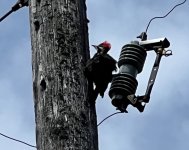
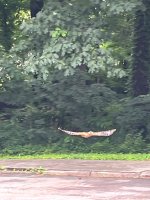
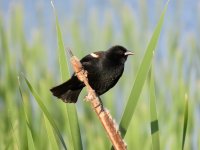
Some gal with a red Mohawk was knocking around my neighborhood today.
SF
SF
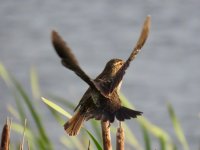
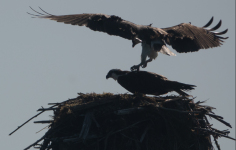

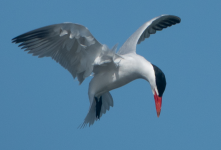
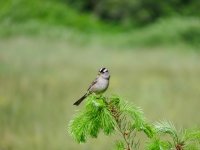
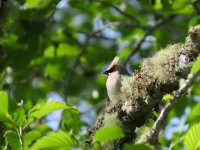
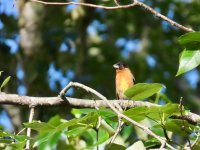
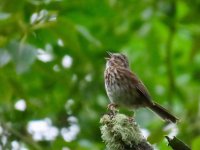
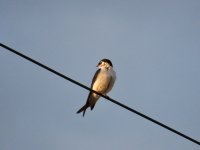
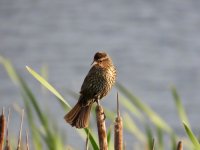
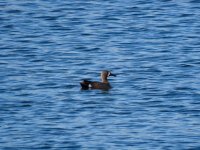
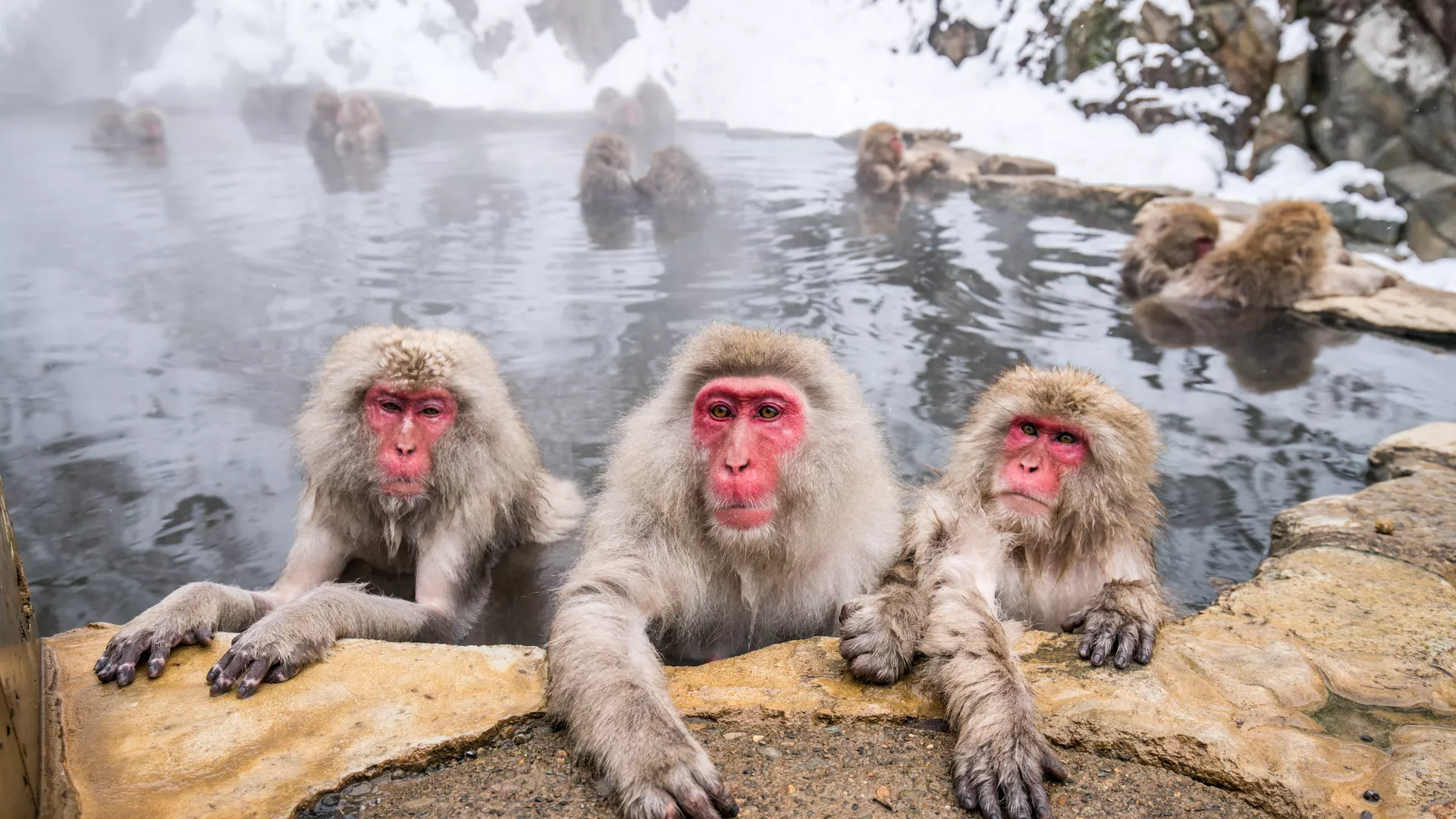
You guys are amazing! Thanks for sharing

/https%3A%2F%2Ftf-cmsv2-smithsonianmag-media.s3.amazonaws.com%2Ffiler_public%2Fc5%2Fbb%2Fc5bb81db-3090-47e3-b6c3-d8efce11edd6%2Fhawk-4564885_1280.jpg)
A Young Cooper's Hawk Learned to Use a Crosswalk Signal to Launch Surprise Attacks on Other Birds
Researcher Vladimir Dinets watched the bird repeatedly sneak behind a row of cars to ambush its unsuspecting prey
 www.smithsonianmag.com
I thought this was a cool story of a bird learning and problem solving using human activity.
Original paper:
Frontiers | Street smarts: a remarkable adaptation in a city-wintering raptor
IntroductionUrban birds have to adapt to their complex and challenging environment. In the present study, a particularly remarkable behavioral adaptation by ...
 www.frontiersin.org


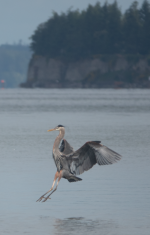
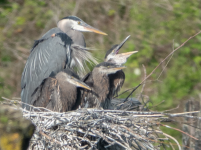
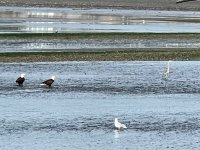
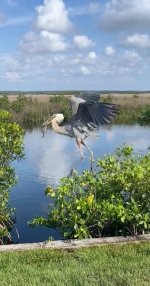
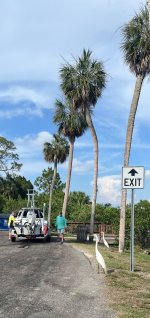
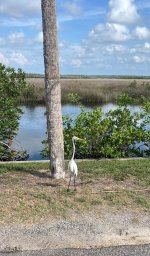
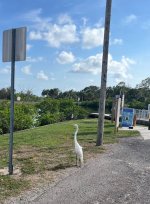
These rather tame Avian citizens were at the boat ramp every day this week in Florida, spending their afternoons waiting for handouts. “Got any leftover bait?” The GBH got what I think is a croaker, but I’m not sure if it was a gift or if it had earned its meal on its own.

Bajema
Life of the Party
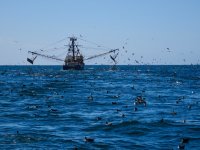
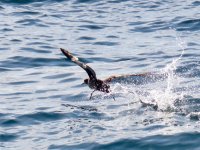
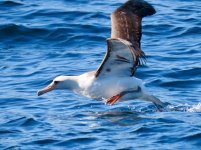
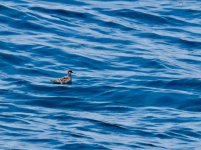
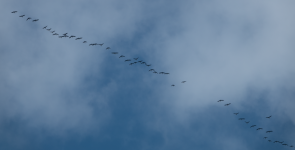
Scored a last minute open seat on a pelagic out of Westport yesterday. It was a beautiful day with lots of birds (we saw over 20k Sooty Shearwater). We did have turn back several hours sooner than expected due to some floating rope getting caught in the props, but they were able to get one of them free and we headed back on one engine.