
Navigation
Install the app
How to install the app on iOS
Follow along with the video below to see how to install our site as a web app on your home screen.
Note: This feature may not be available in some browsers.
More options
Style variation
You are using an out of date browser. It may not display this or other websites correctly.
You should upgrade or use an alternative browser.
You should upgrade or use an alternative browser.
Got any bird pics?
- Thread starter Wadin' Boot
- Start date
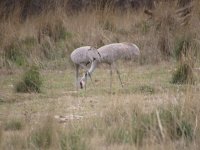
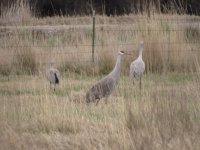
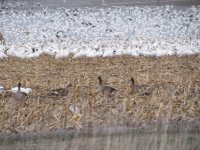
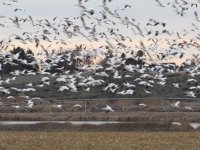
I love the way Sandhills tumble through the sky. Plus, they have great calls.

Gyrfalcon22
Legend
@Cabezon Steve is putting on a masterclass with amazing reports. One can't help but try and contribute after reading his great insights and obvious enthusiasm for nature! I admit, I get jaded and lazy. PNW has an abundance of riches that can lead to complacency. I have been gone for big chunks of time since early Fall and while going back and forth I appreciate things more now..but still, I don't go through flocks of birds or do a lot of listing as I should to look for rarities.
Recently, I lazily ran across an amazing bird that will change how thorough I observe ducks. I already look for the beautiful Eurasian wigeons wandering within the hundreds of American wigeon in big flocks. They are good finds, but I was pretty shocked when I spotted a VERY striking duck through my camera lens while setting up a generic group shot of maybe 400 wigeons.
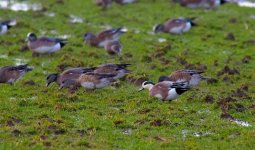
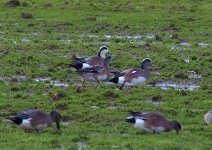
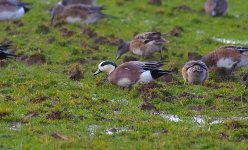
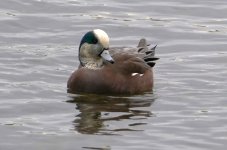
I don't hunt but run across a wide swath of people and have been asked a couple of times about a "Storm" wigeon duck. I had looked at them briefly on the net years back. Then to randomly, unexpectedly see a very bright individual in the mix of hundreds of ducks really popped my eyes out! Still the same species as American wigeon, yet with a genetic feather pigment twist. Via internet searches I see most Storm A. Wigeon cheek patches are creamy, but this guy had the bright whites.
Can now add this to list of favorite ducks.
It is good to pay attention every now and then.
Recently, I lazily ran across an amazing bird that will change how thorough I observe ducks. I already look for the beautiful Eurasian wigeons wandering within the hundreds of American wigeon in big flocks. They are good finds, but I was pretty shocked when I spotted a VERY striking duck through my camera lens while setting up a generic group shot of maybe 400 wigeons.
I don't hunt but run across a wide swath of people and have been asked a couple of times about a "Storm" wigeon duck. I had looked at them briefly on the net years back. Then to randomly, unexpectedly see a very bright individual in the mix of hundreds of ducks really popped my eyes out! Still the same species as American wigeon, yet with a genetic feather pigment twist. Via internet searches I see most Storm A. Wigeon cheek patches are creamy, but this guy had the bright whites.
Can now add this to list of favorite ducks.
It is good to pay attention every now and then.
Last edited:

Excellent @Gyrfalcon22!!! I knew nothing about that color morph. It is so easy to casually scan through a large flock of a common bird species, like American wigeons, and miss something like the storm wigeon.
Steve
And thank you for the kind words...
Steve
And thank you for the kind words...

Bajema
Life of the Party
What an incredible bird! Great find!!!@Cabezon Steve is putting on a masterclass with amazing reports. One can't help but try and contribute after reading his great insights and obvious enthusiasm for nature! I admit, I get jaded and lazy. PNW has an abundance of riches that can lead to complacency. I have been gone for big chunks of time since early Fall and while going back and forth I appreciate things more now..but still, I don't go through flocks of birds or do a lot of listing as I should to look for rarities.
Recently, I lazily ran across an amazing bird that will change how thorough I observe ducks. I already look for the beautiful Eurasian wigeons wandering within the hundreds of American wigeon in big flocks. They are good finds, but I was pretty shocked when I spotted a VERY striking duck through my camera lens while setting up a generic group shot of maybe 400 wigeons.
View attachment 145821
View attachment 145823
View attachment 145824
I don't hunt but run across a wide swath of people and have been asked a couple of times about a "Storm" wigeon duck. I had looked at them briefly on the net years back. Then to randomly, unexpectedly see a very bright individual in the mix of hundreds of ducks really popped my eyes out! Still the same species as American wigeon, yet with a genetic feather pigment twist. Via internet searches I see most Storm A. Wigeon cheek patches are creamy, but this guy had the bright whites.
Can now add this to list of favorite ducks.
It is good to pay attention every now and then.


Good question - we experimented a bit with this thinking there might be a correlation between ground nesting cover (or lack thereof) in the vicinity and the use of the nest tubes. There didn't appear to be - some used them while others preferred to nest on the ground. The other factor is brood water - is your pond suitable for brood rearing? Are there other ponds/wetlands nearby? It's not unusual to have a hen move her brood to more suitable areas. You'll need a pretty good bug supply to support ducklings during their first two weeks of life.Ducks by the pond. @RRSmith, is there anything I can do to attract the hen to the roll nest, or will she just find it on her own?
Cheers
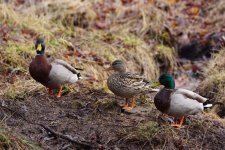
What's the temperature like now in the Poconos? On the West Coast, mallards are starting the egg laying process now - we have even seen them initiate egg laying in February. I see two drakes and a hen in your photo - was there two pairs and now a hen is sitting on a nest somewhere? They will nest up to two miles from brood water.
Last year, our first year here, I think we had the same trio. We just had ice out on local lakes in the last week or so, my understanding is they start more mid to late April.Good question - we experimented a bit with this thinking there might be a correlation between ground nesting cover (or lack thereof) in the vicinity and the use of the nest tubes. There didn't appear to be - some used them while others preferred to nest on the ground. The other factor is brood water - is your pond suitable for brood rearing? Are there other ponds/wetlands nearby? It's not unusual to have a hen move her brood to more suitable areas. You'll need a pretty good bug supply to support ducklings during their first two weeks of life.
What's the temperature like now in the Poconos? On the West Coast, mallards are starting the egg laying process now - we have even seen them initiate egg laying in February. I see two drakes and a hen in your photo - was there two pairs and now a hen is sitting on a nest somewhere? They will nest up to two miles from brood water.
The pond can support a brood, last May 29:
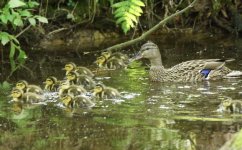
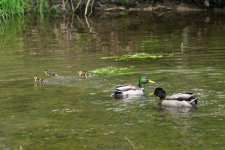
Though by the end of the summer, we were down to 2 ducklings:
Cheers
That very interesting - it's pretty unusual to have a hen with two drakes during breeding season. Are the black ducks gone now? Did you lose most of the ducklings during the first two weeks (while they are small and downy)? Do you have bass in the pond? Two ducklings surviving to fledge isn't great but it's better than zero ha ha.Last year, our first year here, I think we had the same trio. We just had ice out on local lakes in the last week or so, my understanding is they start more mid to late April.
The pond can support a brood, last May 29:
Though by the end of the summer, we were down to 2 ducklings:
Cheers
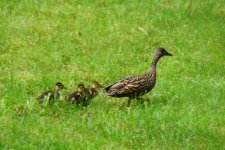
Yeah, they were gone pretty quick, June 7 we were down to 3. No bass in the pond. I think it was raccoons of something like that - not sure where they nested, I think in a back wetland, cause I saw them marching across the yard from the back to the pond on a couple of occasions - one of the reasons for the nest barrel to hopefully increase survival.That very interesting - it's pretty unusual to have a hen with two drakes during breeding season. Are the black ducks gone now? Did you lose most of the ducklings during the first two weeks (while they are small and downy)? Do you have bass in the pond? Two ducklings surviving to fledge isn't great but it's better than zero ha ha.
June 7 2024:
Last edited:
Your hen mallard will nest in any dry spot with dense cover away from water. They tend to not nest near wetlands as those areas attract nest predators. I count 10 newly hatched ducklings in the one photo which leads me to think that nest predation is not an issue. Night time can be perilous for ducklings when the hen moves them out of the water to a roost spot along the edge of the pond (if there's no island). You mentioned raccoons as well as weasels, mink, great horned owls, house cats all have an acquired taste for duckling. They are also vulnerable when the hen is moving them between brood rearing areas. Good luck and please keep us posted!Yeah, they were gone pretty quick, June 7 we were down to 3. No bass in the pond. I think it was raccoons of something like that - not sure where they nested, I think in a back wetland, cause I saw them marching across the yard from the back to the pond on a couple of occasions - one of the reasons for the nest barely to to hopefully increase survival.

Woodies and Hoodies. On my last few trips to Nisqually NWR and McLane Creek Nature Trail I have been fortunate to have great views (and pictures) of two of my favorite duck species: wood ducks and hooded mergansers. I’m spoiled for choice and have had a hard time narrowing them down to these to share…
The drakes tended to follow the direction of the hens. This drake wood duck later preened this hen.
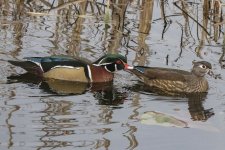
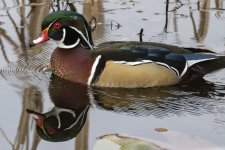
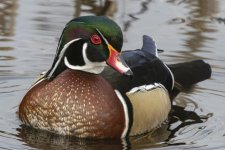
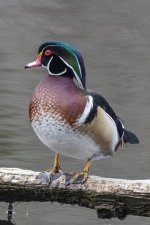
Several views of woody drakes
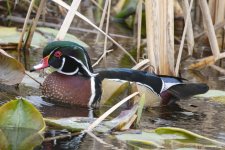
In the image below, you can see the tooth-like lamellae on the bill that allow this duck to tear off vegetation or to grasp aquatic insects and crustaceans.
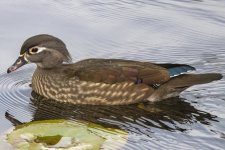
While the hens are less flamboyant, they are quite pretty too.
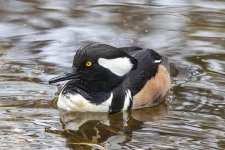
Hooded mergansers can control the elevation of their crest (hood) feathers from this slick-backed 1950’s look
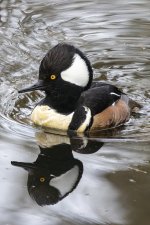
to this elegant pompadour.
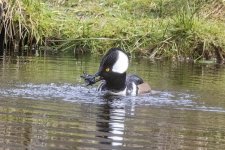
This drake appears to have caught a freshwater sculpin as his afternoon snack. The serrated lamellae on the bills are very useful to hold such a slippery food item.
Like wood duck hens, hooded merganser hens are more cryptic than the drakes. They also can control the elevation of the crest feathers from retracted
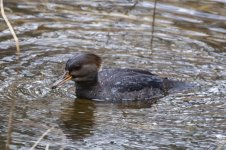
to elevated. This hen may have used too much product…
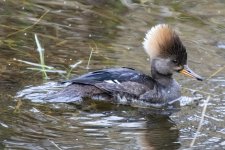
Nesting is imminent and most of the ducks have paired up. The drakes are keeping a close watch on their hens and driving off rivals. The hens are feeding voraciously to bulk up on the nutrients needed for egg production. Wood ducks are omnivores. Plants, especially aquatic plants, comprise 80% or more of their diet. Animal prey include insects, crustaceans, and snails. Hooded merganser are primarily carnivorous. Their serrated bills allow them to grasp small fish, aquatic insects, crayfish and other aquatic crustaceans, and mollusks.
Both wood ducks and hooded mergansers are tree-cavity nesters, often using abandoned nesting holes of woodpeckers. They will also use artificial nesting boxes. Typically, the nest site will be over or near water, but some may be a mile or more from water. A hen may lay up to a dozen eggs or more. But wood duck females are known dump some eggs in the nests of other females when the nesting females leave their nests briefly to feed (= intraspecific brood parasitism). This is especially likely if local nesting sites are limited or close together. Hooded mergansers have also been recorded laying eggs in the nests of wood ducks (and vice versa) = interspecific brood parasitism. If there are too many foreign eggs, a hen may abandon the nest. But at low levels of parasitism, there may even be an advantage to having a few extra eggs in the nest. Up to a point, there is no extra effort required by the nesting female during incubation. After the eggs hatch and the fluff-ball ducklings have fluttered down to the ground (sometimes from heights exceeding 30’), the hen will lead the group to nearby ponds and marshes to grow. These precocial ducklings (i.e., capable of feeding themselves at hatching) do not require any extra effort by the hen. And her own genetic offspring may suffer less proportional predation because the predation risk is spread among the larger group of ducklings.
Steve
The drakes tended to follow the direction of the hens. This drake wood duck later preened this hen.
Several views of woody drakes
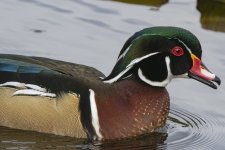
In the image below, you can see the tooth-like lamellae on the bill that allow this duck to tear off vegetation or to grasp aquatic insects and crustaceans.
While the hens are less flamboyant, they are quite pretty too.
Hooded mergansers can control the elevation of their crest (hood) feathers from this slick-backed 1950’s look
to this elegant pompadour.
This drake appears to have caught a freshwater sculpin as his afternoon snack. The serrated lamellae on the bills are very useful to hold such a slippery food item.
Like wood duck hens, hooded merganser hens are more cryptic than the drakes. They also can control the elevation of the crest feathers from retracted
to elevated. This hen may have used too much product…
Nesting is imminent and most of the ducks have paired up. The drakes are keeping a close watch on their hens and driving off rivals. The hens are feeding voraciously to bulk up on the nutrients needed for egg production. Wood ducks are omnivores. Plants, especially aquatic plants, comprise 80% or more of their diet. Animal prey include insects, crustaceans, and snails. Hooded merganser are primarily carnivorous. Their serrated bills allow them to grasp small fish, aquatic insects, crayfish and other aquatic crustaceans, and mollusks.
Both wood ducks and hooded mergansers are tree-cavity nesters, often using abandoned nesting holes of woodpeckers. They will also use artificial nesting boxes. Typically, the nest site will be over or near water, but some may be a mile or more from water. A hen may lay up to a dozen eggs or more. But wood duck females are known dump some eggs in the nests of other females when the nesting females leave their nests briefly to feed (= intraspecific brood parasitism). This is especially likely if local nesting sites are limited or close together. Hooded mergansers have also been recorded laying eggs in the nests of wood ducks (and vice versa) = interspecific brood parasitism. If there are too many foreign eggs, a hen may abandon the nest. But at low levels of parasitism, there may even be an advantage to having a few extra eggs in the nest. Up to a point, there is no extra effort required by the nesting female during incubation. After the eggs hatch and the fluff-ball ducklings have fluttered down to the ground (sometimes from heights exceeding 30’), the hen will lead the group to nearby ponds and marshes to grow. These precocial ducklings (i.e., capable of feeding themselves at hatching) do not require any extra effort by the hen. And her own genetic offspring may suffer less proportional predation because the predation risk is spread among the larger group of ducklings.
Steve
Last edited:

I love this aspect of evolutionary life strategies: things that at first blush are paradoxical, but fully explained by integrating more aspects of biology/physiology/genetics/ecology. Thanks for sharing!Woodies and Hoodies. On my last few trips to Nisqually NWR and McLane Creek Nature Trail I have been fortunate to have great views (and pictures) of two of my favorite duck species: wood ducks and hooded mergansers. I’m spoiled for choice and have had a hard time narrowing them down to these to share…
The drakes tended to follow the direction of the hens. This drake wood duck later preened this hen.
View attachment 146200
Several views of woody drakes
View attachment 146201
View attachment 146202View attachment 146203
In the image below, you can see the tooth-like lamellae on the bill that allow this duck to tear off vegetation or to grasp aquatic insects and crustaceans.
View attachment 146204View attachment 146205
While the hens are less flamboyant, they are quite pretty too.
View attachment 146206
Hooded mergansers can control the elevation of their crest (hood) feathers from this slick-backed 1950’s look
View attachment 146207
to this elegant pompadour.
View attachment 146208
This drake appears to have caught a freshwater sculpin as his afternoon snack. The serrated lamellae on the bills are very useful to hold such a slippery food item.
View attachment 146209
Like wood duck hens, hooded merganser hens are more cryptic than the drakes. They also can control the elevation of the crest feathers from retracted
View attachment 146210
to elevated. This hen may have used too much product…
View attachment 146211
Nesting is imminent and most of the ducks have paired up. The drakes are keeping a close watch on their hens and driving off rivals. The hens are feeding voraciously to bulk up on the nutrients needed for egg production. Wood ducks are omnivores. Plants, especially aquatic plants, comprise 80% or more of their diet. Animal prey include insects, crustaceans, and snails. Hooded merganser are primarily carnivorous. Their serrated bills allow them to grasp small fish, aquatic insects, crayfish and other aquatic crustaceans, and mollusks.
Both wood ducks and hooded mergansers are tree-cavity nesters, often using abandoned nesting holes of woodpeckers. They will also use artificial nesting boxes. Typically, the nest site will be over or near water, but some may be a mile or more from water. A hen may lay up to a dozen eggs or more. But wood duck females are known dump some eggs in the nests of other females when the nesting females leave their nests briefly to feed (= intraspecific brood parasitism). This is especially likely if local nesting sites are limited or close together. Hooded mergansers have also been recorded laying eggs in the nests of wood ducks (and vice versa) = interspecific brood parasitism. If there are too many foreign eggs, a hen may abandon the nest. But at low levels of parasitism, there may even be an advantage to having a few extra eggs in the nest. Up to a point, there is no extra effort required by the nesting female during incubation. After the eggs hatch and the fluff-ball ducklings have fluttered down to the ground (sometimes from heights exceeding 30’), the hen will lead the group to nearby ponds and marshes to grow. These altricial ducklings (i.e., capable of feeding themselves at hatching) do not require any extra effort by the hen. And her own genetic offspring may suffer less proportional predation because the predation risk is spread among the larger group of ducklings.
Steve
If you like the NYT Strands game and this thread, you'll like today's puzzle

Absolutely splendid photos! The hen Hoody looked like she saw something down there that scared her!Woodies and Hoodies
Gyrfalcon22
Legend
Had to look up to see what a hooded merganser x wood duck cross would look like.
Interesting.
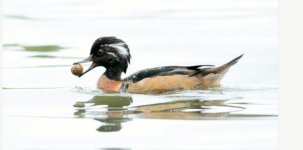
Interesting.

Had to look up to see what a hooded merganser x wood duck cross would look like.
Interesting.
View attachment 146347
Thank you for sharing that, I didn't know they existed.