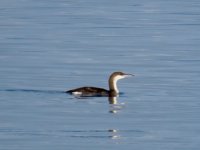
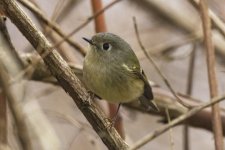
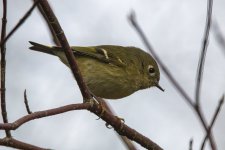
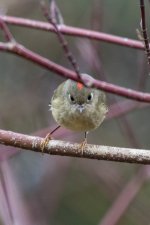
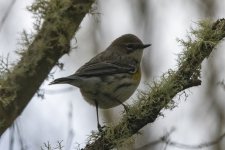
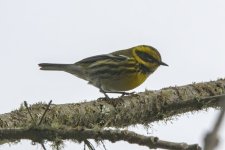
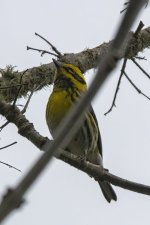
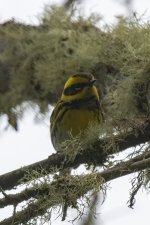
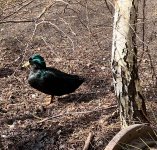
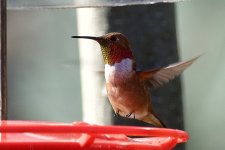
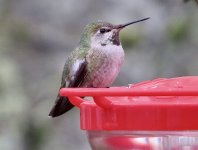
Got any bird pics?

Haven’t been on here in a while, but I’ve been doing plenty of birding.

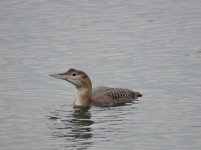
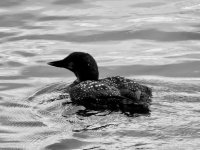
There’s been a Yellow-billed Loon hanging around Blaine this winter. This is a bit south for their normal range in winter, but we’ve been seeing them more frequently in recent years. IMG_8036.jpeg

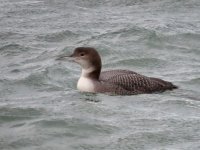
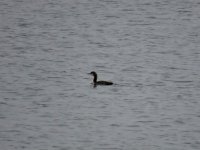
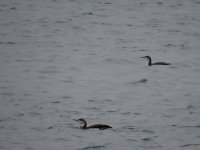
We also have three other loon species that can be seen here every winter. Common Loons, Pacific Loons, and Red-throated Loons.
IMG_7800.jpegIMG_8061.jpegIMG_8084.jpeg

There is a fifth loon species, Arctic Loon, but it’s primarily an Eurasian species. The only time it normally shows up in North America is in a small area of western Alaska in the summer. But then late last December one showed up in Port Angeles and I got the crazy idea to try and see all five loon species in one day. Got up early on New Years Day and hit the road, catching the 7am ferry from Coupville to Port Townsend and got to Port Angeles around d 9am. There were probably 20 other birders there already. We spent an hour trying to find the bird amongst the other loons, and finally honed in on the bird. I spent the next hour watching it as it swan and dove, coming quite close to shore a few times. Also present in Port Angeles were Common Loons and Red-throated Loons.IMG_8275.jpeg
From there I hit the road back north, caught the ferry and made it to Blaine with two more Loon species to find. I first found the Yellow-billed Loon, but had to work a little harder for the Pacific Loon. I finally located it and completed my goal. Truly a great day of birding.
 
Last edited:
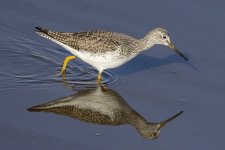
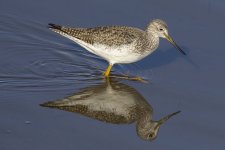
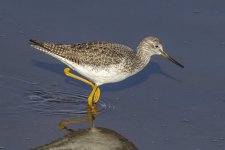
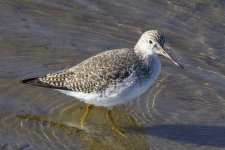
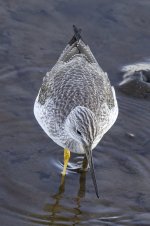
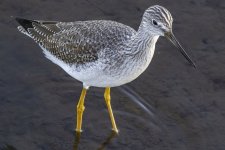
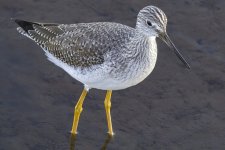
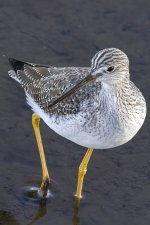
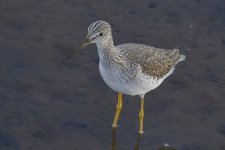
In winter, most of the greater yellowlegs that have bred in bogs and swamps of southern Alaska and across Canada migrate to the southern U.S., to Central America, or even to Tierra de Fuego at the southern tip of South America. But some birds forego these long-distance migrations and overwinter in coastal waters of Washington. Individuals and small flocks can be found along many shorelines in the Salish Sea.
Greater yellowlegs are not shy. They appear to be more focused on finding a meal than viewing me as a threat. With long yellow legs and a long bill, they actively probe the edges of the muddy banks for buried morsels. When a bird feels threatened or is just changing its position, it makes a short flight and produces a loud “tew, tew, tew” call. As you can see, I find them to be quite photogenic.
GreaterYellowlegs0196.jpg
GreaterYellowlegs0197.jpg
GreaterYellowlegs0204.jpg
GreaterYellowlegs0300.jpg
GreaterYellowlegs0302.jpg
GreaterYellowlegs0307.jpg
GreaterYellowlegs0308.jpg
GreaterYellowlegs0311.jpgGreaterYellowlegs0313.jpg
Steve
 
In winter, most of the greater yellowlegs that have bred in bogs and swamps of southern Alaska and across Canada migrate to the southern U.S., to Central America, or even to Tierra de Fuego at the southern tip of South America. But some birds forego these long-distance migrations and overwinter in coastal waters of Washington. Individuals and small flocks can be found along many shorelines in the Salish Sea.
Greater yellowlegs are not shy. They appear to be more focused on finding a meal than viewing me as a threat. With long yellow legs and a long bill, they actively probe the edges of the muddy banks for buried morsels. When a bird feels threatened or is just changing its position, it makes a short flight and produces a loud “tew, tew, tew” call. As you can see, I find them to be quite photogenic.
View attachment 144066
View attachment 144067
View attachment 144068
View attachment 144069
View attachment 144070
View attachment 144071
View attachment 144072
View attachment 144073View attachment 144074
Steve
Steve - The first picture in the group really caught my eyes with the birds image so well reflected, but: the pictures just kept getting better! Thank you sir!
 
Wish I could have gotten closer before it flew off. I never seem to get a good pic of kingfishers. They are like the energizer bunny of birds to me. Always moving…..
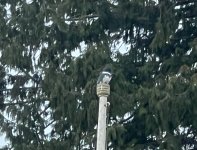
This one was scanning the water from the top of a flagpole. Perhaps looking for chum fry?
SF

IMG_1114.jpeg
 
Wish I could have gotten closer before it flew off. I never seem to get a good pic of kingfishers. They are like the energizer bunny of birds to me. Always moving…..
This one was scanning the water from the top of a flagpole. Perhaps looking for chum fry?
SF
Brian, they get skittish at about 60 yards out and move so quick, they are a super hard to shoot bird!
 
Last edited:
Mudflats are critical foraging habitats for migrating shorebirds and ducks. Some items on the menu are obvious: the worms, clams, and crustaceans that burrow in the mud. We’ve all seen shorebirds probing their bills into the mud in search of these morsels. But an essential food resource for many species is also one of the hardest to see – microscopic biofilms.
These biofilms consist of a paper-thin layer of microorganisms, sediment, and detritus on the surface of the mud flat. The most important players in this biofilm are microscopic single-celled algae called diatoms. Biofilms also include blue-green algae (=photosynthetic bacteria), non-photosynthetic bacteria, and meiofaunal invertebrates (microscopic versions of larger invertebrates such as worms or crustaceans). With longer spring days and abundant nutrients, diatom populations in the water column and in the mud explode. This turns the water column green and the sediments golden or brown. Diatoms form the foundation of the marine food chain in the coastal PNW.
The diatoms in the mud secrete a sticky organic glue that contains carbohydrates, proteins, and lipids. This glue stabilizes the sediments and prevents these benthic diatoms from being washed away by tiny waves. [Similar biofilm glues adhere plaque-causing bacteria to our teeth.] Not only do these extracellular compounds contain organic energy, but the diatoms themselves are rich in energy too, especially internal lipid droplets enriched in omega-3 fatty acids.
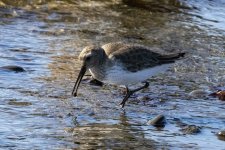
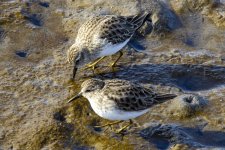
The challenge is how to harvest efficiently the energy in this thin layer (a few millimeters thick). Scientific research over the last 30 years has shown that Western sandpipers have evolved long fine bristles on their tongue (like a toothbrush) to capture the biofilm.
A01WesternSandpipers8069.jpg
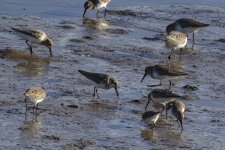
Over half of their diet consists of biofilms during these migratory refueling stops. Other small shorebirds, such as least sandpipers
A03LeastSandpiper1221.jpg
A04LeastSandpipers1201.jpg
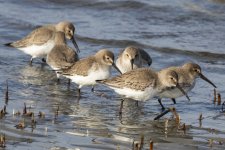
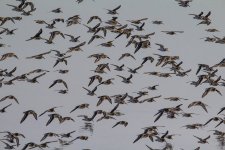
and dunlins
A05aDunlins0233.jpg
A06DunlinsInFlight0241.jpg
also have bristles on their tongues and also incorporate substantial volumes of biofilms in their diet during migration. However, bristles are largely absent or are poorly developed in larger shorebirds, such as curlews and godwits, which feed predominantly on larger burrowing invertebrates. These biofilm feeders use surface tension to draw up a wet drop of sediment into the bill tip.
In the next image, you can see a mud droplet at the tip of the bill of this western sandpiper.
A02WesternSandpiper9800.jpg
As the bird continues to open its bill, the droplet is carried up from the tip of the bill – surface tension transport. In the next image, the central dunlin is using surface tension to draw the mud droplet higher up its bill.
A05Dunlins&LeastSandpiper0275.jpg
The bird’s tongue can then sweep through the ball of mud to trap the organic material and microorganisms.
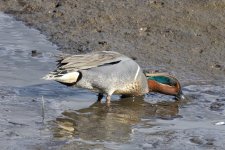
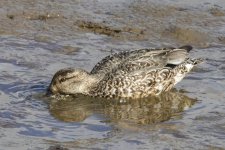
In the spring at Nisqually NWR, green-winged teals also spend a large amount of their foraging effort processing fine surface muds with their bills. While most studies assume that these ducks are using the fine lamellae (comb-like structures) on their bills to filter copepods and other invertebrates from the sediment, they may also be consuming biofilms.
A07GreenWingedTealDrakeSlurpingBiofilm5619.jpg
A08GreenWingedTealHenFilteringBiofilm5611.jpg
Unlike the 50-70 lamellae (“teeth”) on the bill of a dabbling duck like a mallard, blue-wing and green-winged teals have 120-130 lamellae – a finer filter. And the prize winners in the “most lamellae” contest are Northern shovelers with 180- 220 lamellae on their bills; shovelers are adept at filtering planktonic invertebrates from the water column. These lamellae act like the baleen plates of great whales, sieving food particles from the water column or mud.
Steve
 
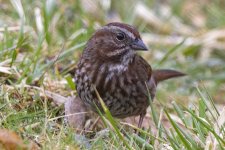
Many birds have transitioned to spring breeding mode. On my last visit to Nisqually NWR, I was struck by the cacophony of bird sounds all around me along the Twin Barns loop. Pine siskins and newly-returned tree swallows twittered continuously high in the canopy. Across the refuge, male song sparrows advertised their territories to potential rivals and their availability to potential mates.
B03SongSparrow5327.jpg
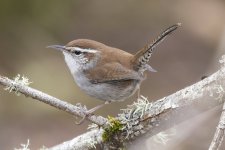
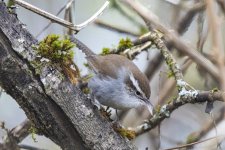
The usually elusive male Bewick’s wrens were singing at the edges of the forests.
B04BewicksWren5428.jpg
B05BewicksWrenSinging5470.jpg
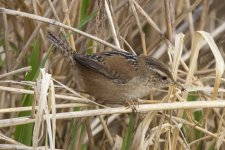
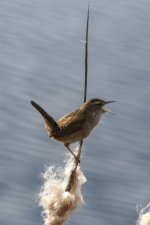
Male marsh wrens are singing from the dead cattails on either side of the causeway separating the freshwater and saltwater marshes.
B06MarshWren5764.jpg
B07MarshWrenSinging5552.jpg
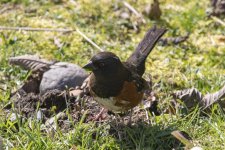
Male rufous-sided towhees have also started singing from their territories.
B07SpottedTowheeMale5546.jpg
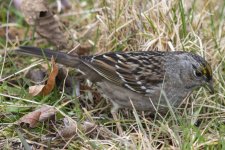
While some species have returned from their wintering sites, other species that spent the winter at Nisqually may have already departed. Three flocks of golden-crowned sparrows could consistently be found feeding on young grass shoots adjacent to the trails.
B08GoldenCrownedSparrow5442.jpg
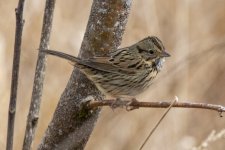
But I did not see any golden-crowned sparrows during my visit last Tuesday. They may have headed north to their breeding areas in B.C., the Yukon, and Alaska. The Lincoln’s sparrow that had been hanging around with the golden-crowned sparrows did not accompany them as I saw it off the dike trail on Tuesday.
B09LincolnsSparrow5766.jpg
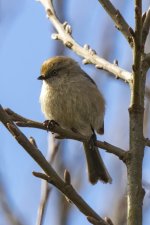
Longer days and warmer weather have stimulated new plant growth and increased activity of insects. In response, the insectivorous birds have taken advantage of this burst of potential food. These include bushtits,
B10BushtitFemale5541.jpg
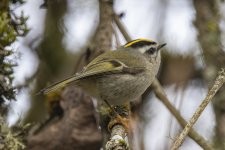
golden-crowned kinglets,
B11GoldenCrownedKinglet5484.jpg
and ruby-crowned kinglets.
B12RubyCrownedKinglet5473.jpg
B13RubyCrownedKinglet5650.jpg
B14RubyCrownedKingletMale5658.jpg
While there may have been a few yellow-rumped warblers
B15YellowRumpedWarbler5335.jpg
and maybe even Townsends warblers
B16TownsendsWarbler5487.jpg
B17TownsendsWarbler5495.jpg
B18TownsendsWarbler5502.jpg
that overwintered at Nisqually, it does seem that the numbers of both have increased as spring progresses.
Steve
 
Cabezon - excellent, as usual.
We have nesting material out for our locals. The birds are really actively calling. Can’t keep the feeders filled.
The local eagles have been doing their nuptial stuff. We have a couple historical aeries in the area. Had a vulture fly through “the hood”, Burien. Highly unusual.
Going to be a fun spring.
 
Back
Top