Navigation
Install the app
How to install the app on iOS
Follow along with the video below to see how to install our site as a web app on your home screen.
Note: This feature may not be available in some browsers.
More options
Style variation
You are using an out of date browser. It may not display this or other websites correctly.
You should upgrade or use an alternative browser.
You should upgrade or use an alternative browser.
Got any bird pics?
- Thread starter Wadin' Boot
- Start date


Diving ducks (in contrast to “puddle ducks” / “dabbling ducks”) actually belong to two separate duck “tribes”, the Mergini (or seaducks with 20 species, for example: long-tailed ducks, harlequins, eiders, scoters, goldeneyes, and buffleheads) and the Aythyini (with 15 species, for example: pochards, canvasbacks, and redheads). Studies have shown that these diving ducks have evolved higher oxidative capacities in their leg muscles, which power underwater movement in most species. Unlike the dabbling ducks whose larger wings allow them to spring into flight directly, diving ducks use their feet running along the water’s surface to augment the power provided by their wings to gain enough lift for flight. The legs of diving ducks are placed farther back on their bodies. This facilitates swimming underwater but limits their agility on land.
Hooded mergansers are my third favorite duck, after wood ducks and harlequin ducks.
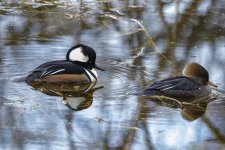
Both sexes can raise and lower their “hood”. The drakes have black heads and large white patches as part of the crest; males also have chestnut flanks that contrast with white stripes against other black flight feathers along their backs.
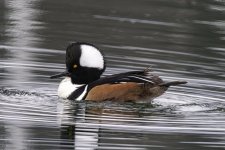
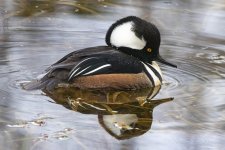
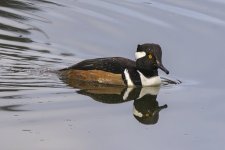
The crests of hooded merganser hens are solid brown and their flanks are brown-gray.
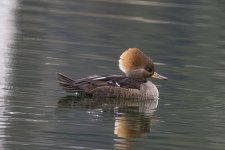 This more subdued plumage provides more camouflage when the hens are guiding their duckling.
These small ducks capture fish, aquatic insects, crabs, and crayfish with their serrated bills. In the Olympia area, they are common at the Swantown Marina and Budd Inlet. There are also a pair or two to be found at the Billie Frank Jr. Nisqually NWR in both the freshwater canals and the estuarine waters. Like the unrelated wood ducks (and like many common mergansers), hooded mergansers nest in holes in trees or in artificial nest boxes.
Goldeneyes are the sister group to the mergansers. Common goldeneyes are quite common in the Salish Sea. Drakes are relatively easy to identify with their white flanks and the round white spot at the base of the bill on the black head.
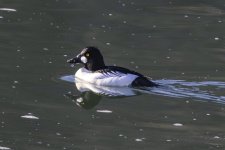
Barrow’s goldeneyes are also common in the Salish Sea, but they have a crescent-shaped white spot.
Goldeneye hens have brown heads and gray bodies.
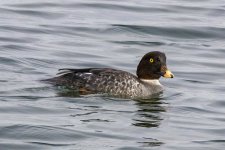
Like some mergansers, common goldeneyes are also tree-nesters. They feed on invertebrates and fish primarily.
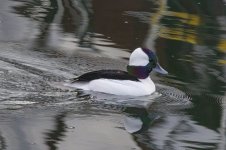
Buffleheads are a common sight in both freshwater ponds and the marine environment in Western Washington. The body plumage of drakes consists of a bright white breast and a black back. The head has a large white patch at the back of its head on a background of iridescent green / purple feathers.
As with other ducks, the plumage of a bufflehead hen is more muted: more grey on the breast and sides, and with a much smaller white patch and dark, non-iridescent feathers on her head.
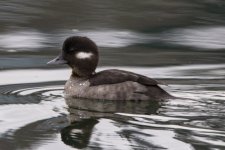
During their 12-25s dives, buffleheads search for invertebrates, such as insect larvae, crustaceans, snails and clams, and small fishes. Normally, it seems that buffleheads, even when in small groups, are foraging solitarily as their dives are not tightly synchronized. But several times this fall, I saw groups of a dozen or more buffleheads diving in synchrony along a muddy bank, similar to the coordinated group feeding that one sees by red-breasted mergansers and common mergansers to drive / ambush schooling fish. In fall, buffleheads may eat seeds of pondweeds and bulrushes.
Bufflehead hens nest in tree cavities, especially abandoned nest holes dug by Northern flickers (and artificial nest boxes too). In fact, the breeding range of buffleheads largely coincides with that of the Northern flicker. As one of the smallest diving ducks (and tree nesters), the small opening in a flicker hole excludes other duck species.
To the casual observer, ring-necked ducks appear to be misnamed; they should be named ring-billed ducks. The most prominent aspect of a drake’s appearance is a white ring between the black tip and the gray body of the bill.
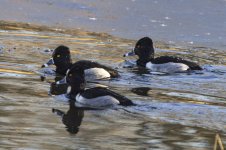
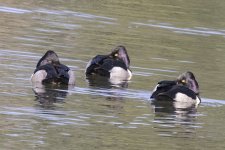
But with his neck fully extended (not shown), a drake ring-necked duck will have a ring of cinnamon feathers at the base of the black neck and above the black breast and back feathers, hence the common name. Hens have gray heads, a white ring on her bill, brown breast and sides, and white eye rings.
Ring-billed ducks feed on both aquatic invertebrates and submerged plants. They nest in deep vegetation of freshwater marshes, often on floating vegetation to reduce predation by land-based predators.
The two scaup species, lesser and greater, can be a real challenge to identify. The differences are fairly subtle. But I think that I have images of the drakes of each scaup species. The first, a greater scaup, was taken in the salt water at Tokeland.
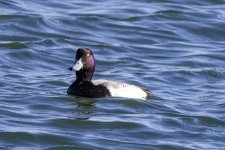
Greater scaups tend to be more common than are lesser scaups in the marine environment (but not exclusively). Several aspects of this bird led me to the decision of greater scaup. First (but not visible in this image), the head is rounded. Second, this bird has a large, wide bill with a large black nail at its tip. Finally, the head not very “tall” (distance from eye to top of the head). The only fly in the I.D. is that this purple sheen on the head is typically associated with lesser scaups; however, the green vs. purple sheen may be an unreliable field mark and very dependent on ambient lighting.
A week or so later, I encountered several pairs of lesser scaup at Capitol Lake, Olympia, a freshwater lake (at present…).
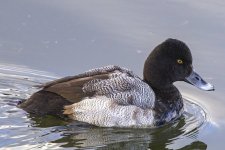
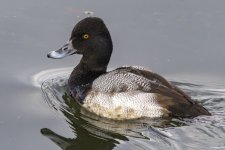
In these drakes, you can see a peak at the rear of the head. The head is taller. And the bill is narrower. The drakes were paired up with hens which I assume were also lesser scaups
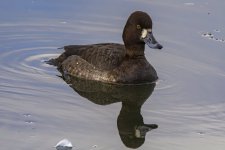
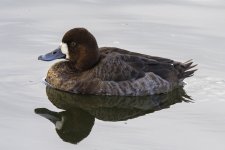
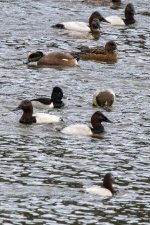
While visiting Capitol Lake, I also saw two other diving duck species, a large flock of canvasbacks and a solitary redhead drake. These and other ducks were resting 50-75’ offshore, but they were quite suspicious of me with my telephoto lens. I have not encountered either species when visiting other locations in Western Washington, though they are reported to use both marine and freshwater areas. They seem to prefer larger bodies of freshwater. Canvasbacks are quite distinctive with their long, sloping black bills. Drakes have red-brown heads, bright red eyes, a black breast, and white backs and sides. Hens have darker gray heads and breasts and lighter gray sides and backs.
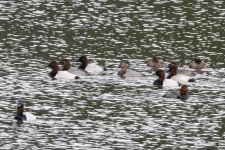
I didn’t notice the redhead drake in the mix (lower right of image above) until I looked at the pictures. The redhead drake is smaller than the canvasback, has a smaller blue bill, and gray sides and back. Mixed in with the canvasbacks were ring-necked ducks and American wigeons.
Our final diving duck is the surf scoter, another member of the Mergini tribe of diving ducks (along with the harlequins, eiders, goldeneyes, and mergansers). These are primarily marine in the winter and are common sights at Tokeland, off Westport, and in the Salish Sea. While the hens have a dark-brown plumage, the drakes are all black with a white patch on the forehead and the back of the neck.
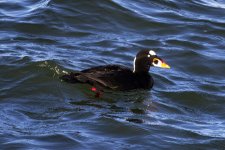
Drakes also have a large sloped bill whose front half is orange and back half is white with a large black dot.
Steve
Hooded mergansers are my third favorite duck, after wood ducks and harlequin ducks.
Both sexes can raise and lower their “hood”. The drakes have black heads and large white patches as part of the crest; males also have chestnut flanks that contrast with white stripes against other black flight feathers along their backs.
The crests of hooded merganser hens are solid brown and their flanks are brown-gray.
This more subdued plumage provides more camouflage when the hens are guiding their duckling.These small ducks capture fish, aquatic insects, crabs, and crayfish with their serrated bills. In the Olympia area, they are common at the Swantown Marina and Budd Inlet. There are also a pair or two to be found at the Billie Frank Jr. Nisqually NWR in both the freshwater canals and the estuarine waters. Like the unrelated wood ducks (and like many common mergansers), hooded mergansers nest in holes in trees or in artificial nest boxes.
Goldeneyes are the sister group to the mergansers. Common goldeneyes are quite common in the Salish Sea. Drakes are relatively easy to identify with their white flanks and the round white spot at the base of the bill on the black head.
Barrow’s goldeneyes are also common in the Salish Sea, but they have a crescent-shaped white spot.
Goldeneye hens have brown heads and gray bodies.
Like some mergansers, common goldeneyes are also tree-nesters. They feed on invertebrates and fish primarily.
Buffleheads are a common sight in both freshwater ponds and the marine environment in Western Washington. The body plumage of drakes consists of a bright white breast and a black back. The head has a large white patch at the back of its head on a background of iridescent green / purple feathers.
As with other ducks, the plumage of a bufflehead hen is more muted: more grey on the breast and sides, and with a much smaller white patch and dark, non-iridescent feathers on her head.
During their 12-25s dives, buffleheads search for invertebrates, such as insect larvae, crustaceans, snails and clams, and small fishes. Normally, it seems that buffleheads, even when in small groups, are foraging solitarily as their dives are not tightly synchronized. But several times this fall, I saw groups of a dozen or more buffleheads diving in synchrony along a muddy bank, similar to the coordinated group feeding that one sees by red-breasted mergansers and common mergansers to drive / ambush schooling fish. In fall, buffleheads may eat seeds of pondweeds and bulrushes.
Bufflehead hens nest in tree cavities, especially abandoned nest holes dug by Northern flickers (and artificial nest boxes too). In fact, the breeding range of buffleheads largely coincides with that of the Northern flicker. As one of the smallest diving ducks (and tree nesters), the small opening in a flicker hole excludes other duck species.
To the casual observer, ring-necked ducks appear to be misnamed; they should be named ring-billed ducks. The most prominent aspect of a drake’s appearance is a white ring between the black tip and the gray body of the bill.
But with his neck fully extended (not shown), a drake ring-necked duck will have a ring of cinnamon feathers at the base of the black neck and above the black breast and back feathers, hence the common name. Hens have gray heads, a white ring on her bill, brown breast and sides, and white eye rings.
Ring-billed ducks feed on both aquatic invertebrates and submerged plants. They nest in deep vegetation of freshwater marshes, often on floating vegetation to reduce predation by land-based predators.
The two scaup species, lesser and greater, can be a real challenge to identify. The differences are fairly subtle. But I think that I have images of the drakes of each scaup species. The first, a greater scaup, was taken in the salt water at Tokeland.
Greater scaups tend to be more common than are lesser scaups in the marine environment (but not exclusively). Several aspects of this bird led me to the decision of greater scaup. First (but not visible in this image), the head is rounded. Second, this bird has a large, wide bill with a large black nail at its tip. Finally, the head not very “tall” (distance from eye to top of the head). The only fly in the I.D. is that this purple sheen on the head is typically associated with lesser scaups; however, the green vs. purple sheen may be an unreliable field mark and very dependent on ambient lighting.
A week or so later, I encountered several pairs of lesser scaup at Capitol Lake, Olympia, a freshwater lake (at present…).
In these drakes, you can see a peak at the rear of the head. The head is taller. And the bill is narrower. The drakes were paired up with hens which I assume were also lesser scaups
While visiting Capitol Lake, I also saw two other diving duck species, a large flock of canvasbacks and a solitary redhead drake. These and other ducks were resting 50-75’ offshore, but they were quite suspicious of me with my telephoto lens. I have not encountered either species when visiting other locations in Western Washington, though they are reported to use both marine and freshwater areas. They seem to prefer larger bodies of freshwater. Canvasbacks are quite distinctive with their long, sloping black bills. Drakes have red-brown heads, bright red eyes, a black breast, and white backs and sides. Hens have darker gray heads and breasts and lighter gray sides and backs.
I didn’t notice the redhead drake in the mix (lower right of image above) until I looked at the pictures. The redhead drake is smaller than the canvasback, has a smaller blue bill, and gray sides and back. Mixed in with the canvasbacks were ring-necked ducks and American wigeons.
Our final diving duck is the surf scoter, another member of the Mergini tribe of diving ducks (along with the harlequins, eiders, goldeneyes, and mergansers). These are primarily marine in the winter and are common sights at Tokeland, off Westport, and in the Salish Sea. While the hens have a dark-brown plumage, the drakes are all black with a white patch on the forehead and the back of the neck.
Drakes also have a large sloped bill whose front half is orange and back half is white with a large black dot.
Steve

Gyrfalcon22
Legend
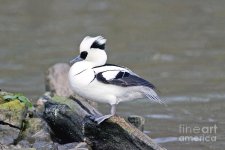
Great stuff, Steve ! I am with you on your favorite ducks in order. My 4th is likely the exotic looking Smew of Asia, mostly-occasionally Alaska. Ultra rare in WA.
Handsome male below.
40+ years ago birding populations were different locally. I was a kid with binoculars and a bird book, with expansive sheet water to look at thousands of ducks in big resting flocks. We had Canvasback and Redheads mixed in at times with all the regulars. There were few eagles, few geese and the only swans were Whistling (Tundra). Wood ducks were common enough in these open flocks on the fringes. I never see them mixed in anymore. Just in hidden ponds it seems now.
Handsome male below.
40+ years ago birding populations were different locally. I was a kid with binoculars and a bird book, with expansive sheet water to look at thousands of ducks in big resting flocks. We had Canvasback and Redheads mixed in at times with all the regulars. There were few eagles, few geese and the only swans were Whistling (Tundra). Wood ducks were common enough in these open flocks on the fringes. I never see them mixed in anymore. Just in hidden ponds it seems now.
Last edited:

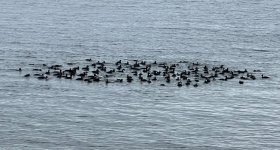
Surf Scoters
SF
SF

That's a scoter-palooza! I don't usually see them in big groups like that - interesting and thanks for posting!Surf Scoters
SF
Cabezon - nice list of favorites. I agree, not sure what my rating would be.
Excellent pics and commentary. I still like drake widgeons too.
Never stop educating us. I know some stuff but not the small details.
Thanks for your continuing commentary.
Excellent pics and commentary. I still like drake widgeons too.
Never stop educating us. I know some stuff but not the small details.
Thanks for your continuing commentary.

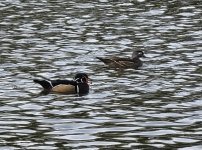

Ruddy's are pretty & funny. That blue bill and the nuptial display is great!


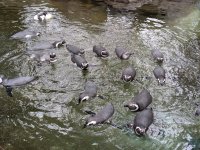
Does it count if they're at a zoo?
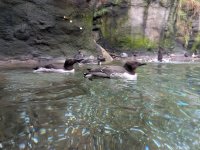
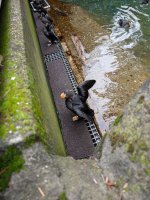
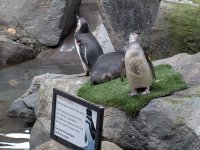

Son and I did a roadtrip El Paso to Denver, stopped to do some birding on the way-
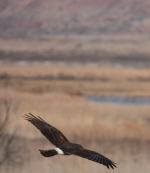
Bitter Lake Wildlife Refuge outside of Roswell- there were a handful of Northern Harrier, but no Sandhill Cranes, we missed them by a few weeks, they were already heading north
But managed to catch up with the cranes 300 miles north in the San Luis Valley in Colorado- I think that's a red tailed hawk above the cranes
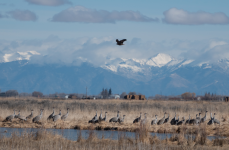
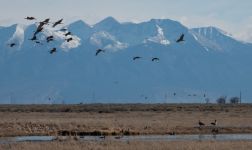
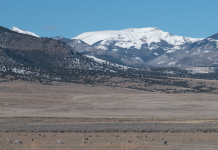
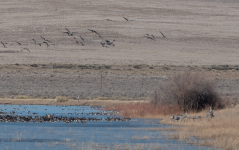
Cranes vs Geese- geese hanging in some of the seeps that were not frozen. And in the background, those white dots in the photo below are pronghorn
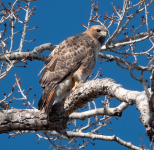
Pays to look up in the relatively rare trees. Saw a kestrel, a white bellied, white under wing raptor (?ferruginous?) heard an owl, but only got a photo of this guy
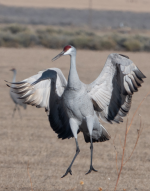
While we were at the Monte Vista wildlife refuge hundreds and hundreds of cranes were arriving from the south. Geese too. There was just a beautiful sound of all these birds, not just the calls, but the sounds of the wings beating as they came in to land in some of these fields. Monte Vista has a Crane Festival in the first week of March each year, so maybe not peak crane, but on the other hand, seemed plenty busy with birds- fortunately for us, no crowds at all.
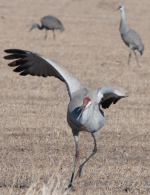
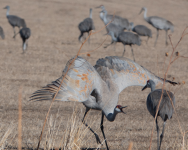
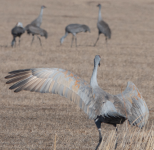
wishing I had a slightly better lens
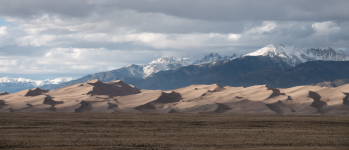
the other highlight of this valley is Great Sand Dune National Park. Originally we were planning on a morning trip there, but changed to an afternoon an account of weather. We lucked out when the sun came out towards the end of the day. One opportunistic Raven was lurking up in the dunes...
Bitter Lake Wildlife Refuge outside of Roswell- there were a handful of Northern Harrier, but no Sandhill Cranes, we missed them by a few weeks, they were already heading north
But managed to catch up with the cranes 300 miles north in the San Luis Valley in Colorado- I think that's a red tailed hawk above the cranes
Cranes vs Geese- geese hanging in some of the seeps that were not frozen. And in the background, those white dots in the photo below are pronghorn
Pays to look up in the relatively rare trees. Saw a kestrel, a white bellied, white under wing raptor (?ferruginous?) heard an owl, but only got a photo of this guy
While we were at the Monte Vista wildlife refuge hundreds and hundreds of cranes were arriving from the south. Geese too. There was just a beautiful sound of all these birds, not just the calls, but the sounds of the wings beating as they came in to land in some of these fields. Monte Vista has a Crane Festival in the first week of March each year, so maybe not peak crane, but on the other hand, seemed plenty busy with birds- fortunately for us, no crowds at all.
wishing I had a slightly better lens
the other highlight of this valley is Great Sand Dune National Park. Originally we were planning on a morning trip there, but changed to an afternoon an account of weather. We lucked out when the sun came out towards the end of the day. One opportunistic Raven was lurking up in the dunes...
Last edited:
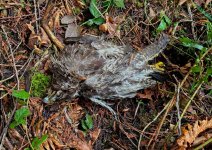
It looks like a juvenile red-tailed hawk. That first year is very tough on hawks, high mortality rates approaching 80% or more. If they make it through the second year, their life expectancy increases to 10-15 years.Had to settle for a dead bird pic today. Can't tell if this raptor (redtail?) was prey, or died of other causes. Feathers were scattered around, so looks like something was feeding on it. Found at the base of a large cedar.
View attachment 142710
Steve
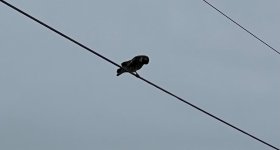
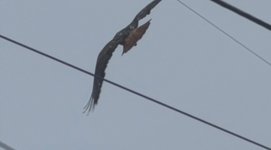
Saw this bird yesterday. Red Tail Hawk I believe. Sorry for the lousy pics.
SF
SF
I see Red Tailed Hawks hunting along I-205 in Oregon on occasion.Saw this bird yesterday. Red Tail Hawk I believe. Sorry for the lousy pics.
SF
View attachment 142714View attachment 142715

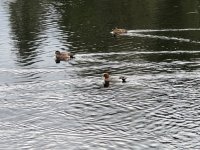
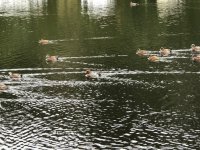
Saw this Eurasian Wigeon mixed in with the local Wigeons at a local pond the other day. Not sure if I’ve ever seen one before.
I always look for those at a pond in Normandy Park. Nada this year. But, nice harlequins.

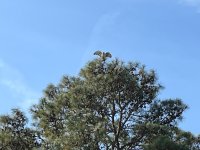
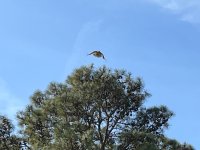

A few of the several dozen Robins that have been working the backyard since the snow melted. Can't remember seeing so many together before.