Navigation
Install the app
How to install the app on iOS
Follow along with the video below to see how to install our site as a web app on your home screen.
Note: This feature may not be available in some browsers.
More options
Style variation
You are using an out of date browser. It may not display this or other websites correctly.
You should upgrade or use an alternative browser.
You should upgrade or use an alternative browser.
Got any bird pics?
- Thread starter Wadin' Boot
- Start date

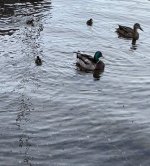
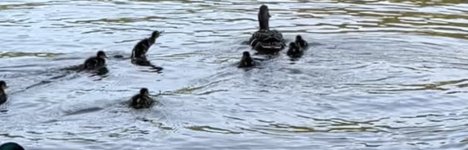
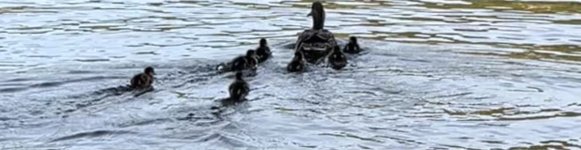

tkww
Life of the Party
Watched a Black-crowned Night Heron struggle for a while with a large garter snake, a struggle it eventually lost.
In other news, this is the third goose to use this nest. This is the first time can remember seeing a nest reuse, let alone 3 in a row. This third goose was circling around island while the newly-hatched batch from the 2nd pair had yet to get in the water. The moment they left she was right up on the nest.
The other thing that stands out is the level of territorial behavior with each successive pair. The first pair's male wouldn't let any other goose within 30-40 yards. Sometimes he'd go off and fight geese 60+ yards away. 2nd pair...maybe 20 yards was the limit. 3rd pair...I've seen geese 5-10 yards away. Goslings from other geese feeding around the same island. Just don't really seem to care much at all. Kinda funny.
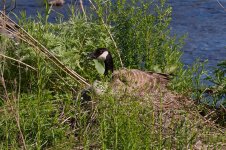
In other news, this is the third goose to use this nest. This is the first time can remember seeing a nest reuse, let alone 3 in a row. This third goose was circling around island while the newly-hatched batch from the 2nd pair had yet to get in the water. The moment they left she was right up on the nest.
The other thing that stands out is the level of territorial behavior with each successive pair. The first pair's male wouldn't let any other goose within 30-40 yards. Sometimes he'd go off and fight geese 60+ yards away. 2nd pair...maybe 20 yards was the limit. 3rd pair...I've seen geese 5-10 yards away. Goslings from other geese feeding around the same island. Just don't really seem to care much at all. Kinda funny.

Uptonogood
PNW raised
Wish I had my Canon instead of my IPhone for this one!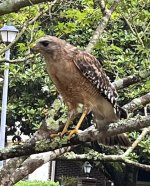

In Oregon? That’s very unusual. Sure they aren’t dark-eyed juncos or something else? Also, tufted titmouse are mostly gray.The little brown birds that visit my bird feeder are known here as "titmouse".

I wonder if hormone levels are dropping as we are reaching the end of the goose nesting season (and deep into the gosling nurturing phase).Watched a Black-crowned Night Heron struggle for a while with a large garter snake, a struggle it eventually lost.
View attachment 114495
In other news, this is the third goose to use this nest. This is the first time can remember seeing a nest reuse, let alone 3 in a row. This third goose was circling around island while the newly-hatched batch from the 2nd pair had yet to get in the water. The moment they left she was right up on the nest.
The other thing that stands out is the level of territorial behavior with each successive pair. The first pair's male wouldn't let any other goose within 30-40 yards. Sometimes he'd go off and fight geese 60+ yards away. 2nd pair...maybe 20 yards was the limit. 3rd pair...I've seen geese 5-10 yards away. Goslings from other geese feeding around the same island. Just don't really seem to care much at all. Kinda funny.
View attachment 114496
Steve

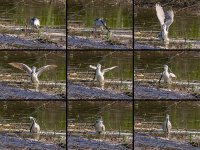
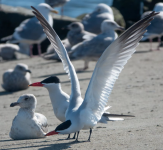
Shooting for motion
(incidentally Caspian tern numbers seem low compared to years past- bird flu?)
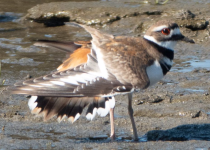
Once I realized what the broken wing dance actually means I back way off shooting the killdeer
Almost like this guy is saluting!
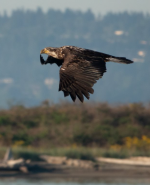
(incidentally Caspian tern numbers seem low compared to years past- bird flu?)
Once I realized what the broken wing dance actually means I back way off shooting the killdeer
Almost like this guy is saluting!
My guess would be bustit, not titmouse.
Bushtit.....My guess would be bustit, not titmouse.
I wear glasses, the light brown could be grey, I know what a Junco looks like. Backed up by book called "Birds of the Willamette Valley Region". In the book the bird is called "Bushtit" page 257.In Oregon? That’s very unusual. Sure they aren’t dark-eyed juncos or something else? Also, tufted titmouse are mostly gray.
Last edited:
Bushtits also tend to come in groups. They are a cute little bird and build an incredible nest!
That makes a lot more sense! Two different birds--the bushtit and the tufted titmouse.I wear glasses, the light brown could be grey, I know what a Junco looks like. Backed up by book called "Birds of the Willamette Valley Region". In the book the bird is called "Bushtit" page 257.
<div style="width:100%;height:0;padding-bottom:100%;position:relative;"><iframe src="https://giphy.com/embed/CKVwcljYh4hfVxSSLq" width="100%" height="100%" style="position:absolute" frameBorder="0" class="giphy-embed" allowFullScreen></iframe></div><p><a href="">via GIPHY</a></p>
huh huh, I wrote bushtit

Sometimes if you clamber up the cliffs of coastal headlands, ford raging runoff creeks, claw your way through the devil's club, trudge through dripping rain forest and scrape the ticks from your legs with a knife blade you get lucky enough to take a usable photo.
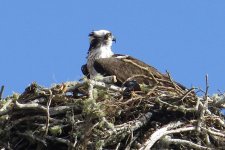
Other times you just rest your lens on the driver's side window.
Other times you just rest your lens on the driver's side window.
McLane Creek, May 1 & 13. Cuteness Overload. When I visited the pond at McLane Creek on May 1st, there were several mallard drakes and wood duck drakes visible, but no hens and no ducklings. But when my wife and I returned on May 13th, we anticipated that there would be duckling galore and we were right. After we walked out to the pier that leads out into the pond, we had to wait only a few minutes before a mallard hen shepherded her active brood of 5 ducklings through the Western pond lily pads.
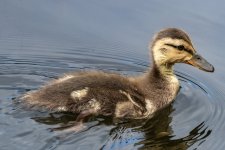
Later, we spied another mallard hen watching over her brood at the far end of the pond.
Ducklings and goslings (and quail, chicken, and turkey chicks, etc.) are precocial (vs. altricial). As a general category, precocial birds are capable of feeding themselves soon after they are hatched and have left the nest (though there are degrees of precocial abilities). For ducks, parents serve a protective function and may guide their ducklings to rich food sources. These ducklings cannot fly yet and are much smaller than the hen. In contrast, the young of altricial species, such as robins or eagles, remain in a nest for weeks and are actively fed by one or both parents. During that period, they develop their flight feathers and grow to a size close to that of their parents before they fledge out of the nest.
Based in their size, these mallard ducklings were at least a week old. A week or so earlier, I had taken pictures of very young mallard ducklings and their mom from Nisqually Wildlife Refuge. These Nisqually ducklings were tiny fuzzballs, but the McLane ducklings looked more like miniature ducks.
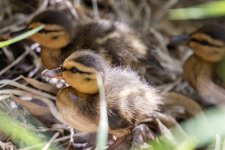
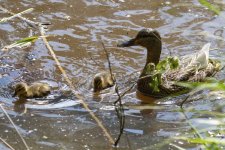
A few minutes later, I spotted a lone tiny duckling in the middle of a sea of lily pads. It was a wood duck duckling and as I scanned around the area, I could see several siblings zooming around. And then, we saw mom, close by us where she had emerged from under some overhanging shrubs along the shoreline. While not a brightly-marked as the wood duck drake, her plumage has a subtle elegance too.
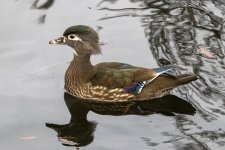
She generated a constant stream of low-decibel contact calls so that her brood of six duckling knew where she was. These wood duck duckling were the definition of chaotic; I had a hard time tracking them and using a fast enough shutter speed for a sharp image.
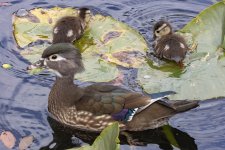
And I kept looking for where to install the key to wind them up – like a child’s toys. They were in constant motion as they zoomed over the surface of the pond.
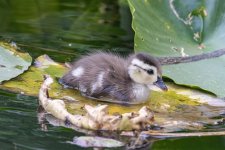
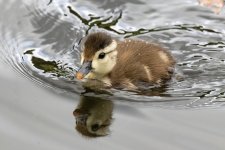
Like a miniature motor boat, this wood duck duckling is generating a significant bow waves as it frenetically zooms around the pond.
Steve
Later, we spied another mallard hen watching over her brood at the far end of the pond.
Ducklings and goslings (and quail, chicken, and turkey chicks, etc.) are precocial (vs. altricial). As a general category, precocial birds are capable of feeding themselves soon after they are hatched and have left the nest (though there are degrees of precocial abilities). For ducks, parents serve a protective function and may guide their ducklings to rich food sources. These ducklings cannot fly yet and are much smaller than the hen. In contrast, the young of altricial species, such as robins or eagles, remain in a nest for weeks and are actively fed by one or both parents. During that period, they develop their flight feathers and grow to a size close to that of their parents before they fledge out of the nest.
Based in their size, these mallard ducklings were at least a week old. A week or so earlier, I had taken pictures of very young mallard ducklings and their mom from Nisqually Wildlife Refuge. These Nisqually ducklings were tiny fuzzballs, but the McLane ducklings looked more like miniature ducks.
A few minutes later, I spotted a lone tiny duckling in the middle of a sea of lily pads. It was a wood duck duckling and as I scanned around the area, I could see several siblings zooming around. And then, we saw mom, close by us where she had emerged from under some overhanging shrubs along the shoreline. While not a brightly-marked as the wood duck drake, her plumage has a subtle elegance too.
She generated a constant stream of low-decibel contact calls so that her brood of six duckling knew where she was. These wood duck duckling were the definition of chaotic; I had a hard time tracking them and using a fast enough shutter speed for a sharp image.
And I kept looking for where to install the key to wind them up – like a child’s toys. They were in constant motion as they zoomed over the surface of the pond.
Like a miniature motor boat, this wood duck duckling is generating a significant bow waves as it frenetically zooms around the pond.
Steve

Gyrfalcon22
Legend
Always incredible to find baby grouse or quail and see how well they "fly" when still just small things. They can truly take to the wing for short burst .
Here was a young sooty grouse I found hiking that was briefly left behind when I spooked a mother herding her brood. A few this size flew up onto a bank to escape.
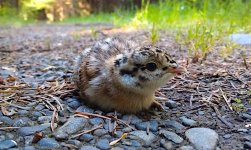
Here was a young sooty grouse I found hiking that was briefly left behind when I spooked a mother herding her brood. A few this size flew up onto a bank to escape.
Last edited:
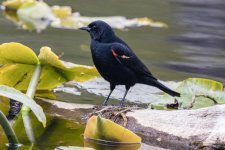
McLane Creek, May 1 & 13. Odds and Ends and Biological Tales – Bird Edition. When I think about freshwater marshes and small ponds, the sounds that are most prominent in my mind are the deep booming calls of bullfrogs and the loud high-pitched trills of red-winged blackbirds. Red-winged blackbirds may be the most common land bird in the U.S. During the breeding season, males establish territories in a marsh or the margins of a pond. They vigorously defend these territories from other males and even much larger birds, such as bald eagles. Males sing from prominent perches within their territories;
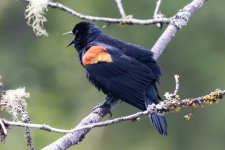
as they sing, they display their bright red shoulder patches.
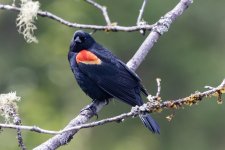
But when not singing, a male can hide his prominent shoulder patches.
The plumage of females is far more cryptic – an oversized sparrow.
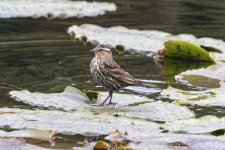
When not singing, we watched the male dance over the top of the lily pads for a meal. The female that we saw did the same, even lifting the edges of some lily pads to search for insect larvae hiding under the blade.
Some territories are better than others: more abundant food resources, better protection for a nest against predators. Therefore, while females prefer to be the only mate of a territorial male blackbird, she will join the “harem” of females within the territory of male with a particularly good territory, a polygynous (many females) reproductive strategy. A single male may have a dozen females nesting within his territory. There are also some advantages of having multiple birds to drive off potential predators that come too close to the territory.
However, genetic evidence proves that a female isn’t especially faithful to the male in whose territory she builds her nest (and vice versa). It doesn’t take long for birds to “do the deed” (or “make whoopee” for fans of the classic “Newlyweds Game” show). Genetic screening of the paternity of the offspring of many “monogamous” birds has shown that some “straying” is quite common, even among socially-monogamous species. And some females even lay their eggs in the nests of another female for the other female to raise.
Male white-crowned sparrows also defend territories; they will find a prominent perch in their territory and loudly proclaim their availability (and alert rival males to stay away).
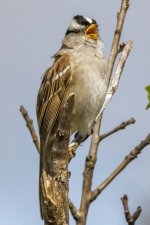
Typically, he will be socially monogamous with a single female for a single breeding season. While the female builds the nest and incubates the eggs, both putative parents feeds the hatchlings. When the two birds migrate back to the breeding grounds the next year, there is a 60-ish% chance that they will pair up again. But as with the red-winged blackbirds, there is some extra-pair “hanky-panky” with as many 40% of the chicks not sharing genes with the putative male of the pair.
As we continued our walk around the pond, the bird ID app, Merlin, indicated that there were several black-headed grosbeaks vocalizing in the forest. After searching the shrubs, we spotted the male who popped into view for a picture or two.
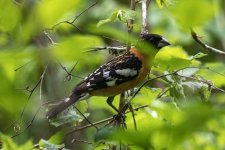
His mate also popped into view briefly before they both headed off deeper in the shrubbery
These birds, related to cardinals, migrate back to the PNW in spring from their wintering grounds in Central Mexico. I had seen my first male black-headed grosbeak of the spring at our bird feeders only a day or so earlier. They are huge fans of the black sunflower seeds in our bird feeders; males, females, and offspring will just land on the perch on the feeder and just chow down for long periods, like an all-you-can-eat buffet.
What I didn’t know previously is that when these black-headed grosbeaks are in Mexico, they are major predators on monarch butterflies that have also migrated there during the winter. This is VERY unusual because monarchs are known to the chemically-defended against most predators. The monarch caterpillars sequester (store) cardiac glycosides that are produced by milkweed plants to deter herbivores. Cardiac glycosides interfere with ion pumps critical for proper muscle function, including heart muscles. But monarch butterflies have mutations that lead to ion pumps that are not blocked by cardiac glycosides. Therefore, very few organisms eat milkweed plants and very few predators eat monarch butterflies and their caterpillars (and live). The bright coloration of monarch caterpillars and adults serve as warning coloration (aposematic coloration) that warns potential predators to even mess with them. So, how can black-headed grosbeaks chow down on monarchs at their winter roosts in Mexico? Well, black -headed grosbeak have several mutations to the genes that produce ions pumps such that the pumps are unaffected by the cardiac glycosides in monarchs too. So, monarch butterflies are on their menu in winter.
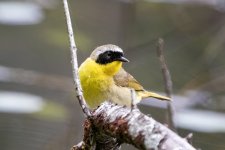
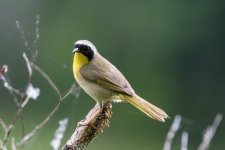
Later, we had great views of a male common yellowthroat warbler. Because their calls and songs are distinctive, you know that they are around somewhere in the rushes or the dense riparian shrubs. But they are often shy, but this bird was very cooperative.
Steve
as they sing, they display their bright red shoulder patches.
But when not singing, a male can hide his prominent shoulder patches.
The plumage of females is far more cryptic – an oversized sparrow.
When not singing, we watched the male dance over the top of the lily pads for a meal. The female that we saw did the same, even lifting the edges of some lily pads to search for insect larvae hiding under the blade.
Some territories are better than others: more abundant food resources, better protection for a nest against predators. Therefore, while females prefer to be the only mate of a territorial male blackbird, she will join the “harem” of females within the territory of male with a particularly good territory, a polygynous (many females) reproductive strategy. A single male may have a dozen females nesting within his territory. There are also some advantages of having multiple birds to drive off potential predators that come too close to the territory.
However, genetic evidence proves that a female isn’t especially faithful to the male in whose territory she builds her nest (and vice versa). It doesn’t take long for birds to “do the deed” (or “make whoopee” for fans of the classic “Newlyweds Game” show). Genetic screening of the paternity of the offspring of many “monogamous” birds has shown that some “straying” is quite common, even among socially-monogamous species. And some females even lay their eggs in the nests of another female for the other female to raise.
Male white-crowned sparrows also defend territories; they will find a prominent perch in their territory and loudly proclaim their availability (and alert rival males to stay away).
Typically, he will be socially monogamous with a single female for a single breeding season. While the female builds the nest and incubates the eggs, both putative parents feeds the hatchlings. When the two birds migrate back to the breeding grounds the next year, there is a 60-ish% chance that they will pair up again. But as with the red-winged blackbirds, there is some extra-pair “hanky-panky” with as many 40% of the chicks not sharing genes with the putative male of the pair.
As we continued our walk around the pond, the bird ID app, Merlin, indicated that there were several black-headed grosbeaks vocalizing in the forest. After searching the shrubs, we spotted the male who popped into view for a picture or two.
His mate also popped into view briefly before they both headed off deeper in the shrubbery
These birds, related to cardinals, migrate back to the PNW in spring from their wintering grounds in Central Mexico. I had seen my first male black-headed grosbeak of the spring at our bird feeders only a day or so earlier. They are huge fans of the black sunflower seeds in our bird feeders; males, females, and offspring will just land on the perch on the feeder and just chow down for long periods, like an all-you-can-eat buffet.
What I didn’t know previously is that when these black-headed grosbeaks are in Mexico, they are major predators on monarch butterflies that have also migrated there during the winter. This is VERY unusual because monarchs are known to the chemically-defended against most predators. The monarch caterpillars sequester (store) cardiac glycosides that are produced by milkweed plants to deter herbivores. Cardiac glycosides interfere with ion pumps critical for proper muscle function, including heart muscles. But monarch butterflies have mutations that lead to ion pumps that are not blocked by cardiac glycosides. Therefore, very few organisms eat milkweed plants and very few predators eat monarch butterflies and their caterpillars (and live). The bright coloration of monarch caterpillars and adults serve as warning coloration (aposematic coloration) that warns potential predators to even mess with them. So, how can black-headed grosbeaks chow down on monarchs at their winter roosts in Mexico? Well, black -headed grosbeak have several mutations to the genes that produce ions pumps such that the pumps are unaffected by the cardiac glycosides in monarchs too. So, monarch butterflies are on their menu in winter.
Later, we had great views of a male common yellowthroat warbler. Because their calls and songs are distinctive, you know that they are around somewhere in the rushes or the dense riparian shrubs. But they are often shy, but this bird was very cooperative.
Steve

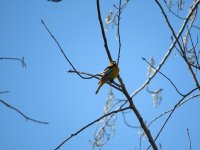
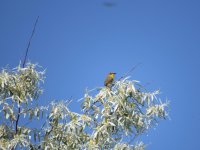
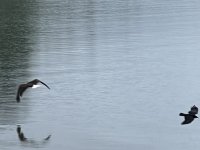
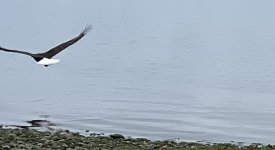
Damn birds always take flight at the wrong time.
My bird equivalent of blurry moon photos.
SF
My bird equivalent of blurry moon photos.
SF
Last edited:

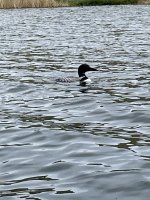
(crummy cellphone pic) This loon swam under me three times while I was fishing. Unfortunately for Ms (or Mr.?) Loon, I didn't catch any fish while the bird was in my vicinity. No trout loon theft! I'll be up in BC at the end of this month, a few of the lakes we fish are quite notorious for loons grabbing a trout while being played by an angler.

Crummy phone pic of a Great Horned Owl and a fuzzy blob of one of her downy but full size chick owlets.