
Navigation
Install the app
How to install the app on iOS
Follow along with the video below to see how to install our site as a web app on your home screen.
Note: This feature may not be available in some browsers.
More options
Style variation
You are using an out of date browser. It may not display this or other websites correctly.
You should upgrade or use an alternative browser.
You should upgrade or use an alternative browser.
Float-n-Fly for bass
- Thread starter Matt B
- Start date

downriver79
Steelhead
Never have but I know that they crush em on Shasta with the float n fly. I have a buddy who fishes a ton of tournaments there. He says a lot of the tournament guys there do well fishing float n fly on a light spinning rod.

Pink Nighty
Legend
The jigs I've seen used in this method involve a decent bit of marabou and bunny fur, stuff that moves even when it's still. Something buggery with a marabou tail and a dubbing loop of bunny fur for the hackle would probably to the trick. Balanced or not, probably doesn't matter.
They use long fixed indicators that lay on their side until the weight of the jig pulls them upright. Apparently a lot of the eats come from below, so they watch for the float to come vertical first, then watch to see if it returns to horizontal from a bite.
They use long fixed indicators that lay on their side until the weight of the jig pulls them upright. Apparently a lot of the eats come from below, so they watch for the float to come vertical first, then watch to see if it returns to horizontal from a bite.


I remember reading about it when I lived down South, for winter bass. It just *seems* like it should work.I don't have faith in it up here. I think it's mostly a spotted bass tactic and mostly warmer water.
That being said I need to play around with it more.
No, it’s essentially indicator fishing for bass, with fly lines and fly rods.Is "float-n-fly" a technique using a casting bubble with water in it for fishing flies with a spinning rod?
I know people catch striped bass using a fly behind a wooden egg, cast with a spinning rod.

Thanks.No, it’s essentially indicator fishing for bass, with fly lines and fly rods.
Yep no problem. If only somebody had worked out a way to effectively use spinning gear for bass, though.Thanks.

I'm not sure the float n fly technique would work well for flyfishing. What indicator would you use to show the vertical to horizontal movement and still fly cast decently?
EDIT:
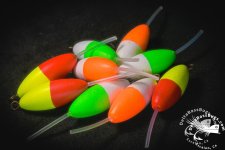
Fly rod indicators
EDIT:
Fly rod indicators
Last edited:

The guys I know down in California all use fly rods. I'll see if I can find some of their stuff online.I'm not sure the float n fly technique would work well for flyfishing. What indicator would you use to show the vertical to horizontal movement and still fly cast decently?
Here we go: Hogan Brown is one of the guys I know who is really into this.
From the article:
As a newcomer to Float N Fly, I immersed myself in instructional videos by Ryan Williams, the pioneer of this technique on Lake Oroville. Equipped with a 10-foot 6-weight Echo Stillwater rod, newly designed floats from Lost Coast Anglers, and a 1/16-ounce Black Leech with rubber legs, I delved into the nuances of this approach, distinct from fishing chironomids for trout. The substantial bobber, long leaders spanning 8 to 12 feet, weighted jigs, and the subtle movements of the bobber all contributed to the challenge. It took some practice, but as they say, “sets are free,” and striking at any sign of movement proved more productive than not. Playing and releasing Spotted Bass bore similarities to local Dink Stripers fishing, although the bass showcased their acrobatic skills by tail-walking and jumping when brought to the surface, adding an exhilarating element to the battle. They exhibited a surprising amount of strength comparable to similarly sized stripers.

From the article:
As a newcomer to Float N Fly, I immersed myself in instructional videos by Ryan Williams, the pioneer of this technique on Lake Oroville. Equipped with a 10-foot 6-weight Echo Stillwater rod, newly designed floats from Lost Coast Anglers, and a 1/16-ounce Black Leech with rubber legs, I delved into the nuances of this approach, distinct from fishing chironomids for trout. The substantial bobber, long leaders spanning 8 to 12 feet, weighted jigs, and the subtle movements of the bobber all contributed to the challenge. It took some practice, but as they say, “sets are free,” and striking at any sign of movement proved more productive than not. Playing and releasing Spotted Bass bore similarities to local Dink Stripers fishing, although the bass showcased their acrobatic skills by tail-walking and jumping when brought to the surface, adding an exhilarating element to the battle. They exhibited a surprising amount of strength comparable to similarly sized stripers.

Old406Kid
Legend
I've been pondering this myself and have had good success with trout sized balanced leeches for "smaller" perch, bass, etc.
My thought is to come up with something much larger and bulkier without so much weight that it becomes unwieldly to cast and can be supported under an indicator.
I have a lake within 15 minutes of my house that I've mostly neglected over the years that is a good bass fishery. With the high fuel prices it makes more sense to spend some time exploring what is right under my nose.
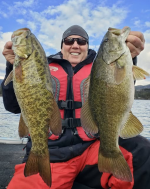
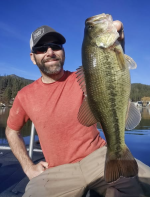
Here's a couple of recent fish caught by others. Yes, even the T-shirt pic was recent, taken during the unseasonably warm spell we had.
My thought is to come up with something much larger and bulkier without so much weight that it becomes unwieldly to cast and can be supported under an indicator.
I have a lake within 15 minutes of my house that I've mostly neglected over the years that is a good bass fishery. With the high fuel prices it makes more sense to spend some time exploring what is right under my nose.
Here's a couple of recent fish caught by others. Yes, even the T-shirt pic was recent, taken during the unseasonably warm spell we had.
The current common incarnation of "Float-n-Fly" does seem to mostly be used in large, clear, deep reservoirs/lakes, which is not exactly what I was thinking about. But Lake Washington is a large, mostly clear lake not too far from me. Sorry if I'm spot burning that one 
I'm seeing people use it for spotted, smallmouth and largemouth bass.
Properly-sized large Iracators are pretty good at showing light takes, if you watch closely. Usually they sit at a bit of angle. On light takes, the float can twitch or get more horizontal. Set!
I'm seeing people use it for spotted, smallmouth and largemouth bass.
Properly-sized large Iracators are pretty good at showing light takes, if you watch closely. Usually they sit at a bit of angle. On light takes, the float can twitch or get more horizontal. Set!
Old406Kid
Legend
I watched the video in your link...nicely done. I must say that I was pretty hyped until I saw the price of Jaydacators.Here we go: Hogan Brown is one of the guys I know who is really into this.
From the article:
As a newcomer to Float N Fly, I immersed myself in instructional videos by Ryan Williams, the pioneer of this technique on Lake Oroville. Equipped with a 10-foot 6-weight Echo Stillwater rod, newly designed floats from Lost Coast Anglers, and a 1/16-ounce Black Leech with rubber legs, I delved into the nuances of this approach, distinct from fishing chironomids for trout. The substantial bobber, long leaders spanning 8 to 12 feet, weighted jigs, and the subtle movements of the bobber all contributed to the challenge. It took some practice, but as they say, “sets are free,” and striking at any sign of movement proved more productive than not. Playing and releasing Spotted Bass bore similarities to local Dink Stripers fishing, although the bass showcased their acrobatic skills by tail-walking and jumping when brought to the surface, adding an exhilarating element to the battle. They exhibited a surprising amount of strength comparable to similarly sized stripers.


Balsa Jaydacator™ Float n Fly
Jaydacators are made from balsa wood rather than foam or plastic, so they float high and never puncture. These new indicators make fishing the Float n Fly that much easier. 3 per pack Made in the USA 3" L x 0.75" W Color: Pink & White CA Warning: WARNING: Cancer and Reproductive Harm -...
 catalog.theflyshop.com
Lots of talk about special casting techniques to use a conventional rod with a long leader to cast a 1/6th oz. jig/fly. Turns out that fly rods are pretty good at that. And the guy at this link I put above here uses a pear shaped 7/8" to 1" float very similar to an Iracator.