Hi WR and Evan,
I fear that I'm in the same situation in trying to find the single perfect truck as trying to buy the perfect, flexible boat - it doesn't exist and you have to decide what is most important to you.
I had a Honda Civic for 20 years as my commuter vehicle and it was consistently over 32mpg - perfect for commuting. But that phase of my life is coming to end in the next year or two. I want the truck for yard projects, to carry my pontoon boat to the mountains for day-trips, and to tow a small A-frame trailer on multi-day expeditions.
Have you tested the accuracy of your trip computer under real world driving conditions? In this Car and Driver
review of the Rivian, they achieved only a range of 220 miles when driving 75mph on a real highway route, 70% of the EPA rating of 314 miles. In the earlier Rivian review that I cited, the range for freeway driving was half (half of 220 miles) of the unloaded freeway range when carrying a trailer with a 5650 pound loadFranciscoy few charging stations are really set up for a drive-through charging situation with a trailer. I haven't found any charging stations on the St. Joe or Kelly Creek. I wonder how long it would take solar panels to recharge an electric truck battery? I am hoping that the vehicle that I am commuting with now will last another year or two and we'll see how the technology evolves, but I fear that I am asking for something that violates the laws of physics...
Steve
@ Cabezon; My driving results somewhat mirror Evan with regard to weather related battery range. In warmer months I can actually get 540 miles on the full charge / full tank. This generation of batteries are very temperature sensitive. That includes the battery packs on Teslas.
I use it as my daily driver, replacing my 22 yro F150 2WD w/ V6 and 5 speed stick, which i was filling once a week @$75.00+ a tank full. Now, once every 4 1/2 weeks I fill up.
I reset the data collection function on the Energi once a week. Consistently it shows me 55-58 MPG each week. That's using both on board systems as they're supposed to be used.
In cold weather I seldom use the EV feature in the morning, but do use the prewarm feature to warm the battery and clear the windows. Ford at least gives us the option to shut off the EV side if we desire. Doing it in reverse like this, lets the car use the heated generated by the fossil burner to warm the battery pack. But the car is happiest when you let it manage itself.
My Enegi is HEAVY compared to Evans Volt. Unloaded curb weight is @4700 lbs. That's the 2.4 l 4 cyl coupled with the 7.4 kw battery in the trunk. And the additional electric motor sandwhiched into the drivetrain.
In comparison the Fusion Sport, which is the high performance, AWD, gas only model, weighs in at 3900 lb.and still get 38 mpg if you aren't racing it. (BTW, if anyone wants a "sleeper" this might be what you want, they're incredibly fast)
My best trip so far was from my house to San Francisco, about 1560 miles round trip , myself and another adult, to pick up a Bassett rescue, and return, with the average for the entire trip of 55 mpg.
That's including one overnight with the Ford supplied 110v charging cable plugged into the outside wall of the hotel.
I'm still not completely sold on full EV for trucks, though many governments are pushing hard to rid their streets of gas and diesel burners by 2030. My concern is battery management and dealer support. A LOT of old school dealerships are not spending the money they should to train their techs how to work on their advanced systems. They think there is no money in it for them, since they base so much of their profit on parts,and labor. So, we are probably looking at at least another 5-8 years before infrastructure catches up. Think automotive history, circa 1928.
Sorry, probably gave you a $10.00 answer to your question.



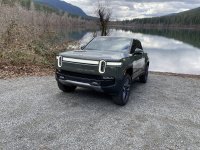
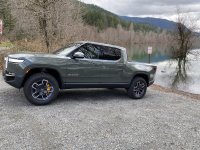
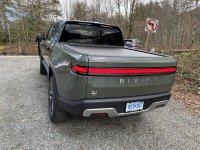


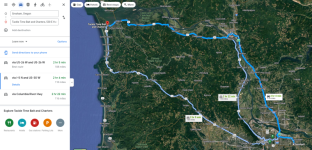



 two very different platforms. Mine has no gas at all. Volt is the plug in hybrid.