Deep water indicator technique (mine)

Shawn Seeger

Legend
Forum Supporter
I didn’t want to hijack another thread… so here goes.


I was asked (not the first time, and not tooting my own horn) about what my deep-water indicator set up was, and I will share what I do and how I do it. There has been some other posts that cover similar methods.

So, first I tie my own leaders, and I don’t use “tippet” I use leader. For all stillwater indicator fishing I use fluorocarbon, because it sinks and is virtually invisible. For stillwater dry fly or surface fishing I use monofilament. The reason I tie my own leaders is that I have cut and burned my hand to many times and hate that “papercut” feeling. By tying my own I can use a long piece of heavier leader in the top long section and then taper down. This also allows me to have knot/split shot in the bottom section just above the top fly to stop the peg. The knots also allow me a way to not have to “hemostat” measure after each fish (measure once with hemostats, then measure from the closest knot or end of fly line). I also, depending on how catching is going, use my fish finder to measure depths and use the yardstick on my boat to measure the length of my indicator (on my Garmin I have set the “Offset” to 1 foot because that is how deep my transducer is under the surface)

I use what we call the “rodeo cast” as it can produce a wild rodeo mess (macrame class) if the wind comes up. I start by pulling up on my line and start making a figure 8 over my head, with arm fully extended overhead, and continue to do this (slowly letting fly line out while swinging) until the flies break the surface, then I continue the figure 8, until I am ready to let it all go in the direction I intend to fish (generally wind at my back) and then swing my rod tip forward and down, letting it all go. The deepest I have used this cast is about 35 feet under the indicator. I understand and have delt with the frustration of missing fish with 35 feet down and say 15/20 feet from the rod tip, part of the game of catching. If I get to frustrated then I don’t cast out further than the rod tip +/-.

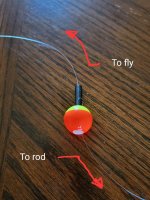
I will say, I peg in from the bottom, the peg is inserted on the fly side of the indicator. My logic is that when a fish pulls/grab and run, it could pop the indicator. When the fish pulls and I set (swing/yank) my rod up it provides pulling in both direction on the leader/peg, popping it loose most of the times.

I have gone to using my own quick release indicators for most indicator fishing, this allows me to quickly adjust the depth I want to target fish. I will still use an indicator that just uses a “toothpick” as the peg when I have a rod set up for only a specific depth (I know I am only going to fish a 9 foot leader, and my indicator is going to be all day at 7 feet).

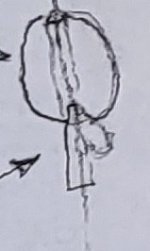
My leader lengths and configuration. And my indicator/pegging.
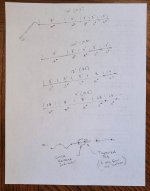
Leader Lengths and Pounds.jpg
Indicator and Pegging.jpg

Again, this is just my configuration and why…

And while you were reading this your indicator went down multiple times!

Tight Lines
 
Shawn -
I agree with the bobber dude ;-) in the post above ----^ about your cast to get things started from the bottom of the lake to make another cast. Sometimes that rodeo cast, if I'm not paying attention, can get tangled on one of my spare rod tips sticking out the bow of my pram..... pay attention Buzzy.

Your leader formulas are interesting and certainly worth noting (mine are a variation of what @troutpocket has shared on this and WFF) where as when I first started the LONG leader thing, I used 15' steelhead leaders and added flouro to it for added length. I much prefer Troutpocket's leader to the tapered monofilament steelhead leader.

I like a knot in my "tippet" to keep split shot (when and where legal) from sliding down the leader. I never thought of using the split shot as a bobber peg stop. I'm gonna have to give this a try.

I recently broke a Rio WF line, Far Bank was good enough to send me a replacement. Fresh out of the box I left the loop on the end of the line and went to a local lake. I was setting my fly at about 3.5' - 4' below the indicator so I was using an Airlok* bobber on a 7.5' store bought tapered leader. I don't like factory welded loops (Eeeevil) so I cut it off and built a leader out of Maxima Ultragreen nail knotted to the loopless fly line. I was digging through the cobwebs of what's left of my mind when I built the leader - I thought (I still think, I think) Maxima used to have a formula for leaders: 60/20/20 and that's what I used to build a 9' leader (complete with a double surgeons knot to keep the split shot in place).

Thanks for sharing your detailed leader data!//Pat


* Airlok: drop the little "nut" in the dirt? Nyeh. Don't get the nut torqued tight? Sayonara bobber and nut and I will have to add a couple quarters to the cuss jar.
 
I’ve always done the bobber peg on top, towards the rod.
I know some folks do the peg on the bottom, towards the fly as Shawn illustrated. Any particular advantage to one versus the other?
SF
 
Thanks for all the details @Shawn Seeger !

A couple thoughts I will add- playing this game means dedicating at least one rig because of the unique layout of the leader. I use a 10’ 5wt Echo 2 with a 7wt SA Titan taper floater. The extra mass in the line and length of the rod make managing 30’ of leader less of a chore. I only break out this rig in a few situations and always when I am in a boat so that I can stand up for every cast. I’m rarely trying to cast more than a couple rod-lengths of line, I mean how far away do you need to put the flies when the fish are down that deep?

@Stonedfish I prefer the peg facing up, or towards the rod tip because the indicators I prefer will tip up on subtle takes. I rely on seeing that peg stick up as much as anything else.
 
Shawn -
I agree with the bobber dude ;-) in the post above ----^ about your cast to get things started from the bottom of the lake to make another cast. Sometimes that rodeo cast, if I'm not paying attention, can get tangled on one of my spare rod tips sticking out the bow of my pram..... pay attention Buzzy.

Your leader formulas are interesting and certainly worth noting (mine are a variation of what @troutpocket has shared on this and WFF) where as when I first started the LONG leader thing, I used 15' steelhead leaders and added flouro to it for added length. I much prefer Troutpocket's leader to the tapered monofilament steelhead leader.

I like a knot in my "tippet" to keep split shot (when and where legal) from sliding down the leader. I never thought of using the split shot as a bobber peg stop. I'm gonna have to give this a try.

I recently broke a Rio WF line, Far Bank was good enough to send me a replacement. Fresh out of the box I left the loop on the end of the line and went to a local lake. I was setting my fly at about 3.5' - 4' below the indicator so I was using an Airlok* bobber on a 7.5' store bought tapered leader. I don't like factory welded loops (Eeeevil) so I cut it off and built a leader out of Maxima Ultragreen nail knotted to the loopless fly line. I was digging through the cobwebs of what's left of my mind when I built the leader - I thought (I still think, I think) Maxima used to have a formula for leaders: 60/20/20 and that's what I used to build a 9' leader (complete with a double surgeons knot to keep the split shot in place).

Thanks for sharing your detailed leader data!//Pat


* Airlok: drop the little "nut" in the dirt? Nyeh. Don't get the nut torqued tight? Sayonara bobber and nut and I will have to add a couple quarters to the cuss jar.
I too cut off the welded loop for a number of reasons. Why taper a line and then put a double thickness section right at the end? I also had one fail when looped to the backing and got to enjoy the pleasure of watching an entire $90 tungsten full sink line go into the river. And one of my favorite rods from the pre-loop era has smaller guides and the loops just don't like going through them.

In deep situations I will fish with the bobber right under the rod tip. For setting up where you might need to fish different depths throughout the day I like a 6" section of 20# with a loop nail knotted to the line. Then attach different length leaders (however you tie them) twith a loop to loop connection. You can pre-make various length leaders and store them by wrapping around a piece of foam pipe insulation. Wind on from the tippet end and secure with a hook through the loop and into the foam.

For fixed bobbers:
They come in different colors and you can make a two tone bobber.

At Lenice this year I used an Echo 11' 3wt trout spey. Talk about a roll casting machine!
 
If you replace the bobber, leader and fly line for a sink 6 or 8 you will have a setup that produces less pollution, discourages slavery, and saves lives.
How many slaves do you think I can free up?
 
I kinda want a shirt that says this:
View attachment 61473
Oh I have thought about that too!!!

Maybe just this image and "I peg from the bottom". 😄

20230412_111231~3.jpg

My wife said it might cause problems haha (and yes she has saved me from myself before).

@Shawn Seeger prepping for a 35 foot deep indie bomb cast
😁
View attachment 61426
My warn up ribbon is green... and my tights are red 😄

Your description of beginning the cast for a deepwater indicator set up is spot on!
And I was hoping I would get at least one thing right... 😄 🤣 😂

Again just my set up...
 
If you replace the bobber, leader and fly line for a sink 6 or 8 you will have a setup that produces less pollution, discourages slavery, and saves lives.
I actually have fished my full sink line this way. Used a balanced leech and just pulled off enough line to hang it a couple feet off the bottom. I don’t recommend setting your rod down though, just hold it still or give it a very slight jigging motion and watch the rod tip closely. Any movement or feel to the line, set it. Caught some decent fish at Pass last week doing this after my wrist and hand got tired of stripping.
 
Won't your bobber be down by the fly when you cast?
Probably close. I am thinking of using a tippet ring or swivel to keep the indicator from sliding all the way down to the flies. It may not work, but I think it might be easier to cast 25-30 feet of leader with all the weight close to the end of the line than with the indicator 25-30 feet away from the flies. I haven't tried it yet. I got the idea from reading about "float and fly" bass fishing....
 
Probably close. I am thinking of using a tippet ring or swivel to keep the indicator from sliding all the way down to the flies. It may not work, but I think it might be easier to cast 25-30 feet of leader with all the weight close to the end of the line than with the indicator 25-30 feet away from the flies. I haven't tried it yet. I got the idea from reading about "float and fly" bass fishing....

I cut the peg back slightly and glue a small plastic bead into the bottom of the indicator.
The shorter peg is to accommodate for the bead.
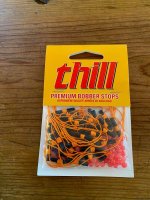
I then use a small rubber bobber stop to stop the indicator from getting to the flies.
Probably not a perfect solution, but it works for me. I’ve never lost a peg or bobber on a break off.
SF
 
Probably close. I am thinking of using a tippet ring or swivel to keep the indicator from sliding all the way down to the flies. It may not work, but I think it might be easier to cast 25-30 feet of leader with all the weight close to the end of the line than with the indicator 25-30 feet away from the flies. I haven't tried it yet. I got the idea from reading about "float and fly" bass fishing....
I use both tippet rings and swivels depending on what I grab first. Both work. I use a bobber stopper to mark depth.
 
I have a new plan for deep water indicator fishing this year:

View attachment 61588
I've been trying this for a steelhead nymphing rig, significantly improved casting capability but I havent cracked the code for getting enough weight to pull the line through the bobber fast enough. I assume you'll have similar issues in a lake with trying to drop it really deep.

Just my .02, you'll need significant weight to overcome the friction of the line through the bobber at 20+ft with a mid on the end.
 
Back
Top