I didn’t want to hijack another thread… so here goes.
I was asked (not the first time, and not tooting my own horn) about what my deep-water indicator set up was, and I will share what I do and how I do it. There has been some other posts that cover similar methods.
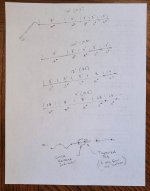
So, first I tie my own leaders, and I don’t use “tippet” I use leader. For all stillwater indicator fishing I use fluorocarbon, because it sinks and is virtually invisible. For stillwater dry fly or surface fishing I use monofilament. The reason I tie my own leaders is that I have cut and burned my hand to many times and hate that “papercut” feeling. By tying my own I can use a long piece of heavier leader in the top long section and then taper down. This also allows me to have knot/split shot in the bottom section just above the top fly to stop the peg. The knots also allow me a way to not have to “hemostat” measure after each fish (measure once with hemostats, then measure from the closest knot or end of fly line). I also, depending on how catching is going, use my fish finder to measure depths and use the yardstick on my boat to measure the length of my indicator (on my Garmin I have set the “Offset” to 1 foot because that is how deep my transducer is under the surface)
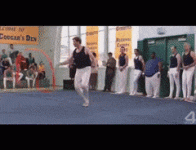
I use what we call the “rodeo cast” as it can produce a wild rodeo mess (macrame class) if the wind comes up. I start by pulling up on my line and start making a figure 8 over my head, with arm fully extended overhead, and continue to do this (slowly letting fly line out while swinging) until the flies break the surface, then I continue the figure 8, until I am ready to let it all go in the direction I intend to fish (generally wind at my back) and then swing my rod tip forward and down, letting it all go. The deepest I have used this cast is about 35 feet under the indicator. I understand and have delt with the frustration of missing fish with 35 feet down and say 15/20 feet from the rod tip, part of the game of catching. If I get to frustrated then I don’t cast out further than the rod tip +/-.
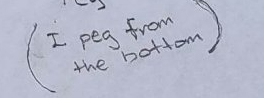
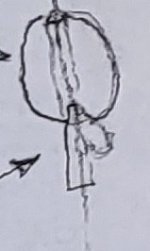
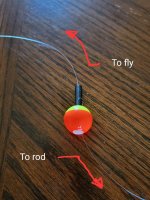
I will say, I peg in from the bottom, the peg is inserted on the fly side of the indicator. My logic is that when a fish pulls/grab and run, it could pop the indicator. When the fish pulls and I set (swing/yank) my rod up it provides pulling in both direction on the leader/peg, popping it loose most of the times.
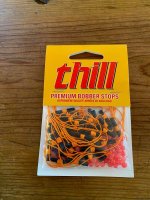
I have gone to using my own quick release indicators for most indicator fishing, this allows me to quickly adjust the depth I want to target fish. I will still use an indicator that just uses a “toothpick” as the peg when I have a rod set up for only a specific depth (I know I am only going to fish a 9 foot leader, and my indicator is going to be all day at 7 feet).
My leader lengths and configuration. And my indicator/pegging.
Again, this is just my configuration and why…
And while you were reading this your indicator went down multiple times!
Tight Lines
I was asked (not the first time, and not tooting my own horn) about what my deep-water indicator set up was, and I will share what I do and how I do it. There has been some other posts that cover similar methods.
So, first I tie my own leaders, and I don’t use “tippet” I use leader. For all stillwater indicator fishing I use fluorocarbon, because it sinks and is virtually invisible. For stillwater dry fly or surface fishing I use monofilament. The reason I tie my own leaders is that I have cut and burned my hand to many times and hate that “papercut” feeling. By tying my own I can use a long piece of heavier leader in the top long section and then taper down. This also allows me to have knot/split shot in the bottom section just above the top fly to stop the peg. The knots also allow me a way to not have to “hemostat” measure after each fish (measure once with hemostats, then measure from the closest knot or end of fly line). I also, depending on how catching is going, use my fish finder to measure depths and use the yardstick on my boat to measure the length of my indicator (on my Garmin I have set the “Offset” to 1 foot because that is how deep my transducer is under the surface)
I use what we call the “rodeo cast” as it can produce a wild rodeo mess (macrame class) if the wind comes up. I start by pulling up on my line and start making a figure 8 over my head, with arm fully extended overhead, and continue to do this (slowly letting fly line out while swinging) until the flies break the surface, then I continue the figure 8, until I am ready to let it all go in the direction I intend to fish (generally wind at my back) and then swing my rod tip forward and down, letting it all go. The deepest I have used this cast is about 35 feet under the indicator. I understand and have delt with the frustration of missing fish with 35 feet down and say 15/20 feet from the rod tip, part of the game of catching. If I get to frustrated then I don’t cast out further than the rod tip +/-.
I will say, I peg in from the bottom, the peg is inserted on the fly side of the indicator. My logic is that when a fish pulls/grab and run, it could pop the indicator. When the fish pulls and I set (swing/yank) my rod up it provides pulling in both direction on the leader/peg, popping it loose most of the times.
I have gone to using my own quick release indicators for most indicator fishing, this allows me to quickly adjust the depth I want to target fish. I will still use an indicator that just uses a “toothpick” as the peg when I have a rod set up for only a specific depth (I know I am only going to fish a 9 foot leader, and my indicator is going to be all day at 7 feet).
My leader lengths and configuration. And my indicator/pegging.
Again, this is just my configuration and why…
And while you were reading this your indicator went down multiple times!
Tight Lines