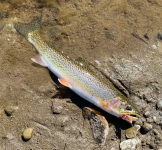
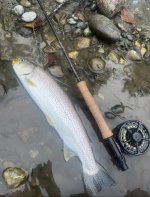
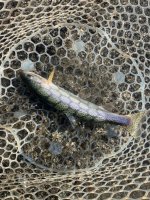
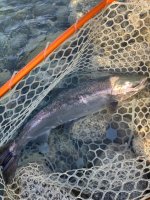
Found a few dozen yesterday up north, they were so desperate they were slamming a stripped Adams

Follow along with the video below to see how to install our site as a web app on your home screen.
Note: This feature may not be available in some browsers.


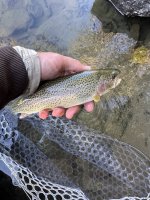
In my opinion... the best time for SRC has always been winter. I swing something with a lot of bunny fur and give the rod a tug every 3 seconds or so through the entire swing. every time they hit right after the tug. All in rivers mind ya, if you know the exact time of winter you know ahaha. This was one of the larger ones I have caught at about 24.5 inches. View attachment 126508

I think most rivers are open here for trout here more than salmon and steelhead. Most certainly the ones that come to my head at least. You can catch a SRC really on anything though lol. just gotta find them. They love Ultra Squid!Are there a lot of sound rivers that remain open to trout in WA? I see giant cutts as steelhead bycatch on IG in the winter (I've also seen some large cutts), but the OR coast is closed to trout fishing, that is what stops me. I guess you could "swing for steelhead" and throw big natural sculpin patterns, but I don't really do that grey area thing.

You can C&R sea run cuts on the Oregon Coast.Are there a lot of sound rivers that remain open to trout in WA? I see giant cutts as steelhead bycatch on IG in the winter (I've also seen some large cutts), but the OR coast is closed to trout fishing, that is what stops me. I guess you could "swing for steelhead" and throw big natural sculpin patterns, but I don't really do that grey area thing.
Not after October 31.You can C&R sea run cuts on the Oregon Coast.
Queets all day. go high and swing.Another few small ones the other day and a coho by catch. I am going to be spending a few days on the west side of the Olympic peninsula next week. Anyone able to point me in the right direction for some cutthroat fishing? Currently leaning towards camping at either the Queets or the upper Hoh but would appreciate suggestions!


I think the hand has been forced already. What would Ralph, Enos, Walt, Wes, Sandy, and Frank do?Creatch'r,
I'm glad you had a good cutthroat season. You should have been able to enjoy it from August when they first begin to show up in the lower river - no thanks to WDFW for not being a sportfishing advocate. Since WDFW is more interested in caving to whatever the Stilly Tribe demands, I think it will take an OCCUPY STILLY kind of effort to persuade the WDFW Commission (and thence the WDFW Director) that they work just as much for non-treaty sport fishers that pay their salaries and keep the lights on in their building as they do for treaty tribes.

Fortunately there is a method to this seeming madness. SRC in Puget Sound are a mixed stock from all the different rivers and creeks. There is no way of knowing whether the cutthroat you just caught in the sound is from a healthy population or a small depressed one that needs protection. In addition, the catch limit and minimum size for freshwater retention is set large enough that a trout is allowed to spawn once before it is "eligible" to be harvested. These regulations have allowed almost every PS SRC population to be as large as the carrying capacity that its natal stream can support. This is why SRC and bull trout, due to being non-commercial species, are the healthiest salmonid populations in all of Puget Sound.Also why protect SRC in the sound ( C&R ) but allow large fish to be retained in fresh water? Logic?

Fortunately there is a method to this seeming madness. SRC in Puget Sound are a mixed stock from all the different rivers and creeks. There is no way of knowing whether the cutthroat you just caught in the sound is from a healthy population or a small depressed one that needs protection. In addition, the catch limit and minimum size for freshwater retention is set large enough that a trout is allowed to spawn once before it is "eligible" to be harvested. These regulations have allowed almost every PS SRC population to be as large as the carrying capacity that its natal stream can support. This is why SRC and bull trout, due to being non-commercial species, are the healthiest salmonid populations in all of Puget Sound.


The Washington Department of Salmon hasn't identified a need to set aside any brain cells for repeat spawning since all salmon die after spawning.For example, a population goal might be that the spawning population would be 50% repeat spawners. Clearly our managers have not bought into this kind of thinking.