Chum 101

IHFISH

Life of the Party
Forum Supporter
I’ve decided to give chum in the salt a few shots this fall. I’ve found lots of good information online and in print and if I could distill it down to single sentence it would be “cast chartreuse, purple and cerise flies in front of moving pods of fish, while being careful not to cast into the middle of the school, waste time on random jumpers, or omit a few change-up flies in black, pink etc. from your box.”

One of my favorite sayings is the one attributed to Mark Twain to the effect that it’s not what we don’t know that gets us in trouble, it’s the things we know for certain that just aren’t so, so please feel free to weigh in with any and all advice for a chum newcomer, even if at odds with my attempt to distill down my research.

I also have the following specific questions:

1. Lines and leader set-up – I have an appropriate 8wt rod and reel, but would like to dial in my floating line and leader approach. Left to my own devices I’d probably go with an SA MPX and 8-9 feet of 15-20# maxima. Should I look at more aggressive tapers? Do you recommend a more sophisticated leader setup?

2. Hook size and style - I’ve tied up some tri-color chum turds, comet style flies, and Les Johnson style Green Weenies all on Sz. 4 Daiichi 2546s. I think I’m in the game pattern wise, but would appreciate feedback on hook model and size. Additional pattern recommendations are also encouraged.

3. Landing fish away from shore – If one finds oneself way out in a shallow estuary somewhere how do you approach landing the fish? Tail it? Slack line it close in? Make the long walk toward shore and hope for the best? Don’t venture out in the first place?

4. Tides – My sense is that the general preference for a strong outgoing that prevails in most coho and SRC fishing may not apply to chum, but I really have no clue. I assume it varies from place to place, but are there any general rules of thumb, e.g. an early morning incoming that may bring in a new school of fish?

If time allows, I’ll probably spread my effort across the spectrum of well-known (rhymes with a 1980s era Van Damme movie or the acronym for the 1970s era federal legislation designed to curb organized crime), medium-known, and lesser-known locations, so no need to mention anywhere by name unless you prefer to discuss via PM.

Thanks,

Andy
 
Re: #3 Landing Fish away from shore: I was at a popular beach spot once years ago, and the chummies were in thick. There was a guy there who really had it dialed in and showed us his technique for unhooking them after the battle. Once he got the fish in close and somewhat tired out, he simply pointed the rod straight at the fish then stripped line until the tip of the rod was all the way against the bend of the hook. Then he just pushed the barbless hook out of the fish, like using a hook disgorger tool.

I was lucky enough to try it out on a fish or two and it worked well. You don't get much of a photo op with this technique but it gets you back fishing quickly and you don't risk blowing up your rod trying to get hands on the fish in waist deep water.

-andy
 
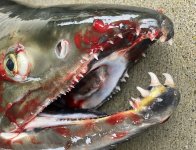
I use a WDFW approved de-hooker. Consists of a cup hook on the end of a stick. Grab the leader a foot or two from the fish, slide the hook down to the fly until it gets to the bend and pull it out. You really don't want to get close to the pointy end of a male chum!
 
Re: #3 Landing Fish away from shore: I was at a popular beach spot once years ago, and the chummies were in thick. There was a guy there who really had it dialed in and showed us his technique for unhooking them after the battle. Once he got the fish in close and somewhat tired out, he simply pointed the rod straight at the fish then stripped line until the tip of the rod was all the way against the bend of the hook. Then he just pushed the barbless hook out of the fish, like using a hook disgorger tool.

I was lucky enough to try it out on a fish or two and it worked well. You don't get much of a photo op with this technique but it gets you back fishing quickly and you don't risk blowing up your rod trying to get hands on the fish in waist deep water.

-andy

Last person I saw try this ended up with a broken rod, and that was with a not particularly large trout on the end of it. It just seems to me like a spectacularly dumb idea to stick the end of a fly rod into the mouth of a chum salmon!
 
Re: #3 Landing Fish away from shore: I was at a popular beach spot once years ago, and the chummies were in thick. There was a guy there who really had it dialed in and showed us his technique for unhooking them after the battle. Once he got the fish in close and somewhat tired out, he simply pointed the rod straight at the fish then stripped line until the tip of the rod was all the way against the bend of the hook. Then he just pushed the barbless hook out of the fish, like using a hook disgorger tool.

I was lucky enough to try it out on a fish or two and it worked well. You don't get much of a photo op with this technique but it gets you back fishing quickly and you don't risk blowing up your rod trying to get hands on the fish in waist deep water.

-andy
Your rod might not blow up this way but it seems like it could easily start out as a 9 foot rod and be about 7’10” by the end of the season.
 
1 - I usually just use 4-6’ of level 12 or 15lb mono between line and fly.

3 - Nets are very useful. Not sure why a person wouldn’t carry one.

4 - In my limited (3-4x/year) experience fly fishing for chum in the salt I have found beach fishing to be usually better on days with big tide changes—like with most salmon.
 
I look forward to estuary chum, either as a bycatch when targeting coho or when specifically targeting chum. My last hurrah in the salt before I turn my thoughts to winter-run steelhead on the coast. I've been fishing estuaries in the fall for 5 years.
My thoughts after catching & releasing some this week:
I use a 9' 9 wt. with a sealed drag reel that I can also palm the reel edge to clamp down on a fish ripping off a lot of backing. Speaking of backing, I like 200' of 30 lb. Dacron with a secure loop to loop connection to the running line. Rio OBS floating fly line. 9' tapered salmon leader that I cut 2' of end off of and then tie a perfection loop. 3' of 15 lb. flourocarbon leader attached with non-slip loop knot to fly then loop to looped to tapered salmon leader. I like to be able to put the wood to these fish with a 9 wt. Wear them out as quick as I can then release.
Favorite hook: Gamakatsu SL12S (1XSHORT) size 4
I make up patterns using various combinations of chartreuse, pink, cerise and purple. I also like some UV/fluorescent materials in my flies. I don't weight my flies. I sometimes catch fish in 18" of water if I'm sneaky.
If I see them I try to cast to the sides of pods of fish, not into the center where I'll spook them. However, often I'm casting randomly into locations that look fishy or else have "nervous water". I retrieve slowly in short strips.
Each season is different with flies. I'll cycle through flies until I find one that the fish seem to like then mainly use it (but still cycle through patterns that look good to me if the "hot fly" doesn't seem so hot after a while).
I prefer to fish an hour on either side of high tide during big tidal exchanges. This season I seem to be catching fish from 2 hours after high until slack low. Go figure? They are chum...
Landing fish: Most hooked fish fish make an initial strong run. Some also jump all over. Some stop after the first run and then run back and forth. Others seem to want to high tail it to the bay. I let those high tailers run until they start taking a lot of backing then I start palming the reel until it stops. I keep my rod to the side and low to the water. The fish are dragging my floating fly line through the water during their runs and I think it wears them down faster. Once I stop the initial run I start slowly walking back to shore while continuing to fight the fish. Sometimes it's a long walk... Sometimes they shake off during their walk with me. Easy release. I don't bring a net because I find it awkward to drag around. Things never seem to go well for me when I try to corral a chum in deeper water. I bring them into shallow water where I can roll them on their side and/or push them up into some flooded vegetation. Maybe a pic, then a quick release. Sometimes I have to push them back out into deeper water where they can recover and then scoot away. Chum seem much stronger and more resilient than other salmon.
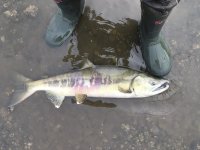
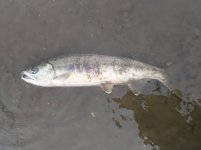
One that I met today:
 

Attachments

  • IMG_2619.JPG
    IMG_2619.JPG
    656.5 KB · Views: 47
Thanks for responding and I think that this is quite a coincidence. Based on some details in your comments, I am pretty sure that you were good enough give me one of your flies this morning. Nice fishing and talking with you and thanks again for the fly. Next time I'll let those really hot fish run longer before turning them toward the beach. You brought in some very nice fish today. Here is the one I did get all the way in on your fly.

IMG_4254 - Copy.jpg
 
Thanks for responding and I think that this is quite a coincidence. Based on some details in your comments, I am pretty sure that you were good enough give me one of your flies this morning. Nice fishing and talking with you and thanks again for the fly. Next time I'll let those really hot fish run longer before turning them toward the beach. You brought in some very nice fish today. Here is the one I did get all the way in on your fly.

View attachment 38402
That was me! Interesting coincidence. I think meeting you today prompted me to write my narrative in this string. I remembered reading Chum 101 earlier and went back to it. Everything I wrote about, and what we talked about today, I learned by experience...often times having that experience drummed into me multiple times before I finally caught on.

Hot chum are unstoppable so you just let them run. I think that when you have a high tailer clamped down with 100' of fly line and 100' or more of backing out that the stretch of all that line helps to avoid leader breakage when they start thrashing and head shaking on a tight line. I figured that out this week...

You got the chum skunk out of the way today and now you are on your way! Hope to see you on the water again!

Blessings, Jim
 
1 - I usually just use 4-6’ of level 12 or 15lb mono between line and fly.

3 - Nets are very useful. Not sure why a person wouldn’t carry one.

4 - In my limited (3-4x/year) experience fly fishing for chum in the salt I have found beach fishing to be usually better on days with big tide changes—like with most salmon.
I gave up on nets after untangling the teeth of a large male chum. Maybe rubber nets are different.

Lately all I use is an indicator and an orange plastic Walmart bead and that seems to work just fine if you want to hook them in the mouth.
 
I gave up on nets after untangling the teeth of a large male chum. Maybe rubber nets are different.

Lately all I use is an indicator and an orange plastic Walmart bead and that seems to work just fine if you want to hook them in the mouth.
Rubber nets are fantastic. No tangles, no hook getting snagged, etc.
 
1. Lines and leader set-up – That sounds about right. Usually the flies aren't too heavy so you don't need too aggressive of a line. Consider a 10-12 lb final size so it's easier to break off in the event you need/want to. You don't want to drag a big foul hooked chum in.

2. Hook size and style - That sounds about right. Throw in a few random red, black, orange versions along with the standard go-to colors. But mostly just green.

3. Landing fish away from shore - you could try a net, but chum get big. I'd go for the slack line (and hope they unhook themselves) method. Watch that rod tip! Much of the time you will find yourself far from shore to get in the best position so don't not do that. You can always just break one off if it's going to be too much trouble to land (see #1).

4. Tides – I'd say fish when you can. Too many variables to nail down a tide unless you do it a lot. I've had great days on incoming, outgoing, and slack morning thru evening. And bad days on all those.

Have fun!
 
Re: #3 Landing Fish away from shore: I was at a popular beach spot once years ago, and the chummies were in thick. There was a guy there who really had it dialed in and showed us his technique for unhooking them after the battle. Once he got the fish in close and somewhat tired out, he simply pointed the rod straight at the fish then stripped line until the tip of the rod was all the way against the bend of the hook. Then he just pushed the barbless hook out of the fish, like using a hook disgorger tool.

I was lucky enough to try it out on a fish or two and it worked well. You don't get much of a photo op with this technique but it gets you back fishing quickly and you don't risk blowing up your rod trying to get hands on the fish in waist deep water.

-andy
My recommendation is to absolutely not use this method. You will no doubt end up with a broken rod.
 
I gave up on nets after untangling the teeth of a large male chum. Maybe rubber nets are different.

Lately all I use is an indicator and an orange plastic Walmart bead and that seems to work just fine if you want to hook them in the mouth.

Are you using a indicator and bead in saltwater?
SF
 
Are you using a indicator and bead in saltwater?
SF
That caught my attention as well. I've always thought an indicator setup could work well for depth control and less foul hook ups but haven't spent much time trying it. Haven't spent much time chum fishing the last handful of years either though.
 
Back
Top