Biodegradable Fishing Gear Graduate Study

WyoFlyGuy

Just Hatched
Hello, fellow anglers.

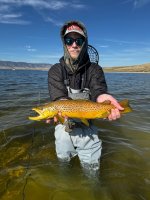
My name is Tyler Shreve. I am a graduate student, a member of the UW Fly Fishing Club, and a very active fly fisher at the University of Wyoming. I attended undergrad at Willamette University in Salem, Oregon, where I learned to love the PNW fisheries and fishing community, but my love for fly fishing and conversation comes from my lifelong passion for the outdoors. Sadly, I have seen many changes to our fisheries and would like to do as much as I can to make a difference. In my graduate studies, I am researching angler preferences and behaviors toward biodegradable fishing gear (fishing line and leader materials).

I am making this post to request the support of the PNW fishing and outdoor community. I am trying to reach as many people as possible across the nation. Your input will be invaluable in helping me understand anglers’ needs and preferences and informing future conservation and management decisions. The survey should take approximately 7 minutes to complete and is completely anonymous.

You can access the survey here

Thank you!
 

Attachments

  • IMG_1630.jpeg
    IMG_1630.jpeg
    766.5 KB · Views: 21
Hello, fellow anglers.

My name is Tyler Shreve. I am a graduate student, a member of the UW Fly Fishing Club, and a very active fly fisher at the University of Wyoming. I attended undergrad at Willamette University in Salem, Oregon, where I learned to love the PNW fisheries and fishing community, but my love for fly fishing and conversation comes from my lifelong passion for the outdoors. Sadly, I have seen many changes to our fisheries and would like to do as much as I can to make a difference. In my graduate studies, I am researching angler preferences and behaviors toward biodegradable fishing gear (fishing line and leader materials).

I am making this post to request the support of the PNW fishing and outdoor community. I am trying to reach as many people as possible across the nation. Your input will be invaluable in helping me understand anglers’ needs and preferences and informing future conservation and management decisions. The survey should take approximately 7 minutes to complete and is completely anonymous.

You can access the survey here

Thank you!

I like what I think is the intent of the survey, but I wished I understood better what it means for biodegradable fishing gear to be 50% as effective or efficient as regular gear. Does that mean that say, biodegradable line with diameter .010” has half the strength of regular .010” line? And does it mean, I’d need to use biodegradable line of .020” diameter to achieve the same strength as regular .010” line? How does this apply to fly line or bobbers or hooks or rods? How would a weight be 50% as effective? It catches 50% as many fish? In whose hands? Etc
 
I believe he meant that if a person caught 10 fish on typical gear, but out of ten similar fish on biodegradable gear 5 would be lost to the gear failing. 50% would be too high for me, but I am careful to clean up after myself. I sure find a lot of discarded line along the Cowlitz though. I wish people would try to be better.
 
I like what I think is the intent of the survey, but I wished I understood better what it means for biodegradable fishing gear to be 50% as effective or efficient as regular gear. Does that mean that say, biodegradable line with diameter .010” has half the strength of regular .010” line? And does it mean, I’d need to use biodegradable line of .020” diameter to achieve the same strength as regular .010” line? How does this apply to fly line or bobbers or hooks or rods? How would a weight be 50% as effective? It catches 50% as many fish? In whose hands? Et

I like what I think is the intent of the survey, but I wished I understood better what it means for biodegradable fishing gear to be 50% as effective or efficient as regular gear. Does that mean that say, biodegradable line with diameter .010” has half the strength of regular .010” line? And does it mean, I’d need to use biodegradable line of .020” diameter to achieve the same strength as regular .010” line? How does this apply to fly line or bobbers or hooks or rods? How would a weight be 50% as effective? It catches 50% as many fish? In whose hands? Etc
There should have been a section in the survey that explained what was meant by efficiency.

We meant that if tradition gear catches 10 out of 10 fish (100% efficient) than 50% efficient would mean you catch 5 out of 10 fish.
 
There should have been a section in the survey that explained what was meant by efficiency.
I don't recall seeing that; did I read right past it?

We meant that if tradition gear catches 10 out of 10 fish (100% efficient) than 50% efficient would mean you catch 5 out of 10 fish.
Thanks for the explanation.
 
Weird question. If the biodegradable gear is 50% as effective, but cost the same, would you use it? Fuck no. I say this living in a house that is 100% solar-powered and a lifestyle that has a net-negative carbon footprint and is as off-the-grid for water consumption as the PUD and local regs will allow.

Now, if the biodegradable gear were as effective, but cost 50% more, I'd use it all the time. Well, until it biodgegraded on me during use. Wait, are RIO lines stealth biodegradable?
 
Weird question. If the biodegradable gear is 50% as effective, but cost the same, would you use it? Fuck no. I say this living in a house that is 100% solar-powered and a lifestyle that has a net-negative carbon footprint and is as off-the-grid for water consumption as the PUD and local regs will allow.

Now, if the biodegradable gear were as effective, but cost 50% more, I'd use it all the time. Well, until it biodgegraded on me during use. Wait, are RIO lines stealth biodegradable?
just degradable...
 
You might have read past it. Thank you again for taking the time to complete it!
Huh. My bad! I need to slow down in many things in life it seems. Moving too quickly...
 
Done. Like @J Watrous , my answer was that I wouldn't use products that are 50% as effective and degrade faster, even though I'm a greenie treehugger. If the stuff is both failing and degrading, I'll need to purchase more of it, meaning that someone will have to make more of it, and there must be environmental costs associated with producing the new stuff.

I agree with this: "Now, if the biodegradable gear were as effective, but cost 50% more, I'd use it all the time."

Side note, I've been using my new PFAS-free Patagonia rain jacket for a while now and it seems to be just as waterproof and breathable as my old PFAS-membrane jacket.
 
Back
Top