Barred Marabou Hack

Mike Cline

Life of the Party
Forum Supporter
PC300761.JPG
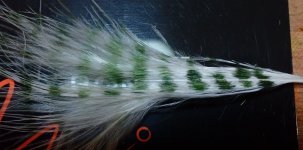
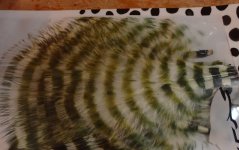
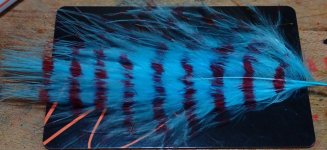
There is no doubt that Barred Marabou is an enticing fly-tying material and has multiple applications across the spectrum of fly patterns. Whether tied in as clumps or wound as hackle, barred marabou lends exceptional mottling and contrasts to patterns that employ it. Clearly the Montana Fly Company (MFC) lines of barred marabou are probably the most well-known barred marabou offerings out there, but Hareline and several Chinese material providers also offer selections of barred marabou. Unfortunately, none of what we find in fly shops or online today is inexpensive. Although the Chinese offerings are cheaper, their quality is far inferior to the MFC and Hareline brands available today. A typical pack of MFC barred marabou might contain 12 feathers and can run as high as $10+ per pack. That’s $1.20 per feather from which you might get 2 or 3 flies out of at the most.

I tie a lot of flies using barred marabou and have probably spent several hundred dollars on the feathers (mostly MFC) in the last few years. When I found myself needing to tie several hundred flies to donate and give away at some FFI shows next year and our local MGTU banquet, I needed to concoct a cheaper solution. So, with a bit of experimentation, I settled on the following technique to create my own barred marabou from strung marabou and blood quills. In particular, strung marabou is available at considerably less cost per feather than the MFC barred marabou. I wasn’t expecting the same precision and quality of barring found in the MFC feathers but soon realized that I could produce my own barred marabou with sufficient resolution that would be suitable for most patterns, and they’ve proved themselves on the water as well. An added benefit was immediately evident. Once I was satisfied with the technique I was no longer bound by the limited color patterns of the MFC barred marabou.

When I first tried to add barring to plain marabou I did it freehand and the results were marginal. The feather itself was much to flimsy to create reasonably straight bars across the width of the feather. Then it struck me that if I could compress and constrain the marabou while I applied the barring with an alcohol marker, I might achieve the results I was looking for. With a wide variety of marabou colors and alcohol marker colors available, you can create your own custom barred marabou with much less expense and very little effort.
PC300762.JPG
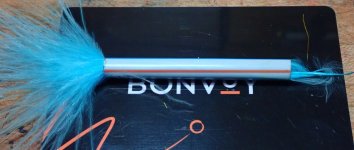
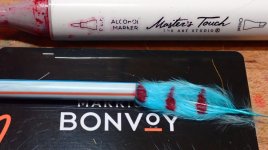
The technique I settled on is relatively simple. A two-inch length of small drink straw, a marabou feather and an alcohol marker. The feather is pushed into the straw stem butt first until it comes out the other end. Align the feather so the fibers are at right angles to the stem. Apply the marker across the feather width, pull out the feather in increments of 1/4 to 3/8” and repeat until you reach the tip of the feather. Repeat the process again after rotating the feather 180 degrees. The first application bars should provide sufficient visibility for placement of the second set of bars. Allow the markings to dry completely before using. A quick stroke with a dubbing brush will separate any fibers sticking together.
PC300763.JPG
PC300764.JPG
PC300760.JPG
Making your own you can create barred marabou with multiple color bars. Below an orange feather with alternating brown and red bars.
PC300766.JPG
 
Good idea! Straws are handy for lots of things.

I've achieved "good enough for the fish" with a Sharpie by tying in the feather, gathering the fibers, attaching a good set of hackle pliers to the end, and pulling tight. Kind of the same principle.
 
Good idea! Straws are handy for lots of things.

I've achieved "good enough for the fish" with a Sharpie by tying in the feather, gathering the fibers, attaching a good set of hackle pliers to the end, and pulling tight. Kind of the same principle.
That works well if tying the marabou in by clumps but doesn’t work to well if you are winding the marabou around the hook soft-hackle streamer style. Good technique though.
 
Interesting and easy concept. How well do the colors hold up when fished? I see that Zucker Feather Products sells a barred marabou in 1 oz bulk. Maybe the white barred then dye the secondary colors. Very likely a lot of poor-quality feathers to go through to get the good ones but its possibly another choice. I have seen silk screening techniques used with concentrated acid dyes on feathers as well. Would definitely take some development to get it right
 
Interesting and easy concept. How well do the colors hold up when fished? I see that Zucker Feather Products sells a barred marabou in 1 oz bulk. Maybe the white barred then dye the secondary colors. Very likely a lot of poor-quality feathers to go through to get the good ones but its possibly another choice. I have seen silk screening techniques used with concentrated acid dyes on feathers as well. Would definitely take some development to get it right
They actually hold up very well. A recent Nov-Dec trip to the Tampa region I caught dozens of speckled trout using flies with the homemade barred marabou and they still looked decent after a lot of fish.
 
View attachment 175641
There is no doubt that Barred Marabou is an enticing fly-tying material and has multiple applications across the spectrum of fly patterns. Whether tied in as clumps or wound as hackle, barred marabou lends exceptional mottling and contrasts to patterns that employ it. Clearly the Montana Fly Company (MFC) lines of barred marabou are probably the most well-known barred marabou offerings out there, but Hareline and several Chinese material providers also offer selections of barred marabou. Unfortunately, none of what we find in fly shops or online today is inexpensive. Although the Chinese offerings are cheaper, their quality is far inferior to the MFC and Hareline brands available today. A typical pack of MFC barred marabou might contain 12 feathers and can run as high as $10+ per pack. That’s $1.20 per feather from which you might get 2 or 3 flies out of at the most.

I tie a lot of flies using barred marabou and have probably spent several hundred dollars on the feathers (mostly MFC) in the last few years. When I found myself needing to tie several hundred flies to donate and give away at some FFI shows next year and our local MGTU banquet, I needed to concoct a cheaper solution. So, with a bit of experimentation, I settled on the following technique to create my own barred marabou from strung marabou and blood quills. In particular, strung marabou is available at considerably less cost per feather than the MFC barred marabou. I wasn’t expecting the same precision and quality of barring found in the MFC feathers but soon realized that I could produce my own barred marabou with sufficient resolution that would be suitable for most patterns, and they’ve proved themselves on the water as well. An added benefit was immediately evident. Once I was satisfied with the technique I was no longer bound by the limited color patterns of the MFC barred marabou.

When I first tried to add barring to plain marabou I did it freehand and the results were marginal. The feather itself was much to flimsy to create reasonably straight bars across the width of the feather. Then it struck me that if I could compress and constrain the marabou while I applied the barring with an alcohol marker, I might achieve the results I was looking for. With a wide variety of marabou colors and alcohol marker colors available, you can create your own custom barred marabou with much less expense and very little effort.
View attachment 175638
The technique I settled on is relatively simple. A two-inch length of small drink straw, a marabou feather and an alcohol marker. The feather is pushed into the straw stem butt first until it comes out the other end. Align the feather so the fibers are at right angles to the stem. Apply the marker across the feather width, pull out the feather in increments of 1/4 to 3/8” and repeat until you reach the tip of the feather. Repeat the process again after rotating the feather 180 degrees. The first application bars should provide sufficient visibility for placement of the second set of bars. Allow the markings to dry completely before using. A quick stroke with a dubbing brush will separate any fibers sticking together.
View attachment 175637
View attachment 175636
View attachment 175639
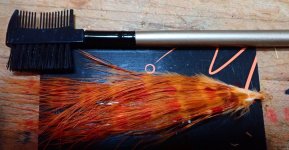
Making your own you can create barred marabou with multiple color bars. Below an orange feather with alternating brown and red bars.
View attachment 175640
Brilliant! Thanks for sharing.
 
Both Hobby Lobby and Michaels carry an extensive line of inexpensive alcohol markers. Hobby Lobby stuff is currently on sale for a ridiculously low price.


Back
Top