
Navigation
Install the app
How to install the app on iOS
Follow along with the video below to see how to install our site as a web app on your home screen.
Note: This feature may not be available in some browsers.
More options
Style variation
You are using an out of date browser. It may not display this or other websites correctly.
You should upgrade or use an alternative browser.
You should upgrade or use an alternative browser.
And there it is...
- Thread starter skyriver
- Start date


Creatch’r
Potential Spam
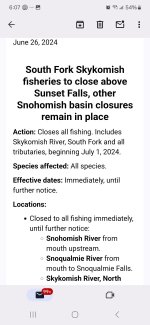
Gotta protect the 75 “wild” kings that we introduced, trap and then haul above the impassable falls that just sit at the bottom of the first few deep dark holes ripening in the SF until it’s time to dig redds end of September lol.
Gamefish seasons will continue to evaporate for chinook conservation if we don’t show up to fight for them. If it’s not effecting your homewaters yet it surely will. This will be the default move going forward I promise you that.
Gamefish seasons will continue to evaporate for chinook conservation if we don’t show up to fight for them. If it’s not effecting your homewaters yet it surely will. This will be the default move going forward I promise you that.


DerekWhipple
Steelhead
Was there ever a run of wild chinook and steelhead above the falls?

NOAA and multiple research papers states it’s an impassable barrier to anadromous fish. In one other paper it does say bull trout may be able to pass but not salmonids, citation list is not provided.Was there ever a run of wild chinook and steelhead above the falls?
This closure is really, really silly.
To expand a bit.NOAA and multiple research papers states it’s an impassable barrier to anadromous fish. In one other paper it does say bull trout may be able to pass but not salmonids, citation list is not provided.
This closure is really, really silly.
Sunset Falls was a barrier (a steep slide or more than 60 degrees that drops some 70 feet) to all anadromous fish. The anadromous fish gained access to the reach of the river in 1958 when Department fish started their truck and haul operation with the goal of producing more coho (estimates are that the habitat above Sunset can produce roughly 1/4 million wild coho smolts/year.
As great bull trout are in finding ways around barriers for other salmonids Sunset Falls presents a clear barrier. The only native salmonid above Sunset was rainbows. Potentially bull trout could have gained access to that habitat the same time the rainbows did (as Ice receded from the region) and exist in the resident life form. However very few bull trout passed over the falls the first 2 decades reaching double digits annually in the 1980s. A tagging study in the early 1990s found that those bull trout that were getting trucked around the falls were all spawning in a very small section of a single tributary. The thinking is that bull trout like chinook, pinks, steelhead gained access via the trucking operation.
A major question in early planning for recovery of Snohomish Chinook past ESA listing (1999) was were the Chinook above Sunset Falls part of the listed populations. In this case the feds decided that yes they were. Considered opening that habitat to anadromous fish was mitigation for lost habitat downstream thus those fish are part of the PS Chinook ESU and covered by the listed.
Curt
WDFW and its staff are slaves to their policies and models which result in effecting our opportunities to target non-steelhead game fish.
Clearly the NOF process has been making decisions that are limiting game fish opportunities in the North Sound rivers. The Commission policy covers the NOF process (C-3608) covers only salmon and steelhead with no mention or direction on making decision affecting game fish opportunities. That policy was updated recently and in spite of input of that lack of direction the commission decided to leave that gaping hole in game fish opportunities decisions.
In modeling impacts from various fisheries, the co-managers use their Fram model. There for stocks with code wire recovery information that information is used in the model. However, for stocks where that information does not yet exist the use existing information from what is surrogate stocks (hopefully one that is a fair representation of stock impacts to modeled). in the Snohomish the recent key stock has been the Snoqualmie population which has not hatchery program thus not code wire information so the decision was to use the Skykomish stock which has good code wire data base. Unfortunately the two stock are very different. The Skykomish stock is a true summer stock entering the river as early and spawn early while the Snoqualmie stock is considered a fall stock, in fact it is the latest spawning Chinook known in PS with spawning typically continuing through November and at times into December. This reliance on the Skykomish information for model results in some non-sensical decision. Last year once the Skykomish stock was done spawning the Snoqualmie was open to coho fishing even though that fishery would be right on top of the Snoqualmie native Chinook peak spawning. And then there is this Sunset Falls decision - there seems to be little use of common sense in the managers' decision.
A good question in the next NOF process if the Snoqualmie continues to be a problem is there a better surrogate to represent the Snoqualmie stock?
curt
Clearly the NOF process has been making decisions that are limiting game fish opportunities in the North Sound rivers. The Commission policy covers the NOF process (C-3608) covers only salmon and steelhead with no mention or direction on making decision affecting game fish opportunities. That policy was updated recently and in spite of input of that lack of direction the commission decided to leave that gaping hole in game fish opportunities decisions.
In modeling impacts from various fisheries, the co-managers use their Fram model. There for stocks with code wire recovery information that information is used in the model. However, for stocks where that information does not yet exist the use existing information from what is surrogate stocks (hopefully one that is a fair representation of stock impacts to modeled). in the Snohomish the recent key stock has been the Snoqualmie population which has not hatchery program thus not code wire information so the decision was to use the Skykomish stock which has good code wire data base. Unfortunately the two stock are very different. The Skykomish stock is a true summer stock entering the river as early and spawn early while the Snoqualmie stock is considered a fall stock, in fact it is the latest spawning Chinook known in PS with spawning typically continuing through November and at times into December. This reliance on the Skykomish information for model results in some non-sensical decision. Last year once the Skykomish stock was done spawning the Snoqualmie was open to coho fishing even though that fishery would be right on top of the Snoqualmie native Chinook peak spawning. And then there is this Sunset Falls decision - there seems to be little use of common sense in the managers' decision.
A good question in the next NOF process if the Snoqualmie continues to be a problem is there a better surrogate to represent the Snoqualmie stock?
curt


I sense some sarcasm?

Dustin Chromers
Legend
Watching the WDFW manage anything is like watching a toddler try to pilot a fighter plane. You know it's going to be bad and only hope the carnage doesn't effect you.

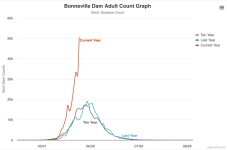
I saw that too and had JUST checked the sockeye count.
I do have a fun theory. Shad counts are down, sockeye counts are sky high. Maybe the fish counters at Bonny are also sky high? I joke, but I'm just never surprised anymore.
"The states of Oregon and Washington discussed the following recreational fisheries and took the following action:"
What really happened-
WDFW- "Yo Oregon, you see the sockeye counts? Haha! Dude, let's close it just to f%$# with people."
ODFW- "Dude, that would be hilarious. What about the tribes tho?"
WDFW- "Yo, chill. We can figure that out Thursday man. Until then, let's party!"
I wonder why WDFW doesn’t explore gear restrictions in cases like these.
I would think a hook size restriction, fly-fishing only, or floating lines only would achieve the same goal in having minimal encounters with chinook in the system. Or could it be that WDFW just wants us off the water entirely?
I would think a hook size restriction, fly-fishing only, or floating lines only would achieve the same goal in having minimal encounters with chinook in the system. Or could it be that WDFW just wants us off the water entirely?

Paige
Wishing I was fishing the Sauk
I'm not Suprised at all and was fully expecting this and, just guessung that they have 1 or 2 Chinook in the trap ready to haul over as their 1st truck usually isnt until July 6th or so and the tribes said WOAW there, you better shut it down, and WDFW said yes sir right away sir.
Just waiting for them to shut down the hatchery zone next.
Just waiting for them to shut down the hatchery zone next.
justme2024
Steelhead
Do you know why the decision to include those new spawning areas was made for the Snohomish but not for fish which are now able to access the Willamette above the falls because of the fish ladder? I feel like similar justifications could be made to include Coho and the expanded range of winter steelhead.To expand a bit.
Sunset Falls was a barrier (a steep slide or more than 60 degrees that drops some 70 feet) to all anadromous fish. The anadromous fish gained access to the reach of the river in 1958 when Department fish started their truck and haul operation with the goal of producing more coho (estimates are that the habitat above Sunset can produce roughly 1/4 million wild coho smolts/year.
As great bull trout are in finding ways around barriers for other salmonids Sunset Falls presents a clear barrier. The only native salmonid above Sunset was rainbows. Potentially bull trout could have gained access to that habitat the same time the rainbows did (as Ice receded from the region) and exist in the resident life form. However very few bull trout passed over the falls the first 2 decades reaching double digits annually in the 1980s. A tagging study in the early 1990s found that those bull trout that were getting trucked around the falls were all spawning in a very small section of a single tributary. The thinking is that bull trout like chinook, pinks, steelhead gained access via the trucking operation.
A major question in early planning for recovery of Snohomish Chinook past ESA listing (1999) was were the Chinook above Sunset Falls part of the listed populations. In this case the feds decided that yes they were. Considered opening that habitat to anadromous fish was mitigation for lost habitat downstream thus those fish are part of the PS Chinook ESU and covered by the listed.
Curt
DerekWhipple
Steelhead
Do you know why the decision to include those new spawning areas was made for the Snohomish but not for fish which are now able to access the Willamette above the falls because of the fish ladder? I feel like similar justifications could be made to include Coho and the expanded range of winter steelhead.
Different fish, different state, different situation.
Willamette basin coho seem to be doing well relative to our current shifted-baseline. Heck, they are almost encouraging a fishery for them above the falls at this juncture. The Clackamas has been a bright spot for wild spring chinook and wild coho, and they are also returning elsewhere.
It's also a different state with a different DFW. Can any one recall when Oregon closed a recreational steelhead and trout fishery to protect chinook?

Treaty tribes?Different fish, different state, different situation.
Willamette basin coho seem to be doing well relative to our current shifted-baseline. Heck, they are almost encouraging a fishery for them above the falls at this juncture. The Clackamas has been a bright spot for wild spring chinook and wild coho, and they are also returning elsewhere.
It's also a different state with a different DFW. Can any one recall when Oregon closed a recreational steelhead and trout fishery to protect chinook?
justme2024
Steelhead
ESA listings aren't determined by state agencies though. I'm just wondering what factors made them decide to include them in the DPS in one case but not the other. The coho and expanded steelhead runs are a cool fishery it just seems like a similar situation where they made a different choice. I could see it being a genetic/population separation thing maybe? Since the Coho are descended from or at least have pretty significant hatchery heritage and the native Willamette Valley steelhead are pretty unique compared to the other strains that are able to get over the falls now.Different fish, different state, different situation.
Willamette basin coho seem to be doing well relative to our current shifted-baseline. Heck, they are almost encouraging a fishery for them above the falls at this juncture. The Clackamas has been a bright spot for wild spring chinook and wild coho, and they are also returning elsewhere.
It's also a different state with a different DFW. Can any one recall when Oregon closed a recreational steelhead and trout fishery to protect chinook?
You are right, the allowable impacts for the various Federally ESA stocks are determined by the feds not the states.ESA listings aren't determined by state agencies though. I'm just wondering what factors made them decide to include them in the DPS in one case but not the other. The coho and expanded steelhead runs are a cool fishery it just seems like a similar situation where they made a different choice. I could see it being a genetic/population separation thing maybe? Since the Coho are descended from or at least have pretty significant hatchery heritage and the native Willamette Valley steelhead are pretty unique compared to the other strains that are able to get over the falls now.
What makes the situation in Puget Sound and much of Washington is that those allowable impacts are divided between the treaty tribes (they get 1/2) and the non-treaty users. It is further complicated in some of the Puget Sound rivers by how the non-treaty impacts are allocated. It is clear in that case the high priority is to use those non-treaty impacts to maximize marine water opportunities. That is doubly so for non-steelhead game fish (resident, sea-run cutthroat), etc.) opportunities.
The final nail in some of the freshwater opportunities is the requirement of monitoring (drive by tribes/feds) of those potential freshwater fisheries to determine the impacts.
And of course, at least in Puget Sound NOF process (where the opportunity pie is divided) the apathy of the freshwater anglers (and their lack of organization) makes them very ineffective in arguing for a piece of the pie.
Curt