Non-Fly 2026 Blackmouth

While Spring Chinook play a small part in our April fishery, the bulk of fish caught are yearling hatchery Chinook kept for a full year prior to release into rivers. This process for reasons currently unknown leaves the yearling fish with a tendency to remain within the Salish Sea for a period or for the entirety of their lives. Two and three salt fish seem to make up the bulk of our catch. The cost of these yearling fish is estimated to be a dollar per fish. With limited opportunity due to restrictive conservation management criteria of undersize and wild encounters, opportunity to fish for these yearling fish outside of the summer season is limited. For the last 4 years, it seems to have only ever lasted 4 days to a week.

The limited conservation impacts affect our summer fishing for larger migratory fish as well. With the WDFW budget getting smaller, I would prefer to see the exuberant amount of money used to raise these yearling fish be used to support monitoring and enforcement of other fisheries, or even expanded hatchery enhancement where it makes sense. The allowed impacts spent on this fishery would be more cost effective if spent on expanding our also dwindling summer opportunity.

Thanks for the reply. I don’t ever recall anyone being concerned with the cost per blackmouth when we had more opportunities like year around fishing. Those fish that aren’t caught in the spring also contribute to the summer fisheries.
Are you also concerned with the cost of the large numbers of returning surplus adult chinook hatchery fish you get very limited opportunities to fish for in the summer? Minter Creek had a chinook escapement that was basically twice the summer quota for MA 9 and MA 10 combined. That’s just one hatchery facility….

If you haven’t read this article before, you might find it interesting.
SF

 
Last edited:
While I am happy to participate in the Spring Blackmouth fishery, with how exuberantly uneconomical the yearling Chinook program is, I think I would prefer sacrificing our week of Blackmouth for a little more time in the summer.
I don't think it works quite like that. We had a related discussion a few years ago in a kayak fishing forum, after consulting with one of the scientists involved in the salmon modeling, we ended up here:
"Fishery impacts are essentially modeled by time and area from coded-wire tag data. You cannot really shift impacts from Winter to Summer because individual stock impacts (ultimately what everything is being managed by, mostly the ESA variety) are present at different times/areas making Winter and Summer apples to oranges"
For full discussion see here:

I think moving the opener to Spring does make more sense than earlier openers in Winter, from my personal experience we used to struggle to get a keeper fish by getting too many 1-inch short fish with earlier openers. This year only on the last day of the opener we got more undersized and wild fish than kept fish, previous days we managed real clean catches. Loosing the Winter/Spring season, however short it has been, would be like with many other opportunities, when they are gone they never come back. The ultimate issue is too many people fishing for fewer fish, not much we can do about that, other than fish responsibly and limit our impacts by trying to avoid as much as possible the limiting factors on each season.
 
Last edited:
ResizedP_5a60efb3-a460-430a-ba1f-a87a456193c4_53217872090219.gif
Estimates of Chinook catch to date indicate there is enough room to allow for an additional in Marine Area 10. Currently, we have reached 78% (3,507 of 4,491) of total encounters, 38% (1,423 of 3,713) of total sublegal encounters, and 79% (762 of 967) of total unmarked encounters agreed to in the 2025-26 List of Agreed Fisheries (LOAF).

 
View attachment 181733
Estimates of Chinook catch to date indicate there is enough room to allow for an additional in Marine Area 10. Currently, we have reached 78% (3,507 of 4,491) of total encounters, 38% (1,423 of 3,713) of total sublegal encounters, and 79% (762 of 967) of total unmarked encounters agreed to in the 2025-26 List of Agreed Fisheries (LOAF).

My GF is in a very big new age spiritual phase and maybe it is rubbing off on me but I swear I manifested this because I got the notification right as I had the thought "I really didn't catch that many shakers or wilds this year, I bet we will get another day".

I doubt this will pass a double-blind control scientific study but I will try to do it again next week. See you guys out there!
 
Good luck to everyone tomorrow who has a chance to get out.
Looks wet and perhaps a bit sporty wind wise.
SF
 
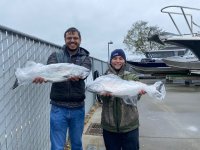
It was super slow for most boats today, I imagine the crappy tide exchange had something to do with it. I fished my lucky spoon and an anchovy on the other rod. Turns out that was a good choice- 2 fish day! My buddy caught one around 25”, mine was around 24”. Both on the bait rod. Around the middle of the bar there were huge schools of large fish suspended between 40-60 feet of water- I have a feeling those were springers but unfortunately couldn’t get them to play

IMG_1616.jpeg

IMG_3210.jpeg
 
Last edited:
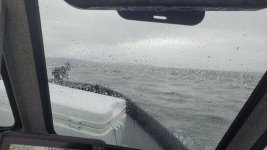
There will be blood, I mean there was blood and almost some tears. Ended up going solo after none of the usual suspects could come along. Was too optimistic in bringing my trusty 8wt and even my jigging gear given the sustained 14-18 kn south wind and related nasty chop, so ended up trolling spoons all day. Water was really brown (algal bloom?), with residue collecting on lines and lure. Caught nothing early during the really weak tide movement, was almost run over by a larger boat that was not paying attention while turning in the wind and lost a downrigger ball and a good chunk of braid to the engine skeg in the evasion (therefore the tears).

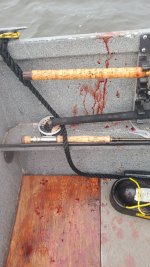
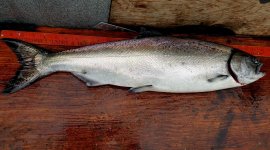
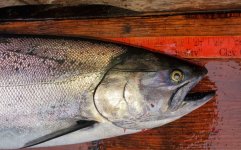
Looked very slow overall, action sped up just a bit mid morning and around noon when the ebb started. I released a nice wild, followed by a gentle bite that went ballistic once it surfaced behind the boat, a couple runs and a few jumps later I netted on my 3rd attempt year a 27 inch 8lb on the scale queen salmon, I started the bleeding too soon, maybe the waves messed up my timing, ended up with a very red splattered boat. Return trip against the wind, waves and rain was pretty sporty, bumpy and wet but no complaints!

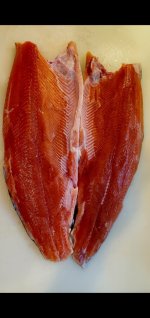
Stomach looked full of sandlance, which may explain the nice scarface. Fish cut the nicest and tasted the best of this season, a very intense orange/red. Visiting family were happy with a fresh fish dinner.

20260411_133834.jpg
20260411_134403.jpg
20260411_134746.jpg20260411_140410.jpg
Screenshot_20260411-171043_Gallery.jpg
20260411_183609.jpg
 
Last edited:
Nice report. Do you mind
I like that kind of "out of the box" thinking. Unfortunately, I don't think would "pencil out" as well as hoped.

Typically, the Chinook impacts in the various fisheries fall into 3 buckets of impacts: 1) the "shaker" encounters/mortalities, 2) the unmarked encounters/mortalities, and 3) the legal-size marked mortality. During the proposed summer fishery, the type 1 and type 2 mortalities would not be much different than what we currently see during summer season without significant changes in allowed gear used (for example banning downriggers). Generally, our summer fisheries are closed due to reaching allowable impacts thresholds for either those type 1 or type 2 impacts. It would pass much of the adult hatchery returns to terminal areas. Fisheries like Tulalip Bay, Elliot Bay, lower Hood canal and the rivers might thrive with roughly 70% of the caught adults being passed through to those fisheries. Not sure how much Chinook impacts would be available for a winter season.

Would also be trading those smaller early season resident coho and smaller blackmouth for the chance at larger adult Chinook in the summer (though to be fair that size difference is not what it once was).

curt

I don't think I've ever seen an explanation from WDFW of how the "shaker", unmarked, and legal marked encounter limits established in chinook mark selective fisheries translate to exploitation rates under the management plan.

Area 10 currently has a coho retention and chinook non-retention season that essentially runs from June 1 to Nov 15. Incidental chinook mortalities are accounted for during these periods, so under my scenario deposited earlier there would be no increases in chinook mortalities there. It is possible there would be the elimination of the 5% "other" "drop off" mortality that is applied to MSF but not non-retention fisheries, so there would potentially be some savings there. The management plan isn't clear in my mind how that "other" mortality would be calculated in a coho retention, chinook non-retention fishery. Presumably there may be some savings to mortalities accruing during the chinook MSF summer fishery, though I don't know the extent of that because as stated above it is not clear to me how the three impacts currently used to manage MSF fisheries relate to exploitation rates set under the management plan.

Area 9 I have no idea on the impact of my proposal. Would adding additional coho retention days in July and/or June eat up any savings in eliminating the 3 day chinook MSF fishery? I don't know.

I would think there may be some AEQ savings as well by targeting younger fish for harvest, though again I don't know whether that is correct or to what extent.

Yes, my proposal would be trading harvest opportunity on larger chinook (at least in non-terminal areas). But if it added fishing opportunity it would be worth it IMO. Frankly some of my more memorable summer days in Area 10 over the last few years have been on non-chinook retention days. A fraction of the boats (the chinook retention days seem to really bring out the jokers in full force), some snappy chinook released, and some coho to take home.

It would be interesting to see it modeled and give recreational fishers something to comment on. I think having the ability to comment on these larger scale direction decisions would be much more productive than trying to comment on how to save 0.01% or 0.02% on a fishery without being given all of the information as is currently being done.
 
If the rules say "release Chinook" as opposed to "do not fish for Chinook", am I technically allowed to catch and release Chinook? I have accidentally encountered very nice Blackmouth in Area 9 while coho fishing, and with Chinook having much better post release mortality than coho, I don't think I would feel guilty about it, especially if I gave jigging a try. For what it's worth, I caught very decent size resis in July targeting Kings on the bottom, so it's not like fishing the bottom or bait balls is exclusively a Chinook thing...
 
Back
Top