Non-Fly 2026 Blackmouth

speedbird

Life of the Party
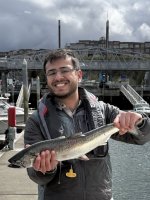
Anyone make it out today or yesterday? I took a couple days off from work to fish it. Wasn't able to make it out yesterday evening but got out late morning today, and only fished for three hours. Had some action, and left the water with just one. Thought it was bigger than it really was- I guessed it was 24-26", but tape measure at home said 22". Not gonna forget it tomorrow, that's for sure. Tasted great, and it's always nice to be out on the water early in the season. Whatever the future of this fishery is at least I can say I partook in Blackmouth and succeeded at least once.
IMG_3345.jpg
 
A coworker landed 3 and kept 2, looked about the same size as yours.
 
Got out today with @Kfish. Found a fish or two. Most in the nearly to barely legal range (measured). No fish were taken home. Did not feel like breaking down a 23 inch fish so they all swam free. Nice change of pace getting the boat out on 10 after 5-6 months down south chasing SRC though.
 
This MA 10 winter season is so popular. It’s really too bad we can’t figure out a way to have some winter opportunities again in some other marine areas, namely 7 and 9.
SF
 
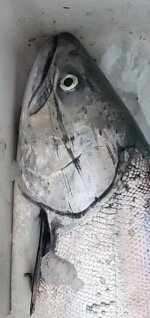
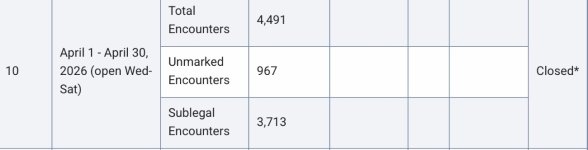
That's all folks, sadly but not surprisingly MA 10 has closed for 2026 blackmouth. Outstanding season with quality fish every outing and hot bite depending on time and spots. Not a lot of bait this year, but found players almost every time we found bait. Last fish kept this Saturday below, as her cheeks show, it had been busy scratching bottom, where we found the action every day.
IMG_0710.jpg
Screenshot_20260406-151637_Gallery.jpg

 
Last edited:
Disappointing but unsurprising. I caught 1 wild and 2 undersized to get my legal fish, and talking to buddies the 1 wild seems like just bad luck. I’m surprised with improved clip rates and decreased shakers it didn’t last longer this year. I don’t think I will ever share online how many shakers I usually go through in the summer for chinook and even coho. (And this is while running 4” kingfishers or plugs)
 
Still trying to figure out which specific conservation management criteria triggered the closure

This hasn’t been updated since everyone is currently down at PFMC in Portland through the 12th.
Give it a few days after that and if it hasn’t been updated and you need to know, drop me a pm and I’ll get you an answer.
SF

IMG_0853.jpeg
 
This MA 10 winter season is so popular. It’s really too bad we can’t figure out a way to have some winter opportunities again in some other marine areas, namely 7 and 9.
SF
Without a doubt those the take part in these winter season enjoy the opportunity and would like to see more such opportunities. That said the real question is how to best use the limited impacts of the ESA Puget Sound Chinook in crafting fishing opportunities.

From WDFW's selective fishing reports last year (2025) in MA 10 winter season the number of angler trips generated per Chinook harvested was 2.67. During the 2025 MA 10 summer Chinook season the number of angler trips generated was 4.92 angler trips per Chinook harvested. In the past through the NOF process a guiding principle is setting seasons was to maximum those limited impacts to generate the most man-days of recreation (the ultimate economic value of such fisheries stat) and engage a wide user base. The current seasons reflect that approach reflecting the continued decline in some key Chinook stocks .

I encourage all that enjoy PS salmon fisheries find a way to engage in the NOF process to lobby for your favorite fisheries and your thoughts on how to best use those limited impacts. Remember with the current paradigm of fisheries management for Puget Sound salmon those Chinook impacts are a major driver. That means that typically increasing opportunity in one area/season means a decline in another area/season.

My guess is that the catch parameter driving this year's fishery will be much like last year which was unmarked encounters. Looking the creel checks it looks like the landed catch the first 4 days was about 15% higher than last year.

Curt
 
Without a doubt those the take part in these winter season enjoy the opportunity and would like to see more such opportunities. That said the real question is how to best use the limited impacts of the ESA Puget Sound Chinook in crafting fishing opportunities.

From WDFW's selective fishing reports last year (2025) in MA 10 winter season the number of angler trips generated per Chinook harvested was 2.67. During the 2025 MA 10 summer Chinook season the number of angler trips generated was 4.92 angler trips per Chinook harvested. In the past through the NOF process a guiding principle is setting seasons was to maximum those limited impacts to generate the most man-days of recreation (the ultimate economic value of such fisheries stat) and engage a wide user base. The current seasons reflect that approach reflecting the continued decline in some key Chinook stocks .

I encourage all that enjoy PS salmon fisheries find a way to engage in the NOF process to lobby for your favorite fisheries and your thoughts on how to best use those limited impacts. Remember with the current paradigm of fisheries management for Puget Sound salmon those Chinook impacts are a major driver. That means that typically increasing opportunity in one area/season means a decline in another area/season.

My guess is that the catch parameter driving this year's fishery will be much like last year which was unmarked encounters. Looking the creel checks it looks like the landed catch the first 4 days was about 15% higher than last year.

Curt

I do think that viewing the expenditure of impacts in terms of how much opportunity they provide is the right approach. However, I wonder if viewing chinook in isolation provides a full picture.

The core Puget Sound areas of 9 & 10 have resident and ocean coho available from roughly June through late October or early November. I wonder if going strictly C&R on chinook during this summer/fall time period (while still allowing people to retain coho), and putting all remaining chinook impacts towards the November through May (when chinook are the primary salmonid anglers would want to retain) would lead to more "salmon fishing" opportunity?

I honestly don't know how the above would model out, and I wonder if it may vary year to year based on forecasts. But I think these broad based kind of scenarios is what the department should be modeling for the public's consideration. Getting into the weeds on minutia as is currently done in these NOF meetings does not seem to lead to effective or meaningful public input.
 
I do think that viewing the expenditure of impacts in terms of how much opportunity they provide is the right approach. However, I wonder if viewing chinook in isolation provides a full picture.

The core Puget Sound areas of 9 & 10 have resident and ocean coho available from roughly June through late October or early November. I wonder if going strictly C&R on chinook during this summer/fall time period (while still allowing people to retain coho), and putting all remaining chinook impacts towards the November through May (when chinook are the primary salmonid anglers would want to retain) would lead to more "salmon fishing" opportunity?

I honestly don't know how the above would model out, and I wonder if it may vary year to year based on forecasts. But I think these broad based kind of scenarios is what the department should be modeling for the public's consideration. Getting into the weeds on minutia as is currently done in these NOF meetings does not seem to lead to effective or meaningful public input.
I like that kind of "out of the box" thinking. Unfortunately, I don't think would "pencil out" as well as hoped.

Typically, the Chinook impacts in the various fisheries fall into 3 buckets of impacts: 1) the "shaker" encounters/mortalities, 2) the unmarked encounters/mortalities, and 3) the legal-size marked mortality. During the proposed summer fishery, the type 1 and type 2 mortalities would not be much different than what we currently see during summer season without significant changes in allowed gear used (for example banning downriggers). Generally, our summer fisheries are closed due to reaching allowable impacts thresholds for either those type 1 or type 2 impacts. It would pass much of the adult hatchery returns to terminal areas. Fisheries like Tulalip Bay, Elliot Bay, lower Hood canal and the rivers might thrive with roughly 70% of the caught adults being passed through to those fisheries. Not sure how much Chinook impacts would be available for a winter season.

Would also be trading those smaller early season resident coho and smaller blackmouth for the chance at larger adult Chinook in the summer (though to be fair that size difference is not what it once was).

curt
 
I do think that viewing the expenditure of impacts in terms of how much opportunity they provide is the right approach. However, I wonder if viewing chinook in isolation provides a full picture.

The core Puget Sound areas of 9 & 10 have resident and ocean coho available from roughly June through late October or early November. I wonder if going strictly C&R on chinook during this summer/fall time period (while still allowing people to retain coho), and putting all remaining chinook impacts towards the November through May (when chinook are the primary salmonid anglers would want to retain) would lead to more "salmon fishing" opportunity?

I honestly don't know how the above would model out, and I wonder if it may vary year to year based on forecasts. But I think these broad based kind of scenarios is what the department should be modeling for the public's consideration. Getting into the weeds on minutia as is currently done in these NOF meetings does not seem to lead to effective or meaningful public input.
With how limited the opportunity for Chinook in the summer has already become, I am not sure that giving up the summer season would really allow us to keep Chinook open from November through May. Especially as undersize encounters seem to have been higher than they are during the summer season from November-February. While I am happy to participate in the Spring Blackmouth fishery, with how exuberantly uneconomical the yearling Chinook program is, I think I would prefer sacrificing our week of Blackmouth for a little more time in the summer.

If there was a way to trade summer Chinook for year round Puget Sound salmon fishing, I would do it. Not just to be out on the water but for the ways it would benefit our local sport fishing industry. As others have said the size difference is not what it once was. Most of the Chinook I have caught in the summer have been in the 6-8lb size range which is a size that seems to still be around Fall-Spring, if you put in your time.
 
While I am happy to participate in the Spring Blackmouth fishery, with how exuberantly uneconomical the yearling Chinook program is, I think I would prefer sacrificing our week of Blackmouth for a little more time in the summer.

Can you please expound on this a bit more?
Thanks,
SF
 
Can you please expound on this a bit more?
Thanks,
SF
While Spring Chinook play a small part in our April fishery, the bulk of fish caught are yearling hatchery Chinook kept for a full year prior to release into rivers. This process for reasons currently unknown leaves the yearling fish with a tendency to remain within the Salish Sea for a period or for the entirety of their lives. Two and three salt fish seem to make up the bulk of our catch. The cost of these yearling fish is estimated to be a dollar per fish. With limited opportunity due to restrictive conservation management criteria of undersize and wild encounters, opportunity to fish for these yearling fish outside of the summer season is limited. For the last 4 years, it seems to have only ever lasted 4 days to a week.

The limited conservation impacts affect our summer fishing for larger migratory fish as well. With the WDFW budget getting smaller, I would prefer to see the exuberant amount of money used to raise these yearling fish be used to support monitoring and enforcement of other fisheries, or even expanded hatchery enhancement where it makes sense. The allowed impacts spent on this fishery would be more cost effective if spent on expanding our also dwindling summer opportunity.
 
Back
Top