
Navigation
Install the app
How to install the app on iOS
Follow along with the video below to see how to install our site as a web app on your home screen.
Note: This feature may not be available in some browsers.
More options
Style variation
You are using an out of date browser. It may not display this or other websites correctly.
You should upgrade or use an alternative browser.
You should upgrade or use an alternative browser.
2025 Tuna and Exotics
- Thread starter Evan B
- Start date

We've got at least 5 months til tuna time. I'm sure I can get some done before then. Whaddya thinking of trading?I AM getting low on flies. Who wants to barter?

This is really helpful. It lets me know how much I was fucking up by casting, dumping line to let it sink, then stripping....rather than just trying to bomb a cast and immediately get into a strip....you'd think I would know that by now. d'oh!I start by weighing them pretty heavily. I've been going with around 25 wraps of .03 lead wire. The only real reason I add weight is because I want the fly to break the surface film and start sinking as quickly as possible. I don't want to have to wait for the line to start pulling it under. One thing I find in fly fishing for albacore is that many times the best opportunities are limited in time. When fish are first located, particularly when a fish is hooked on the troll, many times it seems there is a small window where the fish will be extremely fired up and aggressive. The more time that goes on after initially stopping the boat and casting, their attitude often changes and they become a lot more weary. It doesn't always play out this way, but I can't begin to count the number of fish I've hooked by managing to be the first to get a cast or two after someone hooks up on the troll. I keep my rod where it's easily accesible so I can grab it and make a cast without any hesitation. I find that my fly sinking, and fishing the way I want it to fish in a quicker fashion just produces more opportunities.

The best things I have to offer are boat rides and pizza partiesWe've got at least 5 months til tuna time. I'm sure I can get some done before then. Whaddya thinking of trading?
 if you need material goods, we will need to go through your needs to see what I got.
whatcha want?I AM getting low on flies. Who wants to barter?

Watching video of live squid, I've suspected articulation isn't necessary. They tend to keep to a tight, tapered profile. Maybe not "stiff" per se, but not usually waving tenticles around all willy-nilly. Seems likely some movement wouldn't hurt though.
Yeah I have kinda noticed the same thing. This particular pattern is tied with materials that move well....marabou,saddle hackle, bunny etc.... but it doesn't have a TON of movement overall, and the profile is pretty tight for sure when it gets wet.
Super useful info right here. I've been on dozens of tuna, and other ocean fishing trips and have yet to see a squid that wasn't partially digested.
No doubt they come in all sorts of colors, and there's no way to account for what they actually look like to a tuna in various water conditons and such, so I tend to base a lot of my thoughts just on the small sample size of things I have seen with my own eyes. If nothing else it helps in the confidence department lol.
Again, super useful info. Knowing full well how seconds count out there, I never made that connection until now.
That concept is something I've been aware of for a long time, but really spent a lot of time thinking, and focusing on last season. My deckhand last year, Cal, was very young and innocent in a lot of ways, and he asked me a lot of really good questions as he got more exposed to fly fishing that really made me think about things I hadn't spent a lot of time thinking on. He had fly fished with me in the past, but he did way more fly trips last season than he had done in the past, and he was pretty interested in it. We had many dockside discussions regarding various concepts in the fly world, and my thoughts on certain things. One day, after a particularly successful fly trip, he told me that he had been watching me for the last several trips, trying to figure out what it was I was doing differently than others that resulted in more hookups. He had been trying to land one on a cast fly for a handful of trips, and he told me that he had studied just about everything I was doing, trying to imitate it, and he couldn't figure it out. This got me thinking about the concept of timing....What if I wasn't doing anyting different, what if the difference was when I was doing it... and it really started me down a rabbit hole.
I am still struggling to figure out how to articulate all of my thoughts in a way that makes sense, especially in writing, but in a nutshell it comes down to in the world of fly fishing for albacore, the timing of when your fly fishes through a piece of water is as crucial as any other single aspect of the process, if not more so. I truly believe this. I started down this line of thinking when Cal mentioned that he had noticed there were many times that I would fish with incredible intensity, while other times, even with fish all around the boat, I wouldn't make a cast. He said he noticed it often enough that he thought there was some reasoning behind it beyond just my current mood or something. I started thinking about it, and then I started thinking about it some more, and I realized he's right. I don't know any way of saying this without sounding a bit pretentious, but it occurred to me that in my time albacore fishing I have developed a sense of knowing when it's important that my fly is in the water, and when it's not so important.
I've written about this a bit in the past, but over the years I have become increasingly more convinced that fishing for albacore, in many ways, is less about using the best techniques/gear/lures/flies to entice the fish to eat, but rather finding those opportunities when those things matter far less. When it comes to albacore fishing my experience has taught me that albacore are about as finicky as any fish I've ever encountered. The timing of when you encounter them is everything. Throughout the course of a day offshore you can encounter the same school of albacore six different times, and have six different fishing experiences each time. And this doesn't apply just to the fly fishing world. I see the same thing on live bait trips. I see the same thing trolling gear. I see the same thing with jigs. Gear doesn't seem to matter, the timing does. I might encounter that same school 5 different times, each an hour apart. The first 5 times we hook a total of 8 fish, landing 6 of them. Encounter number six comes along and something has changed. We have changed nothing in our technique, but suddenly we hook 37 fish, landing 29, and we end our day with 35 albacore in the box. What changed? Why did those same fish, when presented with the same techniques, respond so differently? The number of potential influences on the sudden change in behavior is more than I could ever begin to account for, so I truly don't know. Tide? Weather? Time of day? Moon? One of any number of unknown variables I can't even begin to consider? Who knows. All I know is that something changed, and I've seen this play out far more times than I could ever count.
So as usual, I'm babbling on here (I did mention that I'm struggling to articulate all this! lol) so I apologize if this is hard to track, but I do have a point, I promise!
Now, this shift in behavior can happen on many levels. Throughout the season I notice changes in behavior starting from when the fish first come in range through when the fall storms start shifting the water around, there is often a quantifiable change in the fish's behavior. The same can be said from month to month, week to week, throughout the course of a day, and even right down to a twenty-minute bait stop. These fish change their attitude quickly and often, and this gets me back to my original point regarding timing. Those who have fished with me enough times may have noticed that there are times that we hook up on the troll and I just kinda chill out, put us in neutral, watch, take pictures etc.... And there are other times when someone hollers out that they hooked up where I throw the boat in neutral and run to grab my rod and cast as quickly as I possibly can. Certainly my mood, the current conditions, my stress level, and a whole bunch of other factors come into play here, but for what I'm talking about here I will say that there are many, many times I know that there are fish there, they are fired up, and if I can get my fly in the water quickly I will hook up. This is when I am likely to make a mad dash for my rod and start casting.
There are many factors that come into play here, mostly centered around the fact that I'm on the water 7 days a week and can simply see patterns because of that, but when it comes to fly fishing specifically, the reason I will make such an effort to run and get a cast so quickly in those scenarios is because I believe there is a window of time, immediately following a troll hookup, when the fish are particularly charged up and likely to eat just about anything that hits the water. The amount of time that this window is open varies wildly. Sometimes the fish will start off charged up and just never slow down. Other times the first 3 lines in the water hook up, and nobody after. Sometimes it's somewhere in the middle. I never know how each opportunity is going to play out. The one consistent aspect of all those examples is that whether the opportunity lasts five minutes or two hours, the first ones in almost always benefit either way. By that I mean, if its only going to be two fish caught, it's often the first two lines cast that hook up. Not always of course, but far more often than not. And this doesn't apply strictly to flies. The same applies to fishing anchovies. I cannot tell you how many times I watch the first anchovy in get insta-bit. Second anchovy in, insta-bit. Third anchovy hits the water after a 30 second delay......nothing. Time and time and time again I've watched this play out. When converting from a troll hookup to a bait stop on a live bait trip, speed is everything. I tell people this every morning. The faster we clear the troll gear, and get live baits in the water, the better our chances. This is a tough concept to get people to grasp, and I will often demonstrate on the water. Many times we'll hookup on the troll and I'll immediately come out and send a bait while everyone is still getting things figured out, and I'll instantly hookup. Often after a time or two of this playing out I'll have a discussion with the crew and explain how it is that I keep hooking those fish, and it's simply because my bait is going into the water at the peak opportunity. Sometimes that opportunity is nearly endless, and it doesn't matter so much. But far more often that is the difference between a slow day, and a pretty decent day, and sometimes greater.
If I had to pick just one moment to make a single fly cast during any particular offshore trip, barring some oddball exceptions involving a sighted exotic or something, I would one hundred percent choose to make that cast within the first say, 60 seconds of a troll hookup. There is that window of time I mentioned earlier, where for whatever the reason those fish are likely to be extremely aggressive. Again, not always, but often enough that it is my number one priority..... Get my fly in the water. I want my fly coming up through the water column right during that window when those fish were first encountered, and are very likely to be in murder mode. If my first cast doesn't get bit, I'm going to cast again of course, but without a doubt that first cast is the one that has me on edge with expectation. I'd love to get a heart monitor reading during my first cast of any bait stop, I bet its through the roof. I've just seen it too many times. I can't explain it. I don't know what exactly accounts for this, but boy I swear by it. This is the exact reason why many of you have been with me when we drive away from a school of fish and I mention that I want to try to get them fired back up. I find it's better to play into that variation of aggression level, capitalize on those small windows of aggression, and then try to recreate it, rather than just float and keep changing flies/retrieves trying to somehow entice one to eat. Can that be done successfully to some degree? Sure. But frankly I just have too many days doing this, and have seen this play out too many times to be convinced that that is a better route. I believe focusing on those windows of aggression, however long they might be, is the key to albacore fishing. At least thats how I look at it.
If you look at a bait stop, (Or a "fly stop" in the case of this conversation) as a pie chart and you break that pie down to pieces that represent a general sense of a school of albacore's aggression/likeliness to eat a fly/lure/bait, IME the biggest slice of that pie would be the first minute or two after a troll hookup. Without a doubt. That's why I am likely to run and grab a rod so quickly, but there are other factors that will motivate me as well that I may as well mention here since I'm already headed down this rabbit hole
1. More than one hookup. If we hook a single on the troll, I may run and make a cast. If we hook a double on the troll I'm pretty likely to do so. If we hook more than two on the troll and/or on the slide, I am one hundred percent running to my rod. A single troll hookup could be the one aggressive fish in a school, it could be a lone wolf, it could be the top fish of a super deep school not likely to come up.... who knows. But several fish hooked, that tells me that those fish are up, they are aggressive, and I'd better get my fly in the water. Same applies to hookups by those retrieving on the slide. If we hook a single on the troll I may stand at the doorway watching, if two people get grabbed stripping on the slide, I'm making a cast for sure.
2. Immediate Response. By this I mean, if I hear someone shout that they are hooked up, I throw the boat in neutral and by the time I turn around I see fish blowing up on the surface, either organically or on the chum the deckhand is throwing, you'd better step aside, I'm running to my rod. A single random hookup with zero visual response afterwards? Could be anything. But a single hookup followed by the water exploding with tuna? Yup, I'm in.
3. Hooked up on jumpers. Most of us in this thread have experienced the excitement of rolling up on a large, frothing path of albacore. It's about the most exciting thing in the world. No matter how many times I see it, it never fails to get me pumped like few things on earth. But it doesn't always mean you're going to experience great fishing. Over the years, as a deckhand and now as a captain, I have tried just about every approach to jumping albacore that you can imagine. Whether fly fishing or bait fishing, I've seen/tried just about everything. From casting jigs/swim baits from a distance, to sliding in and going directly to live bait, to putting a fly rod on the bow and trying to get them in position to cast.... I've done it all, and all with some level of success. However, with the exception of the perfect scenario where I spot the jumpers where I am upwind of them and can approach without putting them down, I find that my most successful method is to troll right over the top of the damn things. And if I can troll right over the top of them, and one or more rods instantly hooks up, I'm definitely getting my fly in the water ASAP. Fish that are up on the surface are aggressive, period. Fish that were up on the surface, and then aren't put down by the boat going over them and are still willing to eat trolled stuff? Ya, those fish are likely to be fun.
4. Birds. Many times if we hook a single fish on the troll, and there hasn't been a lot happening, I may not run to make a cast. However, as we are trolling I am always watching birds, and if I spot some birds diving on the water, hovering over the water, obviously focused on something, and then we troll up to them and hookup, I am definitely going to run for a cast. Those birds were on fish, and those fish were likely feeding on something. Again, the fact that we trolled up to them and they didn't go down, still ate a fly, is a good sign. This really only applies to very specific birds, doing very specific things, but I can think of more than a few times where I was eager to cast simply because I knew what would happen based on the birds.
Thats just a few of the many things I notice out there, and come in to play for me specifically. I like to break any day of fishing down into sort of like a finite number of opportunities. There may be peak opportunities to hook fish on a particular day, and I feel its up to me to capitalize on them as best as possible. Some days I may only take advantage of one opportunity.... Does that mean fishing was slow that day? Or does that mean I simply didn't capitalize? I dunno. Do I even recognize every peak opportunity that is available to me any particular day of fishing? Not a chance.
Obviously I recognize that there is a big difference between me being out there 7 days a week all summer as a job, and someone paying good money for a single day of fishing, so I'm not accusing anyone of wasting their time fishing at other times.... I would be fishing every waking second if I didn't have the luxury of experiencing it every single day, I'm just trying to share some thoughts of what I see out there.
Anyhow, all of this typing started with the concept of adding weight to my flies lol. What it boils down to is that when I run and grab my rod because I feel that I am faced with one of those opportunities, I want my fly to hit the water and break the film immediately. I will often make a cast and then let my line sink before I start retrieving and in those scenarios when the fly doesn't sink on its own at all then my line might be 40' down but the fly itself is only 5', so when I start my retrieve it's going to start heading down and ultimately not swim how I'd prefer it to swim. Adding the weight that I do, it's not going to sink 40' on it's on in 10 seconds, but it will sink enough that when I start my retreieve its more in the depth that I'd want it to be. Since I already rambled about why I think its so important to have my fly in the water at those peak times, it's obviously just as important that when I make that cast I am able to immediately fish it appropriately.
The hard part for me is expressing this kind of stuff to people on the water in an instructional, understandable, and impactful manner. When we double on the troll I'm not going to yell at someone.... "GUY!!! GET YOUR ASS TO THE BOW AND CAST NOW!!!" You guys know thats not my style. I also don't want anyone to feel like I'm lecturing them, talking down to them, condescending them etc. I understand that for the average person who doesn't get to spend 200 days a year or more on boats, it's often easier said than done to strip in your line, gather it up, and maneuver to the bow for a cast, all while the boat pitches around in the ocean. I'll state a lot of these things, but then find myself holding back at times when I see a missed opportunity simply because I don't want someone to feel bad for any reason. Just last season I had a very specific scenario where we were stopped while two guys fought albacore. The two other guys not hooked to fish were not very comfortable with their footing on the boat, and were a bit older. I remember clear as day a moment where I saw right away that if one of them went to the bow, they would hook up first cast. I encouraged them to do so, but both declined just becuase they weren't comfortable. I totally understood that. At the end of the day, neither of them hooked a fish on a cast fly and I was left thinking about how I knew that opportunity was there, but they did not take advantage of it. Had we been on a large center console boat, would have been totally different no doubt, but neither wanted to go to the bow and I totally get it. I don't think either was upset about it, or really even knew what was going on honestly, and both seemed very happy with their trip.... But the moment made me think alot about these moments of opportunity as I see them, and how I can find ways to help people capitalize on them. I definitely haven't figured it out yet lol.
In regards to the lead, I pretty much just lay lead along the whole shank. I have kinda moved away completely from worrying about jigging action when it comes to tuna flies. I've just never seen anything that makes me think they respond terribly well to it.
One last thought regarding weighted flies...on three very distinct and memorable occasions last year I hooked fish completely on the drop. As in I cast out, and in all three occasions had to turn away from my line while attending to something, and got grabbed while the fly was just sinking. (All three times the cast was on the downwind side of the boat, so I know the fly was sinking rather than being drug by the drifting boat). One of the times I had cast out, then had to kneel down to lean in the window of my cabin to try to grab the radio mic or something, when the rod damn near got jerked out of my hand. That was a rather ackward position lol. In general I am a big advocate of my fly always being moving when its in the water, so those hookups definitely caught my attention. Who knows if it means anything at all, and who knows if a fly without added lead would have gotten eaten there as well, but it was interesting if nothing else.
I apologize for the rambling thoughts lol
Last edited:
@Nick Clayton , so far, I've gotten through where you're talking about potential moon....I'll read the rest in a little bit but need to get this down before I forget. Have you ever paid attention to the time at which you're actually catching them en masse on a given day? I do wonder how that would correlate to moon phase (not actual monthly phase, but daily phases of majors and minors). Obviously that wouldn't be the only thing, but one thing I've noticed when musky fishing is that I encounter far more fish and get far more eats around daily majors and minors of the moon....now, that can last as little as 15 min or in one case, it was nearly 4 hours straight, but timing checked out. Obviously there will be outliers just like any population, but just curious what your observations are in that regard with tuna.
Oh, I wouldn't have minded one bit if you woulda yelled at me to stop casting/dumping/waiting, then stripping back up and to just cast and strip....seriously. For some reason that was stuck in my head to keep doing even though it wasn't working...
Oh, I wouldn't have minded one bit if you woulda yelled at me to stop casting/dumping/waiting, then stripping back up and to just cast and strip....seriously. For some reason that was stuck in my head to keep doing even though it wasn't working...
Last edited:
@clarkman, I'm with you in needing to digest the massive slab of experience-based "rambling" Nick has laid down here.
Nick, what sticks out is what your saying about Cal observing what you're doing differently. I forget which day it was last year but you and I were up front and I was trying to decode what your exact technique was. Normally I would've thought I was doing OK, but watching you hook something like 3 for every one of mine, wasn't helping my confidence.
And BTW, I'm totally OK with you yelling "GUY!!! GET YOUR ASS TO THE BOW AND CAST NOW!!!"
More questions forthcoming.
Nick, what sticks out is what your saying about Cal observing what you're doing differently. I forget which day it was last year but you and I were up front and I was trying to decode what your exact technique was. Normally I would've thought I was doing OK, but watching you hook something like 3 for every one of mine, wasn't helping my confidence.
And BTW, I'm totally OK with you yelling "GUY!!! GET YOUR ASS TO THE BOW AND CAST NOW!!!"
More questions forthcoming.
One last thought regarding weighted flies...on three very distinct and memorable occasions last year I hooked fish completely on the drop. As in I cast out, and in all three occasions had to turn away from my line while attending to something, and got grabbed while the fly was just sinking. (All three times the cast was on the downwind side of the boat, so I know the fly was sinking rather than being drug by the drifting boat).
This last point is a big one, but seems to explain why you were casting, and hooking up, on the downwind side. That really confused me at first because it seems you get a cast out and you're stripping in as much slack line as actually retrieving the fly. I assume it's working for you (other than it's you
 ) because the fly is sinking on it's own instead of the trailing the sinking line?!
 Unweighted seems to work pretty well on the upwind side, with the boat keeping tension and effectively wind trolling the fly. The takes I get "drift jigging" are always with the fly moving. Usually when pulsing the fly (squid imitation) by sweeping the rod 45 degrees to one side. Or holding steady, but under tension. I can't remember any grabs on the sink when stack mending to get deeper. It will be interesting to see this year if weighted patterns work better on both sides of the boat.
Last edited:
This last point is a big one, but seems to explain why you were casting, and hooking up, on the downwind side. That really confused me at first because it seems you get a cast out and you're stripping in as much slack line as actually retrieving the fly. I assume it's working for you (other than it's you, you fishy SOB
That's certainly a possibility. Hadn't really considered that. Though to be perfectly honest I don't find I have much trouble "keeping up" so to speak, with my strip when fishing down wind, so I don't know that my fly spends too much time not affected by the line.... But who knows!
Its funny, I spent more time casting downwind last season than I ever have. Not even sure why, because I've always preferred casting upwind ideally. I think I partly fell into it just because by casting down wind it's often easier for me to make sure I stay out of everyone elses way, but I will say that I noticed that I liked being able to get my fly deeper, easier. Not necessarily to achieve great depths, but more in that I find that often times by casting further downwind it allows me to work my fly up through "the zone" as it were, where I would expect to get a hookup. It may just be in my head, but I feel like the fish will often respond better to a fly presented up through that zone, rather than a fly that is cast directly into that zone and then starts moving. Casting upwind is advantageous because that, in theory, is the direction from which the boat is drifting, so therefore the chum is trailed that direction, so its likely that a cast in that direction is a cast that is covering fish. The downside is that the boat drifting in the wind creates drag on the line, which provides less flexibility for how deep you can effectively fish your fly. Many times theres a big difference in how the fish respond to a fly moving at say 4' under the surface, vs one moving even 8', just to throw out random numbers.
Unweighted seems to work pretty well on the upwind side, with the boat keeping tension and effectively wind trolling the fly. The takes I get "drift jigging" are always with the fly moving. Usually when pulsing the fly (squid imitation) by sweeping the rod 45 degrees to one side. Or holding steady, but under tension. I can't remember any grabs on the sink when stack mending to get deeper. It will be interesting to see this year if weighted patterns work better on both sides of the boat.
I certainly don't mean to imply that unweighted flies don't produce, because they most certainly do. My preferences regarding weighted flies are almost strictly based upon that first cast. If we are stopped up longer than a cast or two, andthe fish continue to respond well, then that is a dream scenario and a lot of things kinda go out the window. I just figure that adding weight adds zero downsides to me, so if adding weight helps increase my first cast shots because I'm able to get that fly fishing a second or two faster, then it's worth the effort to me.
Getting that first cast in quickly is definitely not going to produce a fish one hundred percent of the time. But even on slower overall days I've had plenty of times where I'm able to hook 2, 3, or 4 fish throughout the day simply by making that first cast or two a serious focal point. Think about a good, solid overall day of fly fishing for albacore, then add 3 more fish caught casting and retrieving.....Suddenly that day is pretty damn good.
I have witnessed your wind drifting technique produce fish enough times to know not to argue with it lol. I can't claim to be able to fully understand the how/why behind that but I've definitely seen it work enough times that I know it's not a fluke.

Brute
Legend
In Hawaii, we would pay great attention to the moon phases in regard to ahi and aku…big full moons up early at night and staying in the sky all night long usually meant that the tunas would feed at night and the daytime bite would suffer…but I’m also sure there is a different correlation in regard to the effect on tides that also is a factor@Nick Clayton , so far, I've gotten through where you're talking about potential moon....I'll read the rest in a little bit but need to get this down before I forget. Have you ever paid attention to the time at which you're actually catching them en masse on a given day? I do wonder how that would correlate to moon phase (not actual monthly phase, but daily phases of majors and minors). Obviously that wouldn't be the only thing, but one thing I've noticed when musky fishing is that I encounter far more fish and get far more eats around daily majors and minors of the moon....now, that can last as little as 15 min or in one case, it was nearly 4 hours straight, but timing checked out. Obviously there will be outliers just like any population, but just curious what your observations are in that regard with tuna.
Oh, I wouldn't have minded one bit if you woulda yelled at me to stop casting/dumping/waiting, then stripping back up and to just cast and strip....seriously. For some reason that was stuck in my head to keep doing even though it wasn't working...

I also have a clear picture in my mind from last season when I went to the bow on an active stop, flipped my fly and about 20 feet of line out on the down wind side, was stripping line off the reel to make a cast and watching the unweighted white fly (tied by @ThatGuyRyRy) be pulled down by the line and before I could cast it got absolutely inhaled by a tuna. Cal had to dig that fly out of the fish’s gullet.
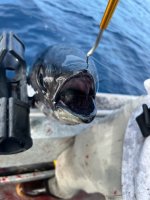
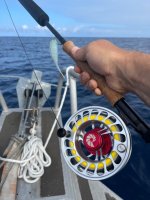
In Hawaii, we would pay great attention to the moon phases in regard to ahi and aku…big full moons up early at night and staying in the sky all night long usually meant that the tunas would feed at night and the daytime bite would suffer…but I’m also sure there is a different correlation in regard to the effect on tides that also is a factor
The moon is a popular, and sometimes polarizing topic in the albacore world for sure.
Similar to deer hunters, I have oft heard the full moon theory based around the fish feeding all night in the moonlight, and while I admit it makes sense on the surface, I've never been able to buy into it. For starters, I've never personally witnessed albacore that weren't feeding to some capacity. By that I mean, even during the many, many times I've experienced fish that just didn't want to bite anything we showed them, in virtually every single instance I can remember those fish would still eat an actual live, unhooked anchovy tossed to them. I just have a hard time believing these fish ever truly " go off the bite" in the sense that they are all just full or something. I dunno, just my personal belief. That said, there obviously has to be times where their previous feeding impacts their current feeding. I just don't have any way to verify such things.
But the biggest reason I have a hard time buying this theory is that I just struggle to believe that the same fish that can easily go down to 500' of water and gorge on a school of squid, and from what I read can go to depths of 1000' or more when they choose to, are so influenced/dependant upon light that a bright moon would have that big of an impact on them. In the case of a deer, who is likely greatly benefitted by a bright moon, I can understand the thought....But for a species of fish that is obviously evolved to not be very light dependant it just doesn't seem as plausible to me. But I don't claim to be the brightest bulb out there either lol. I've also often wondered why the commercial industry specifically hasn't adapted to take advantage of these scenarios. I mean, if albacore feed so heavily during a bright moon, why are those guys just floating around sleeping at night instead of adapting and taking advantage? I don't know the answer, just something I've often wondered.
I get asked about the moon at some point on most charter trips, and my standard answer is this: In my time albacore fishing, both sport and commercial, I have become one hundred percent convinced that the moon has an effect on albacore. In all that time I am also one hundred percent convinced that I truly do not know what exactly that effect is. I've seen absolutely wide open albacore fishing after full moons. I've seen absolutely shit albacore fishing after full moons. I've seen periods of great fishing suddenly slow when a full moon hits, and I've seen a week of dead ass albacore fishing suddenly burst wide open after a full moon. I definitely believe the moon impacts those fish somehow. I just don't truly know how so.
The craziest thing I've seen involving the moon was the full eclipse like 7 years ago or whatever. I was decking that day. The eclipse was some time mid day if I recall. Between the boat I was working, and maybe 8 other charters we were in contact with, there was maybe 4 or 5 fish encountered all morning. It was dead dead dead. The eclipse came and we all put on glasses and made a big deal out of it (Partly trying to make up for the slow fishing!). It was nowhere near as cool as I thought it would be, it just kinda turned dusk for a short bit as the sun was covered up..... But what I'll never forget was the second the sky started lightening back up, it was like the entire ocean just exploded with life. We hooked up on the troll immediately, and went on a wide open bait stop where we plugged the boat. The other boats we were in contact with were all within probably 5-8 miles, and every single one of them reported the same. Fishing just exploded wide open. I can't say that I took any great lesson away from that, other than I still believe the fish are impacted by such things, but I'll be damned if I know how or why.

Pink Nighty
Legend
Guys this is an all time thread. My mind is blowing

@Nick Clayton do you have thoughts on the timing of the strip on the slide. One thing I’ve noticed the last couple years, compared to the first couple I went out, is that I hook up more consistently on the slide when I let my fly sit for a bit and don’t frantically start stripping immediately when there is a troll hookup. I assumed it was because my fly had a chance to get deeper but maybe it’s the timing thing you speak of. Maybe waiting 20-30 seconds gives the deckhand enough time to get bait out allowing me to pull my fly through really fired up fish in that golden period over a longer stretch of water than I could if I’d striped in frantically and recast? I also stop and give it 10 seconds after about 30 feet and again after another 30 assuming I’m not in the way of someone fighting a fish. Fishing it like that keeps the fly in the water fishing longer during the fired up period and not in the air or tangled around something on deck.
BTW if anyone is looking for a solid tuna rod at a good price, spawn fly fish has a 12 weight Redington Predator in stock and I believe they are giving 25% off. Unless they took that discount off rods the last couple days. I have one as my backup tuna rod and it’s performed great.
BTW if anyone is looking for a solid tuna rod at a good price, spawn fly fish has a 12 weight Redington Predator in stock and I believe they are giving 25% off. Unless they took that discount off rods the last couple days. I have one as my backup tuna rod and it’s performed great.
Last edited:
Brute
Legend
I don’t think it’s the light of the moon that they need to rely on to feed at night…I think it’s the light of the moon that attracts food closer to the surface that may trigger feeding. These fish have giant eyeballs that are designed to look up…The moon is a popular, and sometimes polarizing topic in the albacore world for sure.
Similar to deer hunters, I have oft heard the full moon theory based around the fish feeding all night in the moonlight, and while I admit it makes sense on the surface, I've never been able to buy into it. For starters, I've never personally witnessed albacore that weren't feeding to some capacity. By that I mean, even during the many, many times I've experienced fish that just didn't want to bite anything we showed them, in virtually every single instance I can remember those fish would still eat an actual live, unhooked anchovy tossed to them. I just have a hard time believing these fish ever truly " go off the bite" in the sense that they are all just full or something. I dunno, just my personal belief. That said, there obviously has to be times where their previous feeding impacts their current feeding. I just don't have any way to verify such things.
But the biggest reason I have a hard time buying this theory is that I just struggle to believe that the same fish that can easily go down to 500' of water and gorge on a school of squid, and from what I read can go to depths of 1000' or more when they choose to, are so influenced/dependant upon light that a bright moon would have that big of an impact on them. In the case of a deer, who is likely greatly benefitted by a bright moon, I can understand the thought....But for a species of fish that is obviously evolved to not be very light dependant it just doesn't seem as plausible to me. But I don't claim to be the brightest bulb out there either lol. I've also often wondered why the commercial industry specifically hasn't adapted to take advantage of these scenarios. I mean, if albacore feed so heavily during a bright moon, why are those guys just floating around sleeping at night instead of adapting and taking advantage? I don't know the answer, just something I've often wondered.
I get asked about the moon at some point on most charter trips, and my standard answer is this: In my time albacore fishing, both sport and commercial, I have become one hundred percent convinced that the moon has an effect on albacore. In all that time I am also one hundred percent convinced that I truly do not know what exactly that effect is. I've seen absolutely wide open albacore fishing after full moons. I've seen absolutely shit albacore fishing after full moons. I've seen periods of great fishing suddenly slow when a full moon hits, and I've seen a week of dead ass albacore fishing suddenly burst wide open after a full moon. I definitely believe the moon impacts those fish somehow. I just don't truly know how so.
The craziest thing I've seen involving the moon was the full eclipse like 7 years ago or whatever. I was decking that day. The eclipse was some time mid day if I recall. Between the boat I was working, and maybe 8 other charters we were in contact with, there was maybe 4 or 5 fish encountered all morning. It was dead dead dead. The eclipse came and we all put on glasses and made a big deal out of it (Partly trying to make up for the slow fishing!). It was nowhere near as cool as I thought it would be, it just kinda turned dusk for a short bit as the sun was covered up..... But what I'll never forget was the second the sky started lightening back up, it was like the entire ocean just exploded with life. We hooked up on the troll immediately, and went on a wide open bait stop where we plugged the boat. The other boats we were in contact with were all within probably 5-8 miles, and every single one of them reported the same. Fishing just exploded wide open. I can't say that I took any great lesson away from that, other than I still believe the fish are impacted by such things, but I'll be damned if I know how or why.
@Nick Clayton do you have thoughts on the timing of the strip on the slide. One thing I’ve noticed the last couple years, compared to the first couple I went out, is that I hook up more consistently on the slide when I let my fly sit for a bit and don’t frantically start stripping immediately when there is a troll hookup. I assumed it was because my fly had a chance to get deeper but maybe it’s the timing thing you speak of. Maybe waiting 20-30 seconds gives the deckhand enough time to get bait out allowing me to pull my fly through really fired up fish in that golden period over a longer stretch of water than I could if I’d striped in frantically and recast? I also stop and give it 10 seconds after about 30 feet and again after another 30 assuming I’m not in the way of someone fighting a fish. Fishing it like that keeps the fly in the water fishing longer during the fired up period and not in the air or tangled around something on deck.
BTW if anyone is looking for a solid tuna rod at a good price, spawn fly fish has a 12 weight Redington Predator in stock and I believe they are giving 25% off. Unless they took that discount off rods the last couple days. I have one as my backup tuna rod and it’s performed great.
This maybe wrong thinking but I wonder if the keeping the fly further back is keeping it closer to the school? Basically that the troll hookup occurred as the lines passed over the school - so therefore the further back is "better". At least that's what I was thinking the times I starting stripping line off the reel to let the fly further back before beginning a retrieve. I know I've tried this multiple times but only vaguely remember hooking up once or twice. OTOH, I distinctly remember thinking WTF, why is everyone else hooked up and I'm not?!
Maybe the school is already gone, or maybe the aggressive fish peeled off and are chasing the flies being retrieved to the boat? Most likely I should just stop experimenting so much and just fish!
@Nick Clayton do you have thoughts on the timing of the strip on the slide. One thing I’ve noticed the last couple years, compared to the first couple I went out, is that I hook up more consistently on the slide when I let my fly sit for a bit and don’t frantically start stripping immediately when there is a troll hookup. I assumed it was because my fly had a chance to get deeper but maybe it’s the timing thing you speak of. Maybe waiting 20-30 seconds gives the deckhand enough time to get bait out allowing me to pull my fly through really fired up fish in that golden period over a longer stretch of water than I could if I’d striped in frantically and recast? I also stop and give it 10 seconds after about 30 feet and again after another 30 assuming I’m not in the way of someone fighting a fish. Fishing it like that keeps the fly in the water fishing longer during the fired up period and not in the air or tangled around something on deck.
BTW if anyone is looking for a solid tuna rod at a good price, spawn fly fish has a 12 weight Redington Predator in stock and I believe they are giving 25% off. Unless they took that discount off rods the last couple days. I have one as my backup tuna rod and it’s performed great.
That's something I've often thought about, and tried to have people play around with, but it's a bit difficult just because 99 percent of the time I'm not involved at that point, ya know? I've typically settled on telling people to wait 5-10 seconds before stripping your fly in, but I have a hunch there are times where as you mentioned the fish may respond to something with delayed movement or something. I think it's definitely worth playing around with to some degree, but given how many variables could be involved might be difficult to come to too much conclusion, ya know?
I've always been a bit hesitant to wait too long just because it kinda goes against one my favorite parts about trolling with fly rods; the fly can instantly be worked back through the school. One very common technique employed in the gear world is to have someone onboard who's job it is to instantly grab a rod and pitch a jig or a swim bait back behind the boat as quickly as humanly possible upon troll hookup. The idea being to get a quick hookup during that window of opportunity. I haven't employed this technique a TON in the grand scheme of things, because it's often difficult, on a charter, to have someone able to quickly and properly fish such a rig without causing other issues. But without fail the times I've seen this technique work the best is when someone is really on their game and gets that jig into the water immediately. So this background has me a bit focused on speed when shifting over to the fly world.
All that said, I've never actually hooked an albacore on the troll or the slide. I'm always at the wheel when the boat is moving, so I have precisely zero first hand experience so I can't say I've ever personally played around with it. My gut tells me that I would most likely be immediately moving that fly, but no doubt I'd want to play around with it.
I don’t think it’s the light of the moon that they need to rely on to feed at night…I think it’s the light of the moon that attracts food closer to the surface that may trigger feeding. These fish have giant eyeballs that are designed to look up…
Yeah, I have heard this thought as well, and there may well be something to that. It certainly makes sense on some levels. I think my brain just gets in the way when I try to make it that simple. If I think, ok, it being abnormally light is going to attract smaller things from the depths, with in turn will draw the attention of tuna, then I think to myself.... Well, if that's the case then why doesn't fishing seem to be noticeably better on those days when the sun is super bright? Why isn't fishing consistently slower on dark, dreary days? Or I wonder why haven't the overnight charters figured out a way to capitalize on these scenarios? They're out there anyway. I hear all the time about how people want to fish at night and they either aren't allowed for safety reasons, or they end up catching nothing but sharks. I can honestly never recall being told a story of an albacore caught at night, even by those who were trying. Surely in all the trips those boats have spent out there, drifting around totally lit up at night, there had to have been opportunities where there were fish concentrated on them due to their lights and they would have figured out a way to take advantage. I dunno. Surely it's happened, I've just never heard of it. Along the same lines.... Why is the full moon thing really only a thing with albacore fishing up here? Why wouldn't the same apply to salmon? I'm not sure I can recall anyone ever making a big deal about salmon fishing during a full moon, but at least to me it seems like the same concepts would apply.
I think the moon is just one of countless things that can and sometimes does affect albacore behavior, but like most things offshore it lacks consistency. Whatever impact the moon has on the fish, I can say for certainty that this impact is not one hundred percent of the time. I've also never known any serious tuna captain who truly seems to believe they have it figured out. I hear a lot of people talk about the moon, and various theories, but I don't know a single charter or commercial boat that is going to sit in the harbor simply because it's a full moon.
All that said, to be perfectly honest if I was planning for just a single day albacore trip during the course of a season, I would not choose my day during a full moon if possible. Not because I don't believe it would be worth the trip, but simply to remove the variable from the equation altogether. My personal beliefs aside, why even risk it if I'm paying good money and it can be avoided. Still, I can't help myself from thinking down these rabbit holes, and I highly enjoy discussin this stuff with you all!