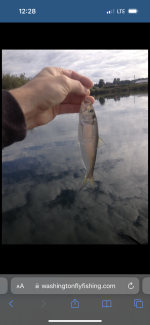
2024 Shad stuff

My concern about potential impacts from shad in Lake Washington would be at the lower trophic levels.

From much of a shad life they feed on zooplankton and smaller aquatic insects. With all the exotic species as well as the longfin smelt and sticklebacks in Lake Washington the fish community is already top heavy with species feeding at that level. Conversely I don't know if much can be done about shad being in the lake. Doubt that netting will do much good and for sure anglers will not be able to remove enough to make a detectable difference in their abundance in the lake.

Curt
Thanks Curt. Always appreciate your input.
Biologically, I would think sockeye are the main concern? Would love to hear your take.

Socially and enforcement-wise the Cedar could become very unsavory.

I got to fish in peace last night. Well, besides the guy sleeping in the back of his truck right in the middle of the limited parking area. I parked in a spot along the road. He left while I was fishing and all my windows were good when I got back. 👍
But if the run continues to grow it will become like right below Bonny.
Most people are great and are just out for a good time, but the dipshits will increase by simple math.
I mean, the dipshits were already the main reason I mostly avoid the Cedar.

Should be "interesting".
 
skyRiver-
Without a doubt sockeye are a major concern of the tribes and dept. of salmon. Fish wise Lake Washington is a mess, my last count (several years ago) there now at least 43 different species of fish (most exotics) in the lake (everything from walleye to weather fish). It should be clear by now that the juvenile sockeye leaving the Cedar every spring are not finding the food resources they need to survival. Collectively the species stew provides a huge abundance of juvenile fish that have the same food preferences as those sockeyes with some of the species (perch for example) getting to that dinning table well in advance of the sockeye (the perch spawn and eggs hatch well in advance of the sockeye fry migration). I believe that food competition is a much larger issue than predation (though that certainly takes a total).

The shad while increasing the species complexity like does not meaningful change the total number of mouths competing for food or predating on the young same.

These begs the question is there anything that can be done to increase the number of sockeye returning to the lake. The obvious action might be to rear the young sockeye to a larger size so they would be some food reserves while they adapt to the lake environment and at a larger size and later release (fall) they potentially would be in a position to fend for themselves. This is not a new idea but would be an expensive option.

Something that might benefit the survival of the sockeye fry would be to increase the number of predators to shift the ratio of the juvenile fish to more larger fish. Of course this is current the opposite of the current strategy. Something that appeals to me would be to quit netting the cutthroat (a native species) and manage then to encourage a larger cutthroat population with larger individuals - a larger minimum size limit? At worst a quality fishery for a native fish might develop.

An idea that a couple of us kicked around some 30 years ago to change that prey/depredator ratio was to begin an aggressive stocking program of tiger muskies. They would certainly do a number on various prey species. Of course, such an idea received the "HELL NO" knee jerk reaction from the salmon managers. Would there be an interest in the recreational community for a potential quality "muskie" fishery in downtown Seattle?

Curt
 
Last edited:
It will be interesting to see what happens with these new Lake Washington species. Not just shad but northern pike as well. The attempts to control them seem doomed to fail.

My big questions with the shad are to what extent they will eat daphnia vs mysis shrimp (I'm assuming those are the likely food sources?) and how will they interact with the longfin smelt. If the shad end up feeding primarily on the shrimp would we see more daphnia? Would the shad squeeze out the smelt? Would any diminishment in smelt numbers available to cutthroat be offset by availability of young-of-year shad?

I am not convinced that northern pike in the lake would be a negative, beyond them being another non-native species in the lake. All the articles I've seen focus on concerns of pike preying on salmon smolts during out migration, but what about the rest of the year? If those pike are preying on yellow perch (a known predator of salmon smolts in the lake) could the number of smolt predators actually be reduced? It's basically smalma's tiger musky idea from 30 years ago playing out, only with little to no control if things go bad.

I think its going to play out how it plays out and we're going to have to live with the results whatever they may be.
 
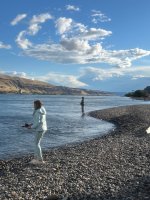
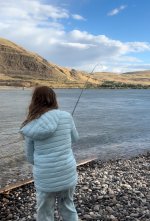
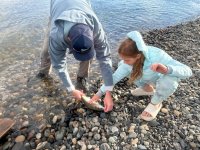
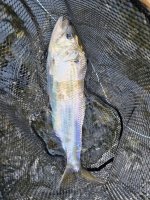
Fished at Bonneville today for our annual family shad fest. It was much slower than years past but still caught about six buckets worth. Gave away all but one bucket for bait and a few to eat. Lost more gear than normal. Saw several sturgeon come up by the bank and my kids and others hooked a few briefly. Fun trip with the family.
 
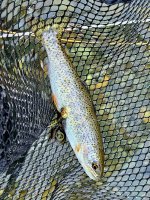
One more. 17", fat and the best fight I've had since some baby tarpon I caught in Cancun in January of 23.
I seriously thought I had an early run sockeye. And 5 of her buddies were chasing all the way to the net.

1000006950.jpg

Lake Washington is rearing some fatties. I've caught plenty smaller ones in the Columbia. I'm not convinced these are only lake-run fish. If they start showing in the Green then it will tell another story.

Had a decent trout on for a bit, but he spit the streamer. The lil dude hit just above him. He don't know he's small!
1000006941.jpg

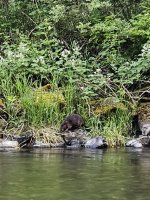
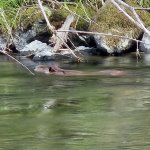
And thought I saw a giant carp swim across the river, but it was a big beaver. He looked like an old one. In fact, he made a very ungraceful entry into the river and pretty much smacked his face on a boulder. He didn't slap the water at me either so I think a bit past the prime.
1000006942.jpg

1000006943.jpg

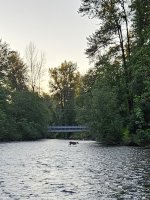
And had a deer cross the river. This is 2 hours after party central with 2 families blaring a boom box and throwing a football back and forth. Summer is here.
1000006946.jpg
 
Skyriver -
Sounds a very interesting day on the river!

I would think that the co-managers in their "predator gill net efforts are catching those shad months prior to they showing up in the Columbia argues strongly that the majority of those shad are rearing in the lake rather than the salt.

For decades there have been the odd shad showing up in our local PS rivers but until the Lake Washington "population" developed there is little evidence that they have successfully established a population in any of those rivers.

Curt
 
I’ve caught shad in the snohomish while fishing for SRC and have seen huge clouds of them in some of the little bays and sloughs. But they were small. Maybe 8-10” long. Is that a different subspecies?
 
Creatch'r-
Don't think those were shad. There are big numbers of peamouth in the lower reaches of the north sound rivers. They are found in the river year-round. Like the shad they do not has an adipose fin.

The other potential candidates would be either of two smelt, the longfin smelt which typically seen in the late winter/early spring on their spawning runs and the eulachon which is found in the rivers on their spawning run during the late fall/winter. Both of these species have adipose fins. At times during spawning, one sees "swarms" of them.

If you caught your mystery fish during one of those smelt spawning periods it could be of them. If caught in the more typical sea-run period (August through October) then my best guess would be a peamouth.

Curt
 
Creatch'r-
Don't think those were shad. There are big numbers of peamouth in the lower reaches of the north sound rivers. They are found in the river year-round. Like the shad they do not has an adipose fin.

The other potential candidates would be either of two smelt, the longfin smelt which typically seen in the late winter/early spring on their spawning runs and the eulachon which is found in the rivers on their spawning run during the late fall/winter. Both of these species have adipose fins. At times during spawning, one sees "swarms" of them.

If you caught your mystery fish during one of those smelt spawning periods it could be of them. If caught in the more typical sea-run period (August through October) then my best guess would be a peamouth.

Curt

Curt,

Here's a somewhat disturbing thought but, IIRC, there are a number of anadromous shad/herring-like, clupeiform (?), fish native to the East Coast that might fit what @Creatch’r is describing. Maybe we've had some bucket biologist, or possibly ballast water transplants?
 
Last edited:
Creatch'r-
Don't think those were shad. There are big numbers of peamouth in the lower reaches of the north sound rivers. They are found in the river year-round. Like the shad they do not has an adipose fin.

The other potential candidates would be either of two smelt, the longfin smelt which typically seen in the late winter/early spring on their spawning runs and the eulachon which is found in the rivers on their spawning run during the late fall/winter. Both of these species have adipose fins. At times during spawning, one sees "swarms" of them.

If you caught your mystery fish during one of those smelt spawning periods it could be of them. If caught in the more typical sea-run period (August through October) then my best guess would be a peamouth.

Curt
I posted a photo on the old forum and you confirmed it was a shad. I may be able to find the photo if I dig on the old site.
 
Ok even smaller then I remember (isn’t that always the case) but on this day there were hundreds swarming around in big clouds and dimpling the surface. They were nipping and flashing at my flies and I kept going smaller until I finally landed one just to see what the hell it was. This was around Lowell while cutthroat fishing end of august.
 

Attachments

  • 97D09E62-A477-4AC2-BC19-4842AD2FA6B1.png
    97D09E62-A477-4AC2-BC19-4842AD2FA6B1.png
    620.1 KB · Views: 46
In thinking about this whole shad range expansion and Creatch't's fish the Snohomish basin has the potential (and may all ready be) to be the next location to have a established population. With climate change providing summer flows that are both lower and warmer as well as the surprising low gradient of the Snohomish/Snoqualmie would seem to meet the spawning requires for the shad.

Another "Climate Change" winner?

Curt
 
In thinking about this whole shad range expansion and Creatch't's fish the Snohomish basin has the potential (and may all ready be) to be the next location to have a established population. With climate change providing summer flows that are both lower and warmer as well as the surprising low gradient of the Snohomish/Snoqualmie would seem to meet the spawning requires for the shad.

Another "Climate Change" winner?

Curt

I had been reading about various "shad" and "herring" species native to the Eastern US, prior to my covid-cancelled striper trip. Seems there are a few species that could fit. What concerns me is the small size. The smallest CR shad I've personally seen, are about half again larger than the one @Creatch'r posted. Alewife would fit the size range neatly.

Interesting shad ID link here: https://dwr.virginia.gov/blog/american-or-hickory-id-your-shad-catch/

Maybe a stretch to suggest a new invasive, but wouldn't be surprised either. Either that or it's an Atlantic salmon.
 
I had been reading about various "shad" and "herring" species native to the Eastern US, prior to my covid-cancelled striper trip. Seems there are a few species that could fit. What concerns me is the small size. The smallest CR shad I've personally seen, are about half again larger than the one @Creatch'r posted. Alewife would fit the size range neatly.

Interesting shad ID link here: https://dwr.virginia.gov/blog/american-or-hickory-id-your-shad-catch/

Maybe a stretch to suggest a new invasive, but wouldn't be surprised either. Either that or it's an Atlantic salmon.
I too have been ready a bit about the life history of American shad.

I wonder if Creatch'r's fish is from the other end of the species life history. On the east coast juvenile shad migrate to the salt in the early fall on northern rivers - that timing fits with the fish in question. At that time of year it is reported that typically those seaward migrates are 3 to 4 inches in length. Don't know whether it is much of a reach for the larger individuals of those migrating juveniles to reach the size in question, but suspect that is more likely than a small adult.

Curt
 
I too have been ready a bit about the life history of American shad.

I wonder if Creatch'r's fish is from the other end of the species life history. On the east coast juvenile shad migrate to the salt in the early fall on northern rivers - that timing fits with the fish in question. At that time of year it is reported that typically those seaward migrates are 3 to 4 inches in length. Don't know whether it is much of a reach for the larger individuals of those migrating juveniles to reach the size in question, but suspect that is more likely than a small adult.

Curt

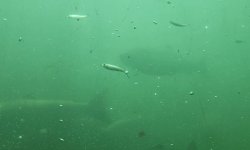
Yeah, that makes a lot of sense. Especially from a timing standpoint. August and September is when I remember seeing juvenile shad in the CR.

Much smaller though around 2". Here's a screenshot from a vid I took at the Bonneville viewing windows 9/6 last year.

Screenshot_20240622_122314_Gallery.jpg

Still a long journey to the estuary from Bonneville, so seems likely they would reach the typical 3-4" inches by the time they get there.
 
I probably “hooked” 20 of them before I finally kept one hooked long enough to get ahold of it. They chased and nipped at whatever fly I threw at them. I think my 6wt was tearing through their lips and the barbless hooks just fell out. We motored over the clouds of them mulitple times trying to get an ID on them. They were all the same size, tightly schooled and in the sun you could see the flashes of their sides as they swarmed around from the surface to the bottom. I have no idea how to guess how many there were. Mainly in one mud bay but we found them to a lesser degree in other similar back bays where I also found cutts and lots of seals and sea lions. I haven’t fished the snohomish for cutts since that day but I wonder if you went out end of august you’d see the same thing?

That photo was taken 8/31/2014 BTW
 
Back
Top