Cutty time

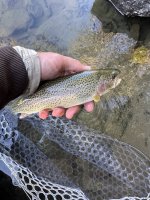
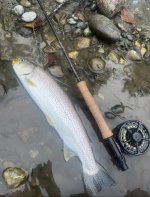
In my opinion... the best time for SRC has always been winter. I swing something with a lot of bunny fur and give the rod a tug every 3 seconds or so through the entire swing. every time they hit right after the tug. All in rivers mind ya, if you know the exact time of winter you know ahaha. This was one of the larger ones I have caught at about 24.5 inches. View attachment 126508

Are there a lot of sound rivers that remain open to trout in WA? I see giant cutts as steelhead bycatch on IG in the winter (I've also seen some large cutts), but the OR coast is closed to trout fishing, that is what stops me. I guess you could "swing for steelhead" and throw big natural sculpin patterns, but I don't really do that grey area thing.
 
Are there a lot of sound rivers that remain open to trout in WA? I see giant cutts as steelhead bycatch on IG in the winter (I've also seen some large cutts), but the OR coast is closed to trout fishing, that is what stops me. I guess you could "swing for steelhead" and throw big natural sculpin patterns, but I don't really do that grey area thing.
I think most rivers are open here for trout here more than salmon and steelhead. Most certainly the ones that come to my head at least. You can catch a SRC really on anything though lol. just gotta find them. They love Ultra Squid!
 
Are there a lot of sound rivers that remain open to trout in WA? I see giant cutts as steelhead bycatch on IG in the winter (I've also seen some large cutts), but the OR coast is closed to trout fishing, that is what stops me. I guess you could "swing for steelhead" and throw big natural sculpin patterns, but I don't really do that grey area thing.
You can C&R sea run cuts on the Oregon Coast.
 
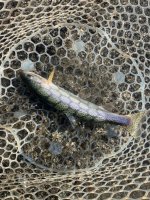
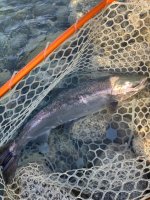
Another few small ones the other day and a coho by catch. I am going to be spending a few days on the west side of the Olympic peninsula next week. Anyone able to point me in the right direction for some cutthroat fishing? Currently leaning towards camping at either the Queets or the upper Hoh but would appreciate suggestions!
 

Attachments

  • 0D879719-2F5E-4D95-9128-424BFDEAE94D.jpeg
    0D879719-2F5E-4D95-9128-424BFDEAE94D.jpeg
    1.1 MB · Views: 37
  • A100F3CE-A739-4653-A124-5A84033D6CE6.jpeg
    A100F3CE-A739-4653-A124-5A84033D6CE6.jpeg
    922.4 KB · Views: 38
Another few small ones the other day and a coho by catch. I am going to be spending a few days on the west side of the Olympic peninsula next week. Anyone able to point me in the right direction for some cutthroat fishing? Currently leaning towards camping at either the Queets or the upper Hoh but would appreciate suggestions!
Queets all day. go high and swing.
 
  • Like
Reactions: tkp
I’m probably done cutty fishing for the season on my local water. All in all there was some really great days this season and some where I had to work a little harder but regardless, I managed to find SRC every outing, including the little walk ins I managed when I had a hour or two to kill here and there. I thought there was plenty of nice fish in that 16-18” category to keep things interesting. I caught fewer larger rainbows this year. I’m not sure if I ever got one over 13” which I found interesting. The last several years I’ve been surprised at the numbers I was finding. BWO was sparse but mahoganies kinda came on strong at the end. Fished a good spinner fall a week or so ago after work.. Never saw a green drake. October caddis was great. I caught fish on them from opening day until the river blew out. Once again I hooked ZERO chinook salmon. I also saw ZERO enforcement officers. I actually saw very little bad behavior and encountered no poachers during the open season. Imagine that. The only redds I saw in the open section of water were from even year pinks and only put eyes on 1 chinook as it swam downriver dying. I fished with a few friends and was happy to share one of my favorite fisheries with them. I’m happy the river did not close a week after it opened. I’m happy I got to fish the river I drive over every day and I’m happy a lot of other people got to enjoy it too. I hope everyone who participated remembers to make their voices heard in the future so we can continue to enjoy gamefish seasons in the Stilly Valley going forward. There is no doubt in my mind that a gamefish season and chinook conservation can co exist. I intend to advocate for it the best I can when the time comes, and I hope others will too.
 
Creatch'r,

I'm glad you had a good cutthroat season. You should have been able to enjoy it from August when they first begin to show up in the lower river - no thanks to WDFW for not being a sportfishing advocate. Since WDFW is more interested in caving to whatever the Stilly Tribe demands, I think it will take an OCCUPY STILLY kind of effort to persuade the WDFW Commission (and thence the WDFW Director) that they work just as much for non-treaty sport fishers that pay their salaries and keep the lights on in their building as they do for treaty tribes.
 
Yeah, my local src river is still closed. My trip up north to find open water was productive, but I still have a bad taste in my mouth from the summer/ fall closure. I fished a local creek that was open just for kicks. Found 3 small resident cutthroat . Saw 2 chinook. Makes no sense to me that a small creek where spawning chinook are present is open, but a large river is closed. Never had a chinook hit one of my SRC flies... Also why protect SRC in the sound ( C&R ) but allow large fish to be retained in fresh water? Logic?
 
Creatch'r,

I'm glad you had a good cutthroat season. You should have been able to enjoy it from August when they first begin to show up in the lower river - no thanks to WDFW for not being a sportfishing advocate. Since WDFW is more interested in caving to whatever the Stilly Tribe demands, I think it will take an OCCUPY STILLY kind of effort to persuade the WDFW Commission (and thence the WDFW Director) that they work just as much for non-treaty sport fishers that pay their salaries and keep the lights on in their building as they do for treaty tribes.
I think the hand has been forced already. What would Ralph, Enos, Walt, Wes, Sandy, and Frank do?
 
It's quite sad that we don't have that summer season, had someone show me gorgeous Cutthroat they caught this year in August and September. They were quite disappointed to learn it was closed waters after I let them know. Showed them the FISHWa app since they wanted to play by the rules from now on.
 
Also why protect SRC in the sound ( C&R ) but allow large fish to be retained in fresh water? Logic?
Fortunately there is a method to this seeming madness. SRC in Puget Sound are a mixed stock from all the different rivers and creeks. There is no way of knowing whether the cutthroat you just caught in the sound is from a healthy population or a small depressed one that needs protection. In addition, the catch limit and minimum size for freshwater retention is set large enough that a trout is allowed to spawn once before it is "eligible" to be harvested. These regulations have allowed almost every PS SRC population to be as large as the carrying capacity that its natal stream can support. This is why SRC and bull trout, due to being non-commercial species, are the healthiest salmonid populations in all of Puget Sound.
 
Fortunately there is a method to this seeming madness. SRC in Puget Sound are a mixed stock from all the different rivers and creeks. There is no way of knowing whether the cutthroat you just caught in the sound is from a healthy population or a small depressed one that needs protection. In addition, the catch limit and minimum size for freshwater retention is set large enough that a trout is allowed to spawn once before it is "eligible" to be harvested. These regulations have allowed almost every PS SRC population to be as large as the carrying capacity that its natal stream can support. This is why SRC and bull trout, due to being non-commercial species, are the healthiest salmonid populations in all of Puget Sound.


Sounds like we need to do that for salmon too!
 
I have come to the opinion that having robust sea-run cutthroat, bull trout and even resident trout required more than a minimum size limit that allows the females to spawn once before harvest. After monitoring the age structure of north sound sea-runs, bull trout and resident trout we cannot overstate the importance of repeat spawners in those populations. Have abundant repeat spawners in the population provides increased stability and resilience in the various population. This becomes more important as fishing pressure increases and productivity declines. In those sea-run populations at some of the fish spawn to spawn at least 5 times, the resident rainbows have similar complex repeat spawner structure while with bull trout I would find fish that had spawned at least 8 times (with the fishing pressure seen through the early 2000s). This requires a much different approach that what we get from our fisheries managers with salmon and steelhead stocks.

Having a number of year classes in the spawning population not only provides for more consistent egg deposition over time. This is especially the case as the females get larger their fecundity increases. For example, an anadromous female bull trout spawning the 8th time will have as much as 10 times the number of eggs as when she spawned the first time (based on average sizes for each age class). I would prefer to see these kinds of populations monitored for a desired aged structure. For example, a population goal might be that the spawning population would be 50% repeat spawners. Clearly our managers have not bought into this kind of thinking.
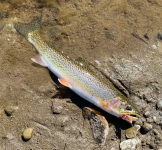
As an aside the work done by coastal cutthroat coalition has found that in the population studied it was rare to find fish that had spawned more than twice. Significantly different (lower) that some of the north sound cutthroat that still have harvest fisheries.

Curt
 
Great info; thanks Curt. It would be amazing to have that kind of monitoring data but I think the fish managers are so focused on salmon, and so pressed for funding/staffing/time, that it isn't prioritized and so bull trout and cutthroat and rainbow monitoring falls by the wayside. I've been told it's difficult even for them to do bull trout redd surveys, and they're a listed species--part of it is timing and access to the spawning grounds in Fall, but a lot of it is capacity and priorities. It's awesome what Coastal Cutthroat Coalition has been able to get done and keep funding for. We probably need some similar grassroots effort to work with the fish managers and to fill that sort of information gap for resident and migratory trout and char. And I'm fully cognizant that that could start with the person typing this right now but sheesh, I've got forum posts to get to. :sneaky:
 
Matt B
I understand the difficulty monitoring those kinds of populations. That does not mean that it could not be done. for some key populations, it is a matter of priority. That said if that sort of monitoring cannot be done, I would argue that the best management option would be selective gear rules (for even salmon fisheries) whenever the species of concern (sea-runs, bull trout and resident rainbows) are likely to be present with CnR release for those game fish species. I suspect with that sort of management paradigm would quickly generate input for users on priority areas.

Curt
 
Back
Top