With Our Already High Fuel Prices This Is Really Going To Hit The Pocketbook

Status
Not open for further replies.
Disagree for sure. If a few cents increase is the end of the world then they will be working the rest of their life until they die. They never could retire. Shows that a person invested, gave up on some expenditures while working, to have a better life with fewer worries so they can live life. Smart not elitist.
Adding those 'few cents' to these few cents is a lot for people, young families, etc., that aren't as well off or as fortunate as you and are really struggling already.

"Wondering exactly how big a bite inflation is taking out of your budget right now?
It’s a nice, round number: $460 a month in extra U.S. household spending, Moody's Analytics economists say.
The number comes from Moody’s senior economist Ryan Sweet, who tracked the price of U.S. goods and services in May 2022 against similar prices in the same month in 2018 and 2019.
Right now, the average inflation rate stands at 8.5% on a year-to-year basis, compared with an average of 2.1% in 2018 and 2019, Moody’s reported.
The difference, Moody’s noted, amounted an extra $460 a month “pure cost” in U.S. household spending versus the 2018-2019 time frame."
 
Last edited:
Adding those 'few cents' to these few cents is a lot for people, young families, etc., that aren't as well off or as fortunate as you and are really struggling already.

"Wondering exactly how big a bite inflation is taking out of your budget right now?
It’s a nice, round number: $460 a month in extra U.S. household spending, Moody's Analytics economists say.
The number comes from Moody’s senior economist Ryan Sweet, who tracked the price of U.S. goods and services in May 2022 against similar prices in the same month in 2018 and 2019.
Right now, the average inflation rate stands at 8.5% on a year-to-year basis, compared with an average of 2.1% in 2018 and 2019, Moody’s reported.
The difference, Moody’s noted, amounted an extra $460 a month “pure cost” in U.S. household spending versus the 2018-2019 time frame."
Last time we had a minimum wage hike was 2009. Do you think think a decent minimum wage would help offset this $460 bite in household budgets?
 
Last time we had a minimum wage hike was 2009. Do you think think a decent minimum wage would help offset this $460 bite in household budgets?
I agree that the Federal minimum wage is extremely low but raising it, whatever it is, creates a double edged sword of sorts.
As it's raised the cost of goods and services has to follow suit and affects everyone to some degree, especially those that are on the edge already. I'm fairly comfortable in retirement but I'll never forget the two job times in my younger years and will always have compassion for those in similar situations.
 
Last edited:
Last time we had a minimum wage hike was 2009. Do you think think a decent minimum wage would help offset this $460 bite in household budgets?

Guess who rising taxes and cost on fuel hurts the most? Guess who feels the effects of poor economic policy leading to missive inflation? Guess who is hurt the most by climate austerity measures? Here's a hint, it isn't the evil big oil companies.
 
Last time we had a minimum wage hike was 2009. Do you think think a decent minimum wage would help offset this $460 bite in household budgets?
I'm not sure who the "we" is you refer to, in Washington (state) the minimum wage has increased yearly since 2017, from WA DLI:

"Initiative 1433, approved by Washington voters in 2016, requires a statewide minimum wage of $11.00 in 2017, $11.50 in 2018, $12.00 in 2019, and $13.50 in 2020. In 2022, the minimum wage in Washington is $14.49 per hour." The minium wage is scheduled to increase to $15.74/hour next year.

Would I want to try and exist on minimum wage? No! I don't think the minium wage program was truly intended to be career wage.

It seems the inflation rate that @Old406Kid has shown is lower than than what I'm seeing in our monthly food budget.
 
@Ernie, check your science. Yes, E vehicles do use a lot of resources to make, however they save massive amounts of resources over their lives. A recent UW economic analysis says the breakeven point is in the range of 15 to 20 months. That is considerably shorter than the expected life of the vehicle. They are frugal. The Tesla Model 3's equivalent gas mileage is 140mpg. Yes, it is the best of breed but the others are close behind.

Your rant is a cheap political ploy.
 
I'm not sure who the "we" is you refer to, in Washington (state) the minimum wage has increased yearly since 2017, from WA DLI:

"Initiative 1433, approved by Washington voters in 2016, requires a statewide minimum wage of $11.00 in 2017, $11.50 in 2018, $12.00 in 2019, and $13.50 in 2020. In 2022, the minimum wage in Washington is $14.49 per hour." The minium wage is scheduled to increase to $15.74/hour next year.

Would I want to try and exist on minimum wage? No! I don't think the minium wage program was truly intended to be career wage.

It seems the inflation rate that @Old406Kid has shown is lower than than what I'm seeing in our monthly food budget.
My question dealt with the Federal Minimum wage as was acknowledged. No one doubts the hardships involved with inflation. The difference of opinion lies in the root causes of our current inflation issue. I choose not to believe Fox News hype who's agenda is trying to create political controversy.

Despite all the controversy, according to Fortune, economists generally agree on some of the causes behind the high inflation that has defined the economy over the last several months:
  • The pandemic shifted consumer demand away from services toward goods, which left producers unable to keep up with demand.
  • Factory closures from early in the pandemic reduced supply just as demand was rising, which sent prices up even further.
  • Russia’s invasion of Ukraine caused a spike in oil prices, which increased the cost of both manufacturing and shipping, while also forcing up the price of wheat and other commodities.
 
.
12.8% I was told on Friday per the owner of a local supermarket who owns around twenty stores across ID/MT/WA.

It's almost as if the people reporting the numbers in the media are the ones involved with how the numbers got to where they are. At any rate is still, "the best economic recovery in history," according to those in charge.

I'm seeing inflation more in line with what you were reported by the store owner.
 
How's that? You millennials aren't even working NOW :LOL:

I hope you are kidding. I am a millennial and am 20 years into my career. I honestly take all of this hate on the young workers as projection from the seniors at this point. Every company I have worked for it was always “the rules are for thee and not for me” from the senior folks, they never lead by example, few people ever know what they are doing. It’s like in their time all you had to do was show up for the job and eventually you move on up.

I can honestly say I would absolutely love to work for a true leader. Most of my bosses have been alcoholics, narcissists, and just play boss games all the time. We are only beginning to see how poorly our country is ready for succession as Boomers retire and I’ll bet the Boomers will continue to blame the younger workers who they didn’t train, didn’t show how to lead, didn’t manage well, because they couldn’t get out of the way of their own ego.
 
@Ernie, check your science. Yes, E vehicles do use a lot of resources to make, however they save massive amounts of resources over their lives. A recent UW economic analysis says the breakeven point is in the range of 15 to 20 months. That is considerably shorter than the expected life of the vehicle. They are frugal. The Tesla Model 3's equivalent gas mileage is 140mpg. Yes, it is the best of breed but the others are close behind.

Your rant is a cheap political ploy.

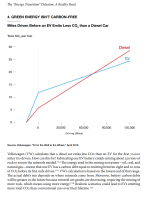
This particular data contradicts your breakeven point if CO2 Emissions are what we should be concerned with.

1666628820270.png
The “Energy Transition” Delusion: A Reality Reset Mark P. Mills, August 2022, Manhattan Institute
 
This particular data contradicts your breakeven point if CO2 Emissions are what we should be concerned with.

View attachment 37969
The “Energy Transition” Delusion: A Reality Reset Mark P. Mills, August 2022, Manhattan Institute
Maybe. It depends, as we well know.

Reuters plugged a series of variables into the Argonne model, which had more than 43,000 users as of 2021, to come up with some answers.

The Tesla 3 scenario above was for driving in the United States, where 23% of electricity comes from coal-fired plants, with a 54 kilowatt-hour (kWh) battery and a cathode made of nickel, cobalt and aluminum, among other variables.

It was up against a gasoline-fueled Toyota Corolla weighing 2,955 pounds with a fuel efficiency of 33 miles per gallon. It was assumed both vehicles would travel 173,151 miles during their lifetimes.

But if the same Tesla was being driven in Norway, which generates almost all its electricity from renewable hydropower, the break-even point would come after just 8,400 miles.

If the electricity to recharge the EV comes entirely from coal, which generates the majority of the power in countries such as China and Poland, you would have to drive 78,700 miles to reach carbon parity with the Corolla, according to the Reuters analysis of data generated by Argonne's model.


As a business owner. We have several schedules for marking up the products we sell. Some small bits that we are able to buy right, we double the price we bought it for, and that's our sell it for.
Some big ticket items we sell, we only make a 20% gross margin.
Everything else falls in between those extremes. As the price we pay for materials goes up, so does our retail price. This leads to a situation where our gross profits look great, but due to a rise in inflation our costs go up. "Keeping the lights on."
A business owner has to due their best to maintain their margins when costs are high just to stay in business. When we have product on the shelf we bought at an inflated price, we try to keep the price up to make our intended margin in tack until we sell the bulk of it. Then if we buy the same at a lesser price, we may pass the decrease on to our customers, or it may go into a different schedule, and we will maintain the retail price.
With volume discounts, seasonal special, sales,..... it's easy to lose money when you're in business. It's hard to maintain margins and keep up on profits.
Those who bitch about "Big Oil" profits just can't seem to get their arms around the idea that if I buy something at a quantity for a price, I need to sell the same at a price plus a margin to stay in business.
I'm fortunate not to have to answer to shareholders that consistently want a profit, but as a shareholder in other businesses, I expect a profit.
A case of eggs went from 30 to 60 dollars over the last month.. Along with everything else, but that's the most dramatic item I have seen. I buy a lot from restaurant supply places like Restaurant Depot and Cash n Carry, they have raised prices a bit more on all items across the board. What's interesting is some of the other grocery chains are purposefully holding prices down on certain staple items like milk, cheese, eggs, butter, etc to limit the shock on customers and keep them in the stores. Now they have jacked the prices in the home goods and other departments to make up for it but if your a savy shopper you can still get deals. I get eggs, butter and milk from Kroger, along with fuel points and sometimes the stuff is on a digital coupon deal. Paper towels, coffee, cans of soda, and some bulk nuts I get at Winco, paper/plastic serving products I get online now. My mobile locations and events I have jacked my prices up dramatically, about 50%, the psychology behind this is when a consumer is out at an event they have a set amount of money they were going to spend that day and they will spend it. Brick and mortar I have only raised prices on a few items a little bit. Locals and regulars dont like price increases even if they understand why, they will stop coming in. I'm hoping my event sales will cover the loss at the brick and mortar. I would rather have customers and make less money then no customers, this is what a lot of businesses are having to do, just take it. Along with going from 5 employees to 1 part time, and cutting my slow hours instead. I have been able to keep making a 'profit' but it's getting harder and harder. I'm sick of this shit, I've had my business for 10 years, expanded to brick and mortar 5 years ago just in time for covid and now inflation I just want some normal sales years with no crisis.
 
Last time we had a minimum wage hike was 2009. Do you think think a decent minimum wage would help offset this $460 bite in household budgets?
They hike the min wage here every July. We're at 14.75 and I have slowly gone from multiple employees down to 1 part time. So I guess people would rather have no job then a job.
 
This particular data contradicts your breakeven point if CO2 Emissions are what we should be concerned with.

View attachment 37969
The “Energy Transition” Delusion: A Reality Reset Mark P. Mills, August 2022, Manhattan Institute
A bit of background on the Manhattan Institute:


The Manhattan Institute was one of the go-to firms for the tobacco industry, when that industry was trying to muddy the waters on the link between smoking and cancer.
 
The Manhattan Institute does not appear to be a neutral source. Wilkipedia says The Manhattan Institute for Policy Research is a conservative American think tank focused on domestic policy and urban affairs, These data have a look of being cherry picked to make a point. I question your source.
 
the solution-----

As much as I dislike Inslee I'd rather he be voted out. In alternative to that I'd settle for a Bastille Day type with Inslee as a star attraction.

But seriously I'd rather he be voted out peacefully with due democratic process.
 
Last edited:
Status
Not open for further replies.
Back
Top