Nation wide airport shutdown….

Status
Not open for further replies.
'copper to optic fiber router upgrade at a remote facility'....we converted hundreds of blds from copper to fiber and never once lost an internet connection much less interrupted an entire national infrastructure system....let's not focus on the 'super intelligence' AI module turned on the day before the failure...lies flow from this administration like crap from a baby's butt, everyone in it is absolutely incapable of telling the truth about anything and everything.

Trying to understand how that could happen...Google says....
"The claim that a single misconfigured or faulty router can trigger a cascading overload across a major network is true—it is a well-documented phenomenon in networking, though the skepticism from IT professionals highlights just how unusual and preventable it should be on a modern network.

Why It Is Technically Possible
  • Control-Plane Flooding: While 1,000 connection attempts every 4 to 5 seconds (about 200 to 250 requests per second) sounds tiny compared to modern internet bandwidth, those requests hit a router's control plane (its CPU), not just its data pipes. When a newly installed router malfunctions or enters a misconfigured routing loop, it can rapidly spam neighboring routers with peering requests, BGP updates, or broadcast storms, consuming their processing power.
  • Legacy Hardware Bottlenecks: The FAA Telecommunications Infrastructure (FTI) still relies heavily on decades-old, low-bandwidth legacy hardware and Time-Division Multiplexing (TDM) switches designed for old copper lines. A sudden flood of modern IP-based connection requests can easily choke older equipment that lacks modern rate-limiting or CPU protections. [1, 2]
  • Cascading Failovers: According to FAA Administrator Bryan Bedford, once the initial routers were overwhelmed, traffic automatically failed over to backup routers at other centers, spreading the instability across 17 of the 22 Air Route Traffic Control Centers. [1, 2]

Why Some IT Professionals Are Skeptical
Network engineers online have expressed disbelief for two main reasons, both of which point to systemic design flaws rather than technical impossibility:
  • Lack of Segmentation and Rate-Limiting: In any properly architected enterprise network, edge routers at a remote site (like El Dorado, Arkansas) are strictly isolated with Access Control Lists (ACLs) and control-plane policing. A remote edge device should never have the permissions or capacity to flood core national infrastructure. [1]
  • Outdated Change Management: IT professionals are also stunned that live core-network cutovers were happening on a Friday afternoon—one of the busiest travel windows of the week—and that the FAA had to sift through manual paper logs for 45 minutes just to figure out which contractor crew had plugged in new hardware. [1, 2]
In short, the scenario is entirely possible when modern IP equipment is bridged onto fragile legacy infrastructure without proper network isolation—which is why the FAA and L3Harris have pulled the routers from both Arkansas and Texas for lab diagnostics."
 
Trying to understand how that could happen...Google says....
"The claim that a single misconfigured or faulty router can trigger a cascading overload across a major network is true—it is a well-documented phenomenon in networking, though the skepticism from IT professionals highlights just how unusual and preventable it should be on a modern network.

Why It Is Technically Possible
  • Control-Plane Flooding: While 1,000 connection attempts every 4 to 5 seconds (about 200 to 250 requests per second) sounds tiny compared to modern internet bandwidth, those requests hit a router's control plane (its CPU), not just its data pipes. When a newly installed router malfunctions or enters a misconfigured routing loop, it can rapidly spam neighboring routers with peering requests, BGP updates, or broadcast storms, consuming their processing power.
  • Legacy Hardware Bottlenecks: The FAA Telecommunications Infrastructure (FTI) still relies heavily on decades-old, low-bandwidth legacy hardware and Time-Division Multiplexing (TDM) switches designed for old copper lines. A sudden flood of modern IP-based connection requests can easily choke older equipment that lacks modern rate-limiting or CPU protections. [1, 2]
  • Cascading Failovers: According to FAA Administrator Bryan Bedford, once the initial routers were overwhelmed, traffic automatically failed over to backup routers at other centers, spreading the instability across 17 of the 22 Air Route Traffic Control Centers. [1, 2]

Why Some IT Professionals Are Skeptical
Network engineers online have expressed disbelief for two main reasons, both of which point to systemic design flaws rather than technical impossibility:
  • Lack of Segmentation and Rate-Limiting: In any properly architected enterprise network, edge routers at a remote site (like El Dorado, Arkansas) are strictly isolated with Access Control Lists (ACLs) and control-plane policing. A remote edge device should never have the permissions or capacity to flood core national infrastructure. [1]
  • Outdated Change Management: IT professionals are also stunned that live core-network cutovers were happening on a Friday afternoon—one of the busiest travel windows of the week—and that the FAA had to sift through manual paper logs for 45 minutes just to figure out which contractor crew had plugged in new hardware. [1, 2]
In short, the scenario is entirely possible when modern IP equipment is bridged onto fragile legacy infrastructure without proper network isolation—which is why the FAA and L3Harris have pulled the routers from both Arkansas and Texas for lab diagnostics."
great job echoing the party line....and absolute horsepuckey it is.
I built/rebuilt interconnected high demand data centers around the globe that hosted DNS top level web traffic for .com and .net, protected the firewalls for Wall Street and a large chunk of the Fortune 500 companies, and two cross linked for the Feds that screen US cell calls via SS7 capture....we never once lost a connection or shut down a service. Cooper to fiber conversion is at the lowest rung of technical demand, the new fiber system is built air gapped from the legacy system, proofed, and then cut over at minimal peak traffic hours.
So biz as usual, f'up, blame others, cover the truth.
 
great job echoing the party line....and absolute horsepuckey it is.
I built/rebuilt interconnected high demand data centers around the globe that hosted DNS top level web traffic for .com and .net, protected the firewalls for Wall Street and a large chunk of the Fortune 500 companies, and two cross linked for the Feds that screen US cell calls via SS7 capture....we never once lost a connection or shut down a service. Cooper to fiber conversion is at the lowest rung of technical demand, the new fiber system is built air gapped from the legacy system, proofed, and then cut over at minimal peak traffic hours.
So biz as usual, f'up, blame others, cover the truth.
Why weren't you there to save us?
 
Trying to understand how that could happen...Google says....
"The claim that a single misconfigured or faulty router can trigger a cascading overload across a major network is true—it is a well-documented phenomenon in networking, though the skepticism from IT professionals highlights just how unusual and preventable it should be on a modern network.

Why It Is Technically Possible
  • Control-Plane Flooding: While 1,000 connection attempts every 4 to 5 seconds (about 200 to 250 requests per second) sounds tiny compared to modern internet bandwidth, those requests hit a router's control plane (its CPU), not just its data pipes. When a newly installed router malfunctions or enters a misconfigured routing loop, it can rapidly spam neighboring routers with peering requests, BGP updates, or broadcast storms, consuming their processing power.
  • Legacy Hardware Bottlenecks: The FAA Telecommunications Infrastructure (FTI) still relies heavily on decades-old, low-bandwidth legacy hardware and Time-Division Multiplexing (TDM) switches designed for old copper lines. A sudden flood of modern IP-based connection requests can easily choke older equipment that lacks modern rate-limiting or CPU protections. [1, 2]
  • Cascading Failovers: According to FAA Administrator Bryan Bedford, once the initial routers were overwhelmed, traffic automatically failed over to backup routers at other centers, spreading the instability across 17 of the 22 Air Route Traffic Control Centers. [1, 2]

Why Some IT Professionals Are Skeptical
Network engineers online have expressed disbelief for two main reasons, both of which point to systemic design flaws rather than technical impossibility:
  • Lack of Segmentation and Rate-Limiting: In any properly architected enterprise network, edge routers at a remote site (like El Dorado, Arkansas) are strictly isolated with Access Control Lists (ACLs) and control-plane policing. A remote edge device should never have the permissions or capacity to flood core national infrastructure. [1]
  • Outdated Change Management: IT professionals are also stunned that live core-network cutovers were happening on a Friday afternoon—one of the busiest travel windows of the week—and that the FAA had to sift through manual paper logs for 45 minutes just to figure out which contractor crew had plugged in new hardware. [1, 2]
In short, the scenario is entirely possible when modern IP equipment is bridged onto fragile legacy infrastructure without proper network isolation—which is why the FAA and L3Harris have pulled the routers from both Arkansas and Texas for lab diagnostics."
We got hacked. Like an attack hack. I don't know what's worse the incompetence it takes to make a disaster like this possible or an attack hack.
 
Written by Chris Henley:

I’ve worked in software for more than 25 years and manage multimillion-dollar technology projects. This FAA timeline is alarming to say the least.

The FAA told Congress that pilot testing would begin in 2027, with initial operational capability later that year. Instead, the contract was announced in June, the AI-supported system went live in September, and it expanded to all 22 control centers on November 10.
Three days later, the entire country’s airspace shut down.

This is safety-critical national infrastructure connected to 200 live data streams. A properly managed rollout should include months of regional testing, production load testing, dependency mapping, failure simulations, security reviews, operator training, and clearly defined readiness criteria. Most importantly, it should have a tested rollback plan capable of immediately isolating the new system without disrupting national operations.

Seven weeks of regional operation before nationwide deployment suggests the schedule took priority over proving the system was ready. Expanding to all 22 control centers at once also increased the potential impact from a regional problem to a national one. This is exactly why high-risk technology is deployed gradually, monitored carefully, and rolled back at the first sign of instability.

The administration ruled out the new system before releasing a complete root-cause analysis. “Old equipment failed” tells us which component broke, but it does not tell us what triggered the failure. Until they explain what changed, what overloaded the system, and why the rollback plan did not prevent a nationwide shutdown, their explanation is incomplete.

Either the government has not disclosed the real development and testing history, or it rushed an extraordinarily high-risk deployment with a poorly managed release plan. Both are unacceptable.

Maybe Trump’s “best people” for a nationwide aviation systems failure should include someone with experience in safety-critical technology, instead of a former contestant from MTV’s The Real World and Road Rules standing beside a plumber, telling us everything is fine and they just need another $50 billion.

Perhaps Trump can contribute some of the money his family made from crypto now that he has finished fixing the Reflecting Pool and can focus on completing his ballroom. There always seems to be money for vanity projects and personal enrichment. Keeping the national airspace functioning apparently requires another shakedown.
 
Did someone divert attention from losing the Mid-terms, the NVidia scandal with potential National Security violations, all at once on Friday @ 4:00pm ET during one of the busiest travel times?

Pray to the heavens that no one was injured or killed.
 
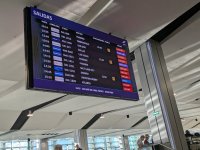
To add to the funnsies they all or mostly closed down the airspace over Cabo for five hours yesterday. Why? Cabo was in the path of the Space X rocket return.

PXL_20261114_233628987.MP.jpg
 
When he assumed the job, the current head of the FAA rejected Congress funding 10B for infrastructure upgrades and recruiting efforts, stating all the FAA needed was better management and a 'streamlining of processes for great efficiencies.'
Yesterday the same clown was demanding 50B for desperately needed upgrades to FAA infrastructure.
 
Of what?

My opinion?

Or my opinion based on facts that I know to be true?

That's all I'll say on the subject. If you want to make it go in that direction, be my guest....you'll be having a conversation with yourself....which honestly, sometimes isn't the worst thing in the world....now, I'm going fishing.
Do you have any real world insight from the FAA from a professional standpoint? Simple question. We can dialogue further from there.
 
Do you have any real world insight from the FAA from a professional standpoint? Simple question. We can dialogue further from there.
simple answer. it's well known that DOGE cut 400 FAA positions. ergo, my opinon. next....

fishing was pretty solid today!
 
Status
Not open for further replies.
Back
Top