
Navigation
Install the app
How to install the app on iOS
Follow along with the video below to see how to install our site as a web app on your home screen.
Note: This feature may not be available in some browsers.
More options
Style variation
You are using an out of date browser. It may not display this or other websites correctly.
You should upgrade or use an alternative browser.
You should upgrade or use an alternative browser.
What fish is this?
- Thread starter Zak
- Start date
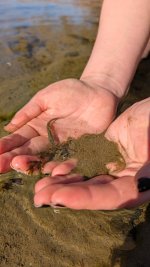
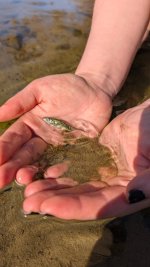

Looks like a stickleback to me. They are little predators.My son and I are trying to figure what kind of fish this little guy is. He caught it with his hands in the Columbia River. It looks like a baby predator to me, maybe a pike, pickerel, or walleye? I don't know what kinds of fish are in the Columbia. Thoughts welcome!
View attachment 195018
View attachment 195019

Yes, that is a three-spiked stickleback, Gasterosteus aculeatus. [It is likely a species complex with multiple cryptic species.]. The genus is from the the Greek words "belly" and "bone". The species epithet is from the Latin words for needle and prickly or sting. The species epithet refers to the spiky dorsal and pelvic fins. Their pelvic fins consist of single spines that are fused to the pelvic girdle. The three dorsal spines and two pelvic fins, when erected, create a challenge for fish predators that they to swallow them. They also have armored plates along their side.
Almost all individuals are anadromous; there are a few populations that are landlocked, same as kokanee, in B.C.. Adults, like this individual, migrate into brackish and freshwater habitats to breed, typically in slow-water habitats. The males weave a nest of algal filaments. A breeding male has a bright green eye and a red belly. He tries to attract a female into his nest. After she lays her eggs, he enters the nest and fertilizes them. Then he drives her off. The male guards and aerates the eggs until they hatch and then he protects the hatchlings for a while. Like steelhead and coastal cutthroat trout, stickleback adults can survive the breeding season (though mortality is high) and head back out to sea to restore their energy reserves. Youngsters migrate back into saltwater and grow there for the next year before migrating back to brackish and freshwater habitats. They feed primarily on planktonic animals, like copepods and various larvae.
Steve

G_Smolt
Legend
The other FishNerds™ beat me to it.
Interesting regional variation - In SE AK, males often have blue eyes. They occasionally commingle with rearing coho in low-gradient and/or off-channel habitat, most often in the upper ITZ meadows of coastal streams.
We nicknamed this one Frank Sinatra
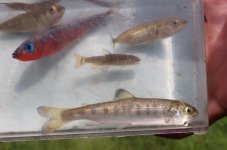
Interesting regional variation - In SE AK, males often have blue eyes. They occasionally commingle with rearing coho in low-gradient and/or off-channel habitat, most often in the upper ITZ meadows of coastal streams.
We nicknamed this one Frank Sinatra

Thank you so much, Steve! I am so appreciative of your expertise and the wealth of knowledge on this forum!Yes, that is a three-spiked stickleback, Gasterosteus aculeatus. [It is likely a species complex with multiple cryptic species.]. The genus is from the the Greek words "belly" and "bone". The species epithet is from the Latin words for needle and prickly or sting. The species epithet refers to the spiky dorsal and pelvic fins. Their pelvic fins consist of single spines that are fused to the pelvic girdle. The three dorsal spines and two pelvic fins, when erected, create a challenge for fish predators that they to swallow them. They also have armored plates along their side.
Almost all individuals are anadromous; there are a few populations that are landlocked, same as kokanee, in B.C.. Adults, like this individual, migrate into brackish and freshwater habitats to breed, typically in slow-water habitats. The males weave a nest of algal filaments. A breeding male has a bright green eye and a red belly. He tries to attract a female into his nest. After she lays her eggs, he enters the nest and fertilizes them. Then he drives her off. The male guards and aerates the eggs until they hatch and then he protects the hatchlings for a while. Like steelhead and coastal cutthroat trout, stickleback adults can survive the breeding season (though mortality is high) and head back out to sea to restore their energy reserves. Youngsters migrate back into saltwater and grow there for the next year before migrating back to brackish and freshwater habitats. They feed primarily on planktonic animals, like copepods and various larvae.
Steve
Thank you!The other FishNerds™ beat me to it.
Interesting regional variation - In SE AK, males often have blue eyes. They occasionally commingle with rearing coho in low-gradient and/or off-channel habitat, most often in the upper ITZ meadows of coastal streams.
We nicknamed this one Frank Sinatra
View attachment 195021
On the Yakima I once found a dead sculpin with a stickleback lodged in its throat. The spines worked I guess. The sculpin wasn’t that much larger than the stickleback, but sculpins have that huge mouth.
I think I once read that sticklebacks, maybe three-spined specifically, are one of the, or the most widely distributed freshwater fish species globally. That reference needs checking, this ain’t Steve posting here.
Sculpins and sticklebacks—by sheer numbers, our “salmon and trout” streams should maybe be called stickleback and sculpin streams.
Yes, if there is a river in the Northern Hemisphere that connects to the ocean, it probably has three-spiked sticklebacks. In the U.S., they are absent south of Wilmington, NC through the Gulf of Mexico.I think I once read that sticklebacks, maybe three-spined specifically, are one of the, or the most widely distributed freshwater fish species globally. That reference needs checking, this ain’t Steve posting here.
Three-spined sticklebacks were a catalyst in my journey to becoming a biologist. In middle school I read about three-spined sticklebacks from a library book, probably summarizing lab research on their breeding behavior by the ethologist Niko Tinbergen . I also loved to tromp around the salt marsh of the Neponset River near my house (if anything, to escape five younger siblings...). I would use home-made nets to collect organisms like clear marsh grass shrimp and the very common mummichogs (Fundulus heteroclitus) from permanent pools in the marsh. My mom let me have a few small aquaria in my bedroom; I suspect that she liked it better for me to fill the aquaria with fish versus garter snakes that kept "disappearing". One spring, I netted several fish from one deep pool that were different. In a "eureka" moment, I connected these real fish with the book fish. I brought them home and actually had a male build a nest, attract and mate with a female, and produce tiny stickleback young. [I also collected two other stickleback species, fourspine sticklebacks (Apeltes quadricus) and ninespine sticklebacks (Pungitius pungitius) but never breed them.]. So, they have always had a soft spot in my heart...
Steve

Yes, your "hard-drive" has retrieved an accurate fact. Sticklebacks are an intermediary in a complex, three-host tapeworm parasite, Schistocephalus solidus. Larvae from tapeworm eggs are eaten by freshwater copepods. The copepods are eaten by sticklebacks. The infected stickleback are eaten by birds, such as a gull or a loon. The worms finally reproduce sexually within the gut of the bird. The fertilized eggs pass out of the bird's gut and hatch into coracidium larvae. The tapeworms grow massively within the stickleback's gut, up to half the fish's mass. In both copepods (see here) and in sticklebacks (see here and here), infected individuals exhibit riskier behaviors that increase the risk of predation by the next stage in the parasitic chain.
Steve
Steve
I occasionally find huge schools of sticklebacks in central Puget sound. It was surprising the first time, as I had thought of them as being a freshwater species that sometimes made forays into brackish water. They do not seem to be a popular snack for the resident salmonids, even the birds seem to leave them alone. Must be too crunchy compared to herring!

One time @DimeBrite and I were beach fishing. The tide wasn’t moving much, so I decided to fish for some flatfish we saw swimming around. I think they were rock sole. I tossed a clouser out and let it sink to the bottom. I got a great hit which turned out to be a nice size coho. When I cleaned it, it was stuffed with small sticklebacks.
SF
SF

Bambooflyguy
Legend
I occasionally find huge schools of sticklebacks in central Puget sound. It was surprising the first time, as I had thought of them as being a freshwater species that sometimes made forays into brackish water. They do not seem to be a popular snack for the resident salmonids, even the birds seem to leave them alone. Must be too crunchy compared to herring!
Or could it possibly be they’re hard to swallow and even nastier to crap out??? Sharp dorsal spines…..
Or could it possibly be they’re hard to swallow and even nastier to crap out??? Sharp dorsal spines…..
The spines on their backs kind of point backwards and I believe fold down, so if eaten head first the spines shouldn’t be an issue. Searun cutts feed on them.
SF

dflett68
Steelhead
i'm curious - has it always been thus with the sticklebacks? i have, of course, encountered sculpins in trout streams all my life - but never sticklebacks until the last two summers when my grandson started catching them in the pilchuck along with the expected sculpins, crawdads, baby lamprey, and what i think are peamouth fry. everything in that list, i've encountered for nearly 50 years in local lowland streams - but not the sticklebacks. i've only encountered those in lakes.On the Yakima I once found a dead sculpin with a stickleback lodged in its throat. The spines worked I guess. The sculpin wasn’t that much larger than the stickleback, but sculpins have that huge mouth.
I think I once read that sticklebacks, maybe three-spined specifically, are one of the, or the most widely distributed freshwater fish species globally. That reference needs checking, this ain’t Steve posting here.
Sculpins and sticklebacks—by sheer numbers, our “salmon and trout” streams should maybe be called stickleback and sculpin streams.
i lived on the pilchuck for about 10 years when my own kids were small and we spent a lot of time down there. granted my grandson has a special passion for rooting out critters that none of my kids had. but the sticklebacks surprised me - and the last two summers i've seen adult sunfish in the pilchuck - didn't catch them but i suspect they are pumpkinseeds. i figure they came down from lake stevens when the water was high enough - but it doesn't cease to be feel wrong and depressing. i would expect as things continue to warm that we're going to eventually have smallies make their way down from the lake and go to work on the salmonids, if they aren't already present.
Sticklebacks will migrate up fast-moving streams, but they only breed in calm, slow pools or lakes.i'm curious - has it always been thus with the sticklebacks? i have, of course, encountered sculpins in trout streams all my life - but never sticklebacks until the last two summers when my grandson started catching them in the pilchuck along with the expected sculpins, crawdads, baby lamprey, and what i think are peamouth fry. everything in that list, i've encountered for nearly 50 years in local lowland streams - but not the sticklebacks. i've only encountered those in lakes.
i lived on the pilchuck for about 10 years when my own kids were small and we spent a lot of time down there. granted my grandson has a special passion for rooting out critters that none of my kids had. but the sticklebacks surprised me - and the last two summers i've seen adult sunfish in the pilchuck - didn't catch them but i suspect they are pumpkinseeds. i figure they came down from lake stevens when the water was high enough - but it doesn't cease to be feel wrong and depressing. i would expect as things continue to warm that we're going to eventually have smallies make their way down from the lake and go to work on the salmonids, if they aren't already present.
Steve
Bass are already present in the Snoqualmie and Snohomish at mostly low levels for now and found concentrated in certain habitats like the mouths of sloughs. I'd assume they make a living in the Pilchuck too in spots where they have the opportunity. And yes, temperatures are one of the big drivers of where that opportunity is.i would expect as things continue to warm that we're going to eventually have smallies make their way down from the lake and go to work on the salmonids, if they aren't already present.