Experiment in removing stunted brookies from Skagit County's Little Gee Lake

Dave Westburg

Fish the classics
Forum Supporter
There was a 2024 HiLakers article on a program to remove the stunted brookies from Little Gee lake in Skagit county by introducing sterile male brookies.


Anyone on the website know how the experiment is progressing? I've fished Little Gee and can testify that it's overpopulated. A fish a cast but most fish only 6-8 inches...
 
Interesting experiment! Thank you for sharing. As to the YY males: "They will come from hatcheries in Idaho that use female hormones to force males to produce eggs..."

!!!
Got my eyes on you, Idaho.
 
Anyone on the website know how the experiment is progressing? I've fished Little Gee and can testify that it's overpopulated. A fish a cast but most fish only 6-8 inches...
The last update I got from Hi-Lakers on the subject was about a year ago...pretty much the same story as the article and it included the point of contact to assist:

We need volunteers to help with a very important project at Little Gee Lake north of Darrington in the Finney Creek drainage. This is a formal experiment, together with WDFW and the Trail Blazers. The overall goal is to rid this lake of stunted over-reproducing Eastern Brook trout. We are planning to stock YY Chromosome modified male EB’s on top of the current stunted trout. When YY Chromosome modified males mate with normal female EB’s, all their offspring will be males, so in time there will only be male fish left in the lake and then they will die off when they reach their normal life time. This technique has been tried in Idaho with promising results. If successful, we will finally have a solution to deal with the 190 mountain lakes in Washington with undesirable stunted fish.

I checked the WDFW stocking database and there aren't any records of stocking since 2013, but since it is an experiment any stocking in the last few years may not have been included. The original post also mentioned that it should take about 10 years, so we probably wouldn't see results for a few years.
 
Last update we had was in the fall if I recall and It hasn’t been working as well as they planned and we’re considering abandoning the project. However, it is still on going after another effort of gill netting but it’s proving to be difficult. I can ask Rex more if anyone is interested.
 
Yes, but... These lakes need vetting, some carry brookies that people love to fish. Examples are Leech Lake and Lost Lake (Okanogan) and I'm sure there are more. One size does not fit all in most cases.
 
While I was working for the Forest Service, the issue from our perspective were brookies in Wilderness lake that were not only stunted and non-native but had issues with Bull Trout.

The Forest Supervisor, rarely told me what to do, but he did in this case. No chemicals. I didn't like the idea of introducing non-trout predators to eat the brookies.

That limited options.

Region 1 did treat their Wilderness lakes and streams with rotenone under a grant from Bonneville Power Administration.

We had one overstocked brookies lake on the edge of a Wilderness, but I could not get the fisheries biologist, nor the DFW to try experiments in reducing the population of brookies. At that time, I was hoping that triploid Brookies planted in the lake would eat the stunted population. On a personal note, I was hoping that it would be one hell of a brookie fishery for a few years!!!

For the Forest Service, it was a Wilderness issue. Both Leech and Lost Lakes are Forest Service managed lakes. The conversation NEVER included them being outside Wilderness. From my recreation perspective, those were successful lakes in providing fishing opportunities for the public. The fish biologists pretty much ignored those two lakes.
 
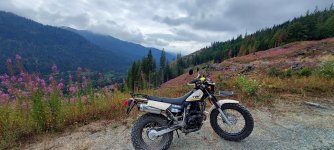
Who's got a street / dirt bike? Would be fun running up to it and fish a bit, park on 530 P&R then zip up. I did it last summer solo but turned back just before the Lk. G point area.jpg
 
Here is what Rex had to say about Little Gee...

Your summary of the situation at Little Gee is basically correct. Together with WDFW Biologist Justin Spinelli, we have been gill netting Little Gee Lake for 3 years for 2 purposes.
1. To determine the population of the brookies in the lake
2. To reduce the population of brookies in the lake
According to the Biologists in Idaho who have been successful using YY modified Chromosome brookies to get rid of stunt populations,
you need to stock at least the same number of YY's as the existing population in the lake to be successful. Currently the available number
of YY fry is very limited; we can only get about 500 per year which means we need to get the total population of brookies in Little Gee down
to less than 500. So each year we have been gill netting the lake to remove as many brookies as possible. Here is our data:
2023: 267 fish removed
2024: 171 fish removed
2025: 394 fish removed
Total Fish Removed from lake = 832

And for each year Justin did an estimate of the number of brookies remaining in the lake after the gill netting, however each time Justin felt that
the estimates were not accurate enough to start stocking YY's. So each year we have continued the gill netting and tried different techniques to
estimate the remaining number of brookies.

This year Justin is planning to use more gill nets to remove more fish, remove smaller fish using electro fishing, and hopefully get a better estimate.

So that is where we stand now. It needs to be noted that each year, we have only been able to do all this work due to volunteers from the Trail Blazers and
the Hi-Lakers. So please keep this in mind. That is a great way to see first hand what it takes to do experiments like this.
 
Blows my mind in an age of no $ they can do this in a lk that really sees no fishing. It's a pond.
Don't know about the money issue, but otherwise it makes perfect sense.

According to the Biologists in Idaho who have been successful using YY modified Chromosome brookies to get rid of stunt populations, you need to stock at least the same number of YY's as the existing population in the lake to be successful.

That means that with only 500 YY fry you need a "small pond" to see if it works. I would also consider growing to YY fry to a larger size before release.

I wonder if you pre-treated with the gill nets, but also released some large triploid brook trout to further reduce the population.

It sounds like there needs to be more research on producing YY brookies as quickly as possible.

When I first read about this, I was pretty excited extending to other invasive fish species other than brookies.
 
Blows my mind in an age of no $ they can do this in a lk that really sees no fishing. It's a pond.
Idk this is essentially a volunteer project that the Trailblazers are doing with a Bio who is involved with the high lakes. Besides paying for the Bio's time and the future expense of paying for the YY Brook Trout, it's not really a huge expense. However, it is certainly more expensive and time consuming then dropping a bucket of rotenone in the lake.

There's also a lot of science and potential conservation concerns going on with high lakes aquatic life right now so a less destructive method of removing stunted populations is a cool idea to try IMO.

Don't know about the money issue, but otherwise it makes perfect sense.

According to the Biologists in Idaho who have been successful using YY modified Chromosome brookies to get rid of stunt populations, you need to stock at least the same number of YY's as the existing population in the lake to be successful.

That means that with only 500 YY fry you need a "small pond" to see if it works. I would also consider growing to YY fry to a larger size before release.

I wonder if you pre-treated with the gill nets, but also released some large triploid brook trout to further reduce the population.

It sounds like there needs to be more research on producing YY brookies as quickly as possible.

When I first read about this, I was pretty excited extending to other invasive fish species other than brookies.

Curious what your reasoning would be behind releasing the fry at a larger size before release? I think generally, the early and younger you get the fry in the better they have at chance of survival.
 
Two classes in fisheries does not make me an expert.....

IMO, YY brookie fry have no survival advantage over the fish in the lake. They might be at a disadvantage compared to the brookies in the pond that are larger than them. 500 is a real small number.

The department has stopped stocking fry at many basin lakes due to poor survival of fry due to predation. This might or might not apply to brookie lakes.

That is the rationale for growing the YY fish to a larger size. I suspect the larger fish might also be more successful in spawning routine, which is what you really looking for.
 
Curious what your reasoning would be behind releasing the fry at a larger size before release? I think generally, the early and younger you get the fry in the better they have at chance of survival.

I caught a brook trout in a Central WA high lake around Sept - Oct 1992 or 93. It took a trolled Spruce Fly once but I missed it. I circled around a 2nd time and hooked it solidly and landed a quite large buck, in full spawn colors, with a gnarly looking kype. It was in the same spot when I came back through.

The Spruce Fly was tied on a #8 or possibly #6 6XL T300 hook so it was a pretty big fly, around 2.5" - 3" long; about the size a BT fingrling would be. I am certainly no expert but I believe it mistook the fly for a BT fingerling and think it's possible that planting larger fish could increase survivability from predation.
 
  • Like
Reactions: Zak
I watched every video on YouTube on that pond. 500 to me is to many for the food that would be available. I'll head up there in a few weeks and have a look. I've hiked into a few lakes of twice this size and found many fish with big heads. Food to fish ratio way off.
 
The question is the pond a research study or a fishery?

The point is to see if you can eliminate stunted brookies from Wilderness lakes.

Finish the study and then restock the lake with STERILE triploid brookies.
 
Maybe a group of us could head up there this summer to catch a mess of brookies. I was catching a fish a cast when I last visited. 5 anglers @30 fish each would almost equal the 2024 nettting total.
Sounds good to me..but yrs ago when I asked game dept. about how many I could keep (since I like them) I was told only daily limit. Which made no sense to me,since I was trying to help the cause..
 
Back
Top