
wolves...

SurfnFish

Legend
Forum Supporter
couple years ago thought I saw a wolf, much too big for a coyote, when I was driving down from the volcano lakes just before dark. Apparently more common and spread out than thought:

"Residents in South Deschutes County reported a wolf sighting in the Caldera Springs neighborhood Friday. It prompted alerts and renewed attention to growing wolf activity in the La Pine–Sunriver area, where state wildlife officials say packs have been established for several years. It's believed the wolf may have come from Crosswater.
"I'm surprised about to hear that, a wolf especially. You know, seeing coyotes here in the area, but this is a new one on me," said Sunriver resident Kirby Lopez.
This comes after a sighting of two wolves back on February 12 in the La Pine and Sunriver area.
"This area is a place where we have residential wolves and it's been that way for about five years now," Oregon Department of Fish and Wildlife Regional Wolf Biologist Aaron Bott said.
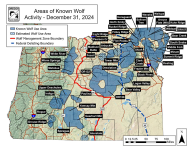
ODFW offers a map to show where wolf packs are most active throughout Oregon. The Upper Deschutes and Paulina packs reside in the west and east parts of the La Pine-Sunriver area.
"We have the Upper Deschutes Pack, which is on the west side of Highway 97. And then we have the Paulina, a pack which is on the east side of 97. The Upper Deschutes Pack has been there longer. This would be, I believe, their fourth or fifth year of reproducing in that area," Bott said.
The Upper Deschutes Pack is the most observed pack in the state, according to Bott."
1777824180267.png
 
Last edited:
Might explain their spread...
 
I have used my Lab's hair for flies as it floats really well (he does too). Maybe wolf hair will work as well, but I suspect wolves will be less amenable to having hair plucked from their coats
 
Thanks for the Oregon map of wolves....what I find interesting is that Washington state refuses to reintroduce wolves to the Olympic Penninsula. Excellent wolf habitat and minor conflicts with human uses unlike eastern Washington.

from AI.......

Gray wolves (Canis lupus) were extirpated from the Olympic Peninsula by 1938 due to government predator control but the area remains prime habitat with abundant elk and deer. While no breeding packs are currently documented on the peninsula, experts consider it a key area for potential reintroduction or eventual natural recolonization to restore ecological balance. [1, 2, 3, 4, 5, 6]
Current Status and Habitat
  • Historical Presence: Wolves formerly thrived across the entire Olympic Peninsula, ranging from ancient forests to coastal areas, according to Conservation Northwest.
  • Extirpation: The last known wolves on the peninsula were killed in the 1930s, leaving a void that allowed for ecological imbalances, such as overgrazing by elk.
  • Ideal Habitat: The region is considered a "paradise" for wolves due to a high density of prey, particularly Roosevelt elk and black-tailed deer.
  • Connectivity Issues: Natural return is hindered by isolation, as the Peninsula is surrounded by water and the heavily developed I-5 corridor. [1, 2, 3, 4, 5]
Reintroduction and Ecological Impact
  • Feasibility: Studies, including a 1975 case study and subsequent reports, suggest that reintroducing wolves is biologically feasible.
  • Ecological Benefits: Proponents argue that wolves would strengthen elk populations, reduce diseases, and curb overgrazing, which in turn helps restore habitat for species like salmon and beavers.
  • Challenges: Concerns exist regarding the impact on local livestock, pet safety, and hunting opportunities for elk and deer, as outlined in this Executive Summary. [1, 2, 3, 4, 5]
Future Outlook
  • Long-Term Projection: A University of Washington study suggests that wolves could naturally colonize the Olympic Peninsula and South Cascades within 20 years, provided they can navigate human-dominated landscapes.
  • Support: Organizations like Olympic Park Advocates advocate for restoring this apex predator to complete the ecological restoration of the area. [1, 2, 3]
 
According to a friend who is in Wildlife Management, wolf reintroduction has become very secretive here in WA. Unfortunately, this is due to the wolves inevitable slaughter once the word is out about their selected location. :(
 
Thanks for the Oregon map of wolves....what I find interesting is that Washington state refuses to reintroduce wolves to the Olympic Penninsula. Excellent wolf habitat and minor conflicts with human uses unlike eastern Washington.

from AI.......

Gray wolves (Canis lupus) were extirpated from the Olympic Peninsula by 1938 due to government predator control but the area remains prime habitat with abundant elk and deer. While no breeding packs are currently documented on the peninsula, experts consider it a key area for potential reintroduction or eventual natural recolonization to restore ecological balance. [1, 2, 3, 4, 5, 6]
Current Status and Habitat
  • Historical Presence: Wolves formerly thrived across the entire Olympic Peninsula, ranging from ancient forests to coastal areas, according to Conservation Northwest.
  • Extirpation: The last known wolves on the peninsula were killed in the 1930s, leaving a void that allowed for ecological imbalances, such as overgrazing by elk.
  • Ideal Habitat: The region is considered a "paradise" for wolves due to a high density of prey, particularly Roosevelt elk and black-tailed deer.
  • Connectivity Issues: Natural return is hindered by isolation, as the Peninsula is surrounded by water and the heavily developed I-5 corridor. [1, 2, 3, 4, 5]
Reintroduction and Ecological Impact
  • Feasibility: Studies, including a 1975 case study and subsequent reports, suggest that reintroducing wolves is biologically feasible.
  • Ecological Benefits: Proponents argue that wolves would strengthen elk populations, reduce diseases, and curb overgrazing, which in turn helps restore habitat for species like salmon and beavers.
  • Challenges: Concerns exist regarding the impact on local livestock, pet safety, and hunting opportunities for elk and deer, as outlined in this Executive Summary. [1, 2, 3, 4, 5]
Future Outlook
  • Long-Term Projection: A University of Washington study suggests that wolves could naturally colonize the Olympic Peninsula and South Cascades within 20 years, provided they can navigate human-dominated landscapes.
  • Support: Organizations like Olympic Park Advocates advocate for restoring this apex predator to complete the ecological restoration of the area. [1, 2, 3]
Unless I'm mistaken, Washington doesn't transplant wolves. The wolves we have spread from Idaho and bc, they were not reintroduced intentionally.

My assumption here, but coastal wolves, while gray wolves, are something of a subspecies with changes to their coats and behaviors that suit constantly wet, rainforest environments. Wolves dispersing through eastern WA may not be terribly well suited to life on the coast.
 
That is correct. Washington state does NOT transplant wolves.

Except Olympic National Park is prime wolf habitat in need of restoration by wolves. Remember that was why they were introduced in Yellowstone by President Clinton. That is where ALL the wolves currently in the US came from that the releases in Yellowstone.

Even as a forester, I am pretty confident that the current genetic makeup of wolves will survive in the Olympics. They have made their way to southern California, but they need help getting past the urban nightmare that is Puget Sound to get to the Olympics.

Flymph....that is why the Olympics are perfect. There are few human/wolf conflicts compared to other parts of the state.
 
Even as a forester, I am pretty confident that the current genetic makeup of wolves will survive in the Olympics. They have made their way to southern California, but they need help getting past the urban nightmare that is Puget Sound to get to the Olympics.
That’s some solid forester-led wolf biology and geography there, haha.
Last I checked there was a decent stretch of rural area south of Olympia that does indeed connect to the peninsula.

Edit to add—point being, it’s more consistently logical to assume that if wolves can spread on their own to So Cal, they’ll be able to reach and possibly, if allowed, re-colonize the OP eventually too. Maybe soon.
 
Last edited:
It didn't for spotted owls. When I was working there was a lot of discussion about Joint Base Lewis-McCord and its ecological significance for wildlife species as a corridor.

The point is the Olympics were good wolf habitat and their reintroduction there would be an important ecological plus. AND little ranching or livestock issues to complicate management.
 
That is correct. Washington state does NOT transplant wolves.

Except Olympic National Park is prime wolf habitat in need of restoration by wolves. Remember that was why they were introduced in Yellowstone by President Clinton. That is where ALL the wolves currently in the US came from that the releases in Yellowstone.

Even as a forester, I am pretty confident that the current genetic makeup of wolves will survive in the Olympics. They have made their way to southern California, but they need help getting past the urban nightmare that is Puget Sound to get to the Olympics.

Flymph....that is why the Olympics are perfect. There are few human/wolf conflicts compared to other parts of the state.

Not quite accurate. As a northern Minnesota native I can assure you that there were plenty of wolves in the US long before the Yellowstone reintroduction. It may well be true that all of the western wolves came from Yellowstone (or natural movement from Canada though).
 
Yeah plenty of wolves iu un that area. Always has been.
 
Not quite accurate. As a northern Minnesota native I can assure you that there were plenty of wolves in the US long before the Yellowstone reintroduction. It may well be true that all of the western wolves came from Yellowstone (or natural movement from Canada though).
Your absolutely correct. I was thinking western US, but my fingers didn't type western!!
 
That is correct. Washington state does NOT transplant wolves.

Except Olympic National Park is prime wolf habitat in need of restoration by wolves. Remember that was why they were introduced in Yellowstone by President Clinton. That is where ALL the wolves currently in the US came from that the releases in Yellowstone.

Even as a forester, I am pretty confident that the current genetic makeup of wolves will survive in the Olympics. They have made their way to southern California, but they need help getting past the urban nightmare that is Puget Sound to get to the Olympics.
Flymph....that is why the Olympics are perfect. There are few human/wolf conflicts compared to other parts of the state.
Why is olympic national park in need of habitat restoration by wolves? It doesn't seem to suffer from the same issues the wolves solved in Yellowstone. Is cervid overgrazing causing elevated stream temperatures on the peninsula?

Your initial post mentioned likely colonization within 20 years. Is there an ecological emergency on the peninsula requiring immediate reintroduction?

As far as i know, precisely one wolf has crossed the cascade crest to access the "prime wolf habitat" in the north cascades, and he didn't stick around despite abundant elk, deer and habitat. Even as a chef, I'm pretty sure that tells me something about what these wolves prefer.

All those wolves came from Yellowstone, except all the ones that came from Canada and remained in Idaho and Montana.
 
I howled at a WOLF in '99. June 99. I was up east creek ridge left of the pine inlet station. Out back the LAKE!!! EAST PINE INLET!!! Boatlaunch. East Pine I believe it was. If my mind is remembering, believe it may have been the East Pine Launch. Howled at a wolf!!!
 
Why is olympic national park in need of habitat restoration by wolves? It doesn't seem to suffer from the same issues the wolves solved in Yellowstone. Is cervid overgrazing causing elevated stream temperatures on the peninsula?

Your initial post mentioned likely colonization within 20 years. Is there an ecological emergency on the peninsula requiring immediate reintroduction?

As far as i know, precisely one wolf has crossed the cascade crest to access the "prime wolf habitat" in the north cascades, and he didn't stick around despite abundant elk, deer and habitat. Even as a chef, I'm pretty sure that tells me something about what these wolves prefer.
Historically, wolves were part of the Olympic ecosystem. They are now missing. You being a chef, I will defer to your judgement as to the food preferences of wolves.

Actually, I never dealt with wolves in my professional career. My opinions, are based on 50 years of working on natural resource issues. But, wolves arrived after I retired in eastern Washington after I retired and have never been an "issue" on the Wenatchee.

It is not about a "ecological emergency on the peninsula requiring immediate reintroduction". It is the perfect place for reintroduction that has minimal conflicts with humans. That insures, that wolf reintroduction would be successful, without costs to the taxpayers, and set the stage for wolf restoration in other places.

That wolf that crossed the Cascades was looking for a young sweet young thing. Finding none west of the Cascades, he hightailed it back into eastern Washington. He needed a "pretty, long-tailed wolf with pretty eyes".

We as humans, needed to provide a sweet young wolf for him to meet.
 
Historically, wolves were part of the Olympic ecosystem. They are now missing. You being a chef, I will defer to your judgement as to the food preferences of wolves.

Actually, I never dealt with wolves in my professional career. My opinions, are based on 50 years of working on natural resource issues. But, wolves arrived after I retired in eastern Washington after I retired and have never been an "issue" on the Wenatchee.

It is not about a "ecological emergency on the peninsula requiring immediate reintroduction". It is the perfect place for reintroduction that has minimal conflicts with humans. That insures, that wolf reintroduction would be successful, without costs to the taxpayers, and set the stage for wolf restoration in other places.

That wolf that crossed the Cascades was looking for a young sweet young thing. Finding none west of the Cascades, he hightailed it back into eastern Washington. He needed a "pretty, long-tailed wolf with pretty eyes".

We as humans, needed to provide a sweet young wolf for him to meet.
You being a forester working in a place without wolves, 'll defer to your knowledge about wolf reintroduction.

I think wolves are bad ass and belong on the landscape in olympic national park. I also think Washington getting into the business of putting wolves places is a terrible call.

If the park is as isolated as you fear, inbreeding would doom them in a few generations anyways. They are, fortunately, not that isolated, as it appears natural spread will get there within 20 years, without humans. That's why I ask for the reasons for your urgency.

Would it be worth putting washington back into the business of deciding where wolves should be? It didn't go great for the wolves previously. I personally support the non intervention of the state in these kinds of issues, because them doing nothing is usually the best thing they can do.
 
The decision to NOT MAKE A DECISION is a DECISON.

The only reason for "Washington getting into the business of putting wolves places is a terrible call" is that it provides a mechanism for politicians to cover their ass.

Just do the right thing.

In twenty years I will be dead. I would like to see the Olympic ecosystem restored before I die. Yeah, I am selfish.
 
Back
Top