Skagit game fish regulation proposal

I wish SCL could carve a chunk of that money for you to work with.
I offered to volunteer as an advisor to the SCL relicensing proceeding because of my past experience, and I know all the agency and tribal representatives. (This was during the covid protocols, remember.) Townsend declined my offer and hired a bunch of $800/hr attorneys instead. It's been said I should learn to deal with rejection better. :ROFLMAO:
 
There was one last year but I think it's probably dead, so, no. There are not any.

@Salmo_g you make a strong case as usual, but I still think it's maybe a little oversimplified and maybe some of it based on outdated info? Is it possible that there wasn't a gravel deficit in the Marblemount-Gorge reach in the 1990s, but there is now, due to a lack of recruitment? There is a lack of large wood as you point out, and channel forming flows are artificially constrained, so the river doesn't get to access its floodplain and recruit new wood and new sediment. It's a bit of a negative feedback loop. Also, I could be wrong but it seems like you might only be considering true old growth trees as functional large wood. I contend that there are lots of examples where enough supply of mid-size to large mature trees can "glom up" together, resulting in a persistent habitat-forming log jam. There does need to be spots for them to hang up on and stick around. I have to say the Skagit above MM up to the Gorge is not universally a gorge with no floodplain. It's not entirely a transport reach at all flows. There are islands, there are side channels, there is floodplain, there is scouring and there is deposition. I believe that more wood and sediment supply from the Gorge dam on down would re-engage these features and processes and increase habitat complexity up there, and below the Cascade as well.

Matt,

I can only say "maybe?" I don't think pre and post-1990 is in play with respect to gravel recruitment. Channel aggredation due to sediment starvation, if it applies, dates to construction of Gorge Dam in 1927. If you look at the Gorge between Gorge Dam and Newhalem you could conclude that the by-pass reach is gravel starved. What I don't know is if gravel recruited to that reach how much would stay and not be blown through during high water events caused by spill at Gorge Dam. Remember, high flows from Gorge now are less than high flows in a "without project" condition. As soon as you get downstream to Newhalem and Goodell Creeks, I have not seen a lack of spawning gravel anywhere it would be deposited and stay.

I said over half of the river miles from Gorge Dam to Marblemount is gorge like geomorphology, so yes there is some floodplain type channel in the area. And there is important spawning habitat in that area. And it is served by the very dynamic larger tributary creeks in that same area. Hence, my over-simplified conclusion that there is "enough" gravel. I just haven't seen any evidence that the habitat quality would be better if the supply were increased. None of the instream flow and other research has identified a lack of spawning gravel.

With respect to wood, yes, the larger, the better. However, any sticks of 100' or better are regarded as large woody debris (LWD). Because of the logistics and expense of moving large wood from Ross reservoir, I would choose to install engineered log jams (ELJ) in the suitable locations from Newhalem to Marblemount and even downstream from there, given SCL's deep pocket. I think that would be a more effective mitigation measure.
 
Matt,

I can only say "maybe?" I don't think pre and post-1990 is in play with respect to gravel recruitment. Channel aggredation due to sediment starvation, if it applies, dates to construction of Gorge Dam in 1927. If you look at the Gorge between Gorge Dam and Newhalem you could conclude that the by-pass reach is gravel starved. What I don't know is if gravel recruited to that reach how much would stay and not be blown through during high water events caused by spill at Gorge Dam. Remember, high flows from Gorge now are less than high flows in a "without project" condition. As soon as you get downstream to Newhalem and Goodell Creeks, I have not seen a lack of spawning gravel anywhere it would be deposited and stay.

I said over half of the river miles from Gorge Dam to Marblemount is gorge like geomorphology, so yes there is some floodplain type channel in the area. And there is important spawning habitat in that area. And it is served by the very dynamic larger tributary creeks in that same area. Hence, my over-simplified conclusion that there is "enough" gravel. I just haven't seen any evidence that the habitat quality would be better if the supply were increased. None of the instream flow and other research has identified a lack of spawning gravel.

With respect to wood, yes, the larger, the better. However, any sticks of 100' or better are regarded as large woody debris (LWD). Because of the logistics and expense of moving large wood from Ross reservoir, I would choose to install engineered log jams (ELJ) in the suitable locations from Newhalem to Marblemount and even downstream from there, given SCL's deep pocket. I think that would be a more effective mitigation measure.
ELJs to start to serve as surrogates for those missing old growth logs and jams, then a steady supply of wood and sediment…you know, like a continuous river…sounds good to me.
 
How did those ELJ work on the Stillie right above Hazell?
I don't think I've ever seen one actually work as intended, on the upper Sky they drove hundreds of peillings in to trap LWD & create LJs.
Every single spot had the exact opposite result, either more land lost to homeowners, or channel movement in the wrong direction.
 
How did those ELJ work on the Stillie right above Hazell?
I don't think I've ever seen one actually work as intended, on the upper Sky they drove hundreds of peillings in to trap LWD & create LJs.
Every single spot had the exact opposite result, either more land lost to homeowners, or channel movement in the wrong direction.
Losing more land is the opposite of the "desired future condition." We want river channels to have a place to overflow during high water and floods, but the intent is usually to have tighter channels during normal flows. The effects of forest practices has often been wider, shallower stream channels, which tends to not be good for fish.

People sometimes think that ELJs don't work when the river moves away from the structure. Not so. Unless they're in bedrock, it is natural for river channels to meander. That ELJ will still be there when the river moves back toward it again one day.
 
How did those ELJ work on the Stillie right above Hazell?
I don't think I've ever seen one actually work as intended, on the upper Sky they drove hundreds of peillings in to trap LWD & create LJs.
Every single spot had the exact opposite result, either more land lost to homeowners, or channel movement in the wrong direction.
My understanding is that the flood fencing on the Sky (those pilings in the floodplain) was a sort of compromise with landowners to help ease concerns about potential flood damages and debris in fields, related to levee removal/setback. They haven’t ever really engaged but I don’t think that was a complete surprise. It was part of a sort of “deal.”
And I think the NF Stilly ELJs are viewed as mostly a success. A number of them are creating scoured out pools where Chinook hold along with spawning areas adjacent where there is spawning. So those are doing what they were intended to do. I think some blew out and/or the river moved away from them for now. It’s a learning process and rivers are unpredictable. The point is trying to re-engage habitat forming processes which create and destroy but overall should maintain habitat features and functions over time.
There are lots of examples of successful ELJ projects in different sized rivers. Check out the Upper Quinault ELJs for a BIG river project that’s working. I really appreciate the technique they employed of using alluvium to stabilize the ELJ but still allow deformability so the river can work on it and shape it over time.
 
ELJs (engineered log jams) can come with a short cost to the fish resource which often is not considered. A couple of examples
In the early 1990s the USFS installed a log structure in a mid-sized Sauk tributary that had blown out (upstream logging?) during the summer. The stream supported both steelhead and bull trout. That fall I found bull trout spawning next to the structure. The following spring after the winter floods had scoured out a pool next to the structure a pair of steelhead spawned at the same site. The bull trout redd and its eggs were destroyed by the scouring to form that pool while the steelhead spawning post scouring benefited.

In 1998 when those 5 ELJs were installed in the NF Stilli in the Hazel/c-post reach WDFW mapped all the Chinook redds in the Deer Creek to Swede Heaven section of the river. That Chinook spawning occurred after the installing those ELJs as required by the timing restrictions in the Hydraulic permit. After the Chinook spawning approximately 15% of the total redds in the mapped area where next to those ELJs and risked of scouring during the flood season. Is that immediate cost of losing those redds out weighted by the longer-term benefits? I doubt that was even considered and, in this case, I suspect the long-term benefits were not worth it.

curt
 
Moving back to the Skagit -
"A Two-decade Watershed Approach to Stream Restoration Log Jam Design and Stream Recovery Monitoring: Finney Creek, Washington", Nichols and Ketcheson, 2013.

"Finney Creek was once the most productive salmon stream in the lower Skagit River (WDFW and Western Washington Treaty Indian Tribes, 1994)"

"Finney Creek was intensively managed for timber production from the 1950s to the early 200s. By the late 1980s it became evident that land use was disrupting watershed functions and causing decreased quality of aquatic habitat. In particular, elevated runoff and sediment caused extensive channel widening of Finney Creek. The physical changes in Finney Creek led to warmer instream water temperatures and loss of channel complexity for native salmonid fish species."

"Timber harvest on federal lands in Finney Creek ceased in the early 1990s ..." " Initial restoration work focused on minimizing sediment delivery to streams by stabilizing eroding hillslopes and roads..." "Starting in 1999 ...a structural channel restoration program involving both federal and private ownership along 12.2 km of Finney Creek. the program consisted of augmenting existing wood accumulations or creating new log jams to improve aquatic habitat by reintroducing channel complexity."

By 2010 130 kms of a total 275 km on federal lands (1.56 km/km2) had been treated (BTW the road density on private land exceeded 2.8 km/km2). In addition, 181 log jams with a total of 1,881 logs had been constructed. On the surface appeared to be a significant restoration effort. "Stream temperature appears to be responding to more consistent interception of cooler hyporheic flow in deeper pools." The report went on to say "Definitive documentation of channel morphology and temperature recovery will require continued monitoring"

Fast forward 15 years, WDFW reports that Finney Creek's Chinook and steelhead have not seen increases in productive or numbers,
Found some temperature monitoring information for Finney Creek near the mouth of Quartz Creek (rm 3) which remains elevated. The Washington State stream temperature standard for anadromous fish spawning, rearing, and incubation is 63.5 degrees F. From "Stream Temperature Monitoring in Forested Tributaries of the Skagit Basin: 15-year update -Skagit River System Cooperative 2023. The 7-DADM (7-day average daily maximum) data:
In 2019 the 7-DADM temperature was 22.5 degrees C (72.5 degrees F)
In 2020 the 7-DADM temperature was 22.6 degrees C
In 2021 the 7-DADM temperature was 23.2 degrees C
in 2022 the 7-DADM temperature was 24.5 degrees C (76.1 degrees F)

My takeaway is that once a system is thrown out of wack recovery will likely take as long or longer than the time it took to damage the ecosystem - there is no magic bullet.

curt
 
My understanding is that the flood fencing on the Sky (those pilings in the floodplain) was a sort of compromise with landowners to help ease concerns about potential flood damages and debris in fields, related to levee removal/setback. They haven’t ever really engaged but I don’t think that was a complete surprise. It was part of a sort of “deal.”
And I think the NF Stilly ELJs are viewed as mostly a success. A number of them are creating scoured out pools where Chinook hold along with spawning areas adjacent where there is spawning. So those are doing what they were intended to do. I think some blew out and/or the river moved away from them for now. It’s a learning process and rivers are unpredictable. The point is trying to re-engage habitat forming processes which create and destroy but overall should maintain habitat features and functions over time.
There are lots of examples of successful ELJ projects in different sized rivers. Check out the Upper Quinault ELJs for a BIG river project that’s working. I really appreciate the technique they employed of using alluvium to stabilize the ELJ but still allow deformability so the river can work on it and shape it over time.

The Quinault ELJ are an interesting one. That river really moves back and forth across the valley. We were up there one time and the log jams were there, but absolutely bone dry. The river was on the north side of the valley at that time. The channel movement there is really dynamic. A couple places I caught steelhead at back in the 80’s are now gone. Such a fun, cool river to fish.
SF
 
Seems like since it took decades to alter the existing habitat, so taking decades for the systems to heal seems reasonable, if not logical.

@Stonedfish
There's a spot on the Hoh that is like that. Used to do well swinging both spoons and flys along a nice boulder strewn run that is now a few hundred yards from the river. Alders are now colonizing a spot where I used to stand streamside.
 
That’s what postglacial gravel bed rivers of the PNW should be expected to do—meander within a meander belt.
The Quinault ELJ are an interesting one. That river really moves back and forth across the valley. We were up there one time and the log jams were there, but absolutely bone dry. The river was on the north side of the valley at that time. The channel movement there is really dynamic. A couple places I caught steelhead at back in the 80’s are now gone. Such a fun, cool river to fish.
SF
Yeah the river was downcutting in the treated reach prior to treatment and spawning areas for blueback sockeye were being lost. Post-treatment there’s been whole feet of aggradation. Side channels that had been disconnected have been re-activated, and strategic placement and design of structures helped save private property and the road. This is after decades of work, and that work had the benefit of learning from earlier projects like some of the ones mentioned above. I think river restoration ecologists have learned to be a lot more specific with their objectives for wood treatment than they were in the 1990s. That has informed designs and I think is part of progress being made. I reject the notion that all stochasticity or unplanned events in anything scientific or ecological restoration should be considered “failure.” Isn’t science supposed to be about testing hypotheses and learning from experiments? Not everything can be modeled and known for certain in advance. That’s why we, ideally, monitor and adaptively manage.
 
Last edited:
Circling back to this regulation proposal; the window for commenting on or influencing this proposal is fast closing. Commenting (either pro or con) are likely to be most effective as part of the NOF process. This is because this potential change is tangled up with the salmon seasons in the basin.

There are 3 public NOF meetings left in this year's process; 3/18 NOF #1 (zoom or meeting in Olympia) 9 to 3, 3/24 Puget Sound Freshwater meeting (zoom) 6 to 8PM. and 3/31 NOF #2 (zoom or in person meeting in Lynnwood) 9 to 3. Comments can be provided during these meetings or via the public input port found in the NOF WDFW page. Emails also can be sent to WDFW to either the regional, headquarter, or NOF staff as well as to the WDFW commission.

If after reviewing the proposal (in the attachment in post #1 here) if there are questions or other comments, I will do my best to address them.

Curt
 
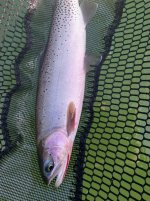
A number of years ago, circa 2019, I spoke at length with one of the fish checkers on the Skagit/Sauk during the spring steelhead season. He was a fisheries biologist intensively studying bull trout and their declining populations in the upper Skagit. He informed me at that time, that his preliminary studies showed that, surprisingly, a non-indigenous cutthroat species was playing a significant role in their survival, not only in spawning tributaries, but in main stem Skagit. He was not at all surprised to see my collection of said cutthroat photos from the Skagit where I have fished extensively for searins and bull trout since 1989. I do not know if his work has been published or peer reviewed, but it does show that there are more factors at play than readily meet the eye.

RR
IMG_20201031_125017989_HDR~2.jpg
 
@Riverrun I'd be curious to read his study or how he came to that conclusion and if they've done any genetic testing on the cutthroat. I could see non native cutthroat playing a role in shrinking the native coastal cutthroat population and o'mykiss population but wouldn't think it would really have an effect on the bull trout population.
 
A number of years ago, circa 2019, I spoke at length with one of the fish checkers on the Skagit/Sauk during the spring steelhead season. He was a fisheries biologist intensively studying bull trout and their declining populations in the upper Skagit. He informed me at that time, that his preliminary studies showed that, surprisingly, a non-indigenous cutthroat species was playing a significant role in their survival, not only in spawning tributaries, but in main stem Skagit. He was not at all surprised to see my collection of said cutthroat photos from the Skagit where I have fished extensively for searins and bull trout since 1989. I do not know if his work has been published or peer reviewed, but it does show that there are more factors at play than readily meet the eye.
Those non-indigenous cutthroat are west-slope cutthroat or what often were referred to as Montana black spots (MBS). Those MBS often establish self-reproducing populations in lakes in which they have been planted and typically colonizing downstream streams. Those west-slopes have been planted in numerous lakes across the upper Skagit, Cascade, Illabot, Suaittle, Whitechuck, Sauk and its forks basins. Those plants were 75 or more years ago so they likely are not a new issue.

Some 50 years ago I was catching some west-slopes in the main Skagit and have caught a few downstream of Mt Vernon in tide water while targeting sea-runs. They can achieve some nice size, in lakes my best fish was in the 5# class with some of the river fish getting nearly as large.

curt
 
Last edited:
@Riverrun that’s a pretty fish, regardless. It is an interesting thing to think about since inland bull trout and westlopes seem to go like peaches and cream, at least population-wise/ecologically, in the Northern Rockies.
 
@Riverrun I'd be curious to read his study or how he came to that conclusion and if they've done any genetic testing on the cutthroat. I could see non native cutthroat playing a role in shrinking the native coastal cutthroat population and o'mykiss population but wouldn't think it would really have an effect on the bull trout population.
It's not a genetic issue as I understand, rather an issue of predation and competition for a limited food source in tributary spawning creeks they share. He seemed to have plenty of research and data to back it up.
 
Those non-indigenous cutthroat are west-slope cutthroat or what often were referred to as Montana black spots (MBS). Those MBS often establish self-reproducing populations in lakes in which they have been planted and typically colonizing downstream streams. Those west-slopes have been planted in numerous lakes across the upper Skagit, Cascade, Illabot, Suaittle, Whitechuck, Sauk and its forks basins. Those plants were 75 or more years ago so they likely are not a new issue.

Some 50 years ago I was catching some west-slopes in the main Skagit and have caught a few downstream of Mt Vernon in tide water while targeting sea-runs. They can achieve some nice size, in lakes my best fish was in the 5# class with some of the river fish getting nearly as large.

curt
That's what they say about the dams-been around a long time. Like I said, there are obviously a lot of factors in play. Some easier to ID than others and some with a more popular band wagon to jump aboard than others .
 
This discussion of cutthroat moving downstream has me wondering about the billion dollar fish ladder and what fish that will start to convey from the lakes and into the USA portion of the Skagit River. Will it potentially be good for steelhead since there are lots of self sustaining rainbows in Ross? I know there are a lot of brookies up there these days but I’d guess we already have lakes dumping them into lower Skagit.
 
HauntedByWater

I would expect that any improvement in fish passage on the upper Skagit dams will have for downstream movement of resident rainbows to the lower river will be just like the Baker dams. That is to say minimal. About the only time in the past when there has been downstream movement through the Skagit dams is when there is spill rather than flowing through the turbines. Of there is a significant flow is required in the by-pass reach below Gorge there may be some recruitment of resident rainbows.

The brook situation is interesting. Yes, you are correct there brookies in a number of alpine lakes and even a few low elevation beaver ponds/ponds. The concern with brook trout in bull trout waters is the potential of hybridization between the two species. For more than 30 years I have kept my eye out for potential hybrids. In spite in handling a significant number of bull trout I have yet to see a single hybrid. That is not to say they don't exist, just have seen any. If there is a problem, I would expect it to occur in resident headwater streams which have not been sample widely.

Curt
 
Back
Top