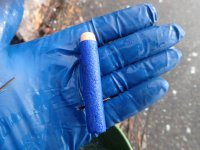
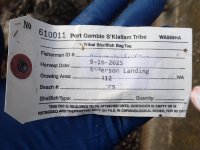
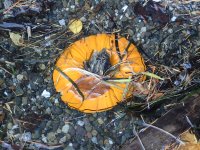
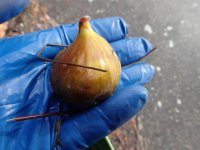
Strange, weird or odd or whatever beach finds thread….

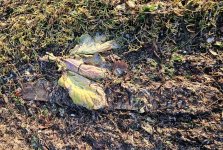
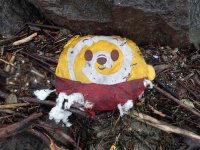
That's the Pinkebellus Powerbaitaria. Once they release their spores, their flesh firms up and they are easily baited on snelled hooks. Just wait another week or so.

😉
Glad I posted here!

My knowledge of mushrooms is limited to what’s edible and “edible” in Western Washington. Now I can add “fishable”.
 
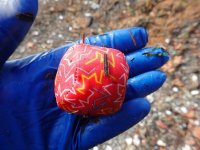
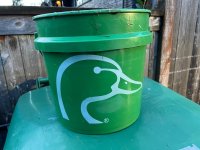
Rhubarb (I think?) with your gourd, Brian?
View attachment 172421
Southern boy here recognizes a sad-ass PNW bunch of collard greens when he sees them. Sorry but it’s true. I’ve been disappointed so many times. You’re not supposed to have to spend $27 on 4 bunches to make a decent mess of greens. Just sayin’s all.
 
Southern boy here recognizes a sad-ass PNW bunch of collard greens when he sees them. Sorry but it’s true. I’ve been disappointed so many times. You’re not supposed to have to spend $27 on 4 bunches to make a decent mess of greens. Just sayin’s all.
Collards picked soon after the fall frost when they are a bit sweeter.
Steve
 
No pictures due to names and addresses, but found some stolen mail on the last beach I fished today. Dropped it off at the post office on the way home. Lots of scumbags out there these days.
SF
 
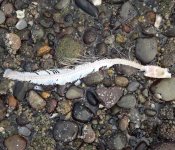
On my last visit to Nisqually NWR, a dead spotted ratfish, Hydrolagus colliei, was washed up on the mudflat.
View attachment 169837
I have no idea of the cause of death. While other ratfish species are more typically found in deep water, I have encountered spotted ratfish several times while diving in the San Juan Islands (and they are pretty common in research otter trawls). They are pretty wary of divers and will swim away by flapping their pectoral fins. Unlike the replaceable teeth of sharks, ratfish have plate-shaped incisors on the upper and lower jaw (hence the genus name Hydrolagus = "water" "rabbit").
The ratfish have been placed in their own class, the Holocephali, within the class Chondrichthyes (cartilaginous fishes). Unlike the other Chondrichthyans, the upper jaws of ratfishes are fused to their skulls. Also, ratfishes have a single gill opening per side, while other Chondrichthyans have 5-7 gill slits per side.
Steve

On my last visit to Nisqually NWR, a dead spotted ratfish, Hydrolagus colliei, was washed up on the mudflat.
View attachment 169837
I have no idea of the cause of death. While other ratfish species are more typically found in deep water, I have encountered spotted ratfish several times while diving in the San Juan Islands (and they are pretty common in research otter trawls). They are pretty wary of divers and will swim away by flapping their pectoral fins. Unlike the replaceable teeth of sharks, ratfish have plate-shaped incisors on the upper and lower jaw (hence the genus name Hydrolagus = "water" "rabbit").
The ratfish have been placed in their own class, the Holocephali, within the class Chondrichthyes (cartilaginous fishes). Unlike the other Chondrichthyans, the upper jaws of ratfishes are fused to their skulls. Also, ratfishes have a single gill opening per side, while other Chondrichthyans have 5-7 gill slits per side.
Steve
Nice find, Cabezon!

In my youth, I moved to a remote fishing village on the B.C. coast. We used to catch ratfish incidentally on commercial halibut gear. I read somewhere that ratfish liver oil was used in the old days for lubricating fine machinery, watches, guns, and fishing reels. This was decades before PCs and the internet, so I must have brought a few of my marine life books with me. And nobody else in the village had heard of such a thing.

I always liked to make gifts, rather than buy them, and since there was nowhere to shop out there, I decided to gift some ratfish liver oil to my inventive Dad at Christmas. Opening up a ratfish, I found the abdominal cavity was mostly taken up by its liver, like sharks. Boiling a liver or two sure stunk up the cabin! And the decanted oil had a rather unpleasant odour, too. I figured it would be doubtful gift, but what the hell.

When Dad opened his Christmas present, the conversation around my family members showed that my reputation as a fish nerd was as strong as ever!

When clearing out Dad's estate 30 years later, I found his bottle of ratfish oil, looking unused. It still stunk, so I deep sixed it.

Thanks for reviving a portion of my old memory, Cabezon!
 
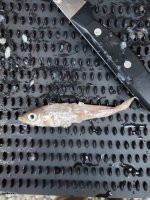
Fished the central sound earlier in the week and took home a few flounders. Found the below in one's belly. Was maybe 3-4 inches long. Any ideas on what it is? My guess is juvenile pollock. If correct it is encouraging to see that reproduction.

View attachment 172583
I’d say maybd a codling but will let one of our fish bios note what it really is.
 
Back
Top